
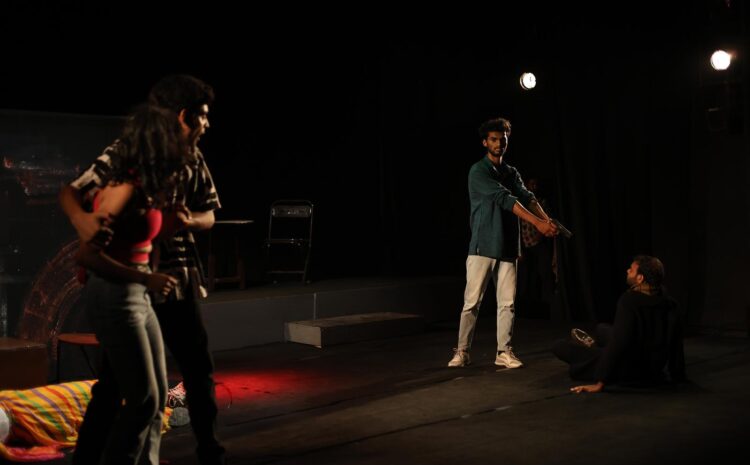
Ek Khoon Sau Baatein is set against the background of old Bombay, brimming with Indian film noir and drama. The story is about a protagonist, Deva, who witnesses the death of a renowned public figure, Mamu. Mamu’s death is blamed on Aapa, another Donna in Bombay. The blame game causes riots all over Bombay, especially in Dharavi, where a famous builder, Basant, is plotting something fishy. Deva is stuck between the riots because he was on good terms with Mamu’s gang and is Aapa’s adopted son as well. When he finds Anamika, who comes into the story with her own surprises.
Basant plans to ‘develop’ the slums of Dharavi into high-tech living spaces, offering to provide a reasonable and better living space for the current residents of Dharavi. Anamika gets on board with Basant and eventually discovers the dark side of the real estate business. Deva, meanwhile, wishes to fish out the murderer who took Mamu’s life, but the riddle keeps getting tougher whenever he gets closer to the answer. In solidly changing venasio of events, deva oppeans instrumental in sassing anamika’s life.
Towards the end, Basant kidnaps Anamika and Deva. Rehman and Potya enter the picture to make things more mysterious. Deva and Anamika are questioned to get the whereabouts of the money, which was supposed to come to Mamu, revealing that Basant had a contract with Mamu and got him killed too to keep the money and cause riots all over Dharavi. Just when things seem hopeless, Aapa and Mamu’s Wife, and Rajmani enter Basant’s stronghold and kill him and his minions. Anamika reveals that she is a secret agent and she had been figuring out a way to get to a bigger underworld don named Talwani, through Basant, and that’s why she ended up in the chaos. Anamika and Deva make it out in the end with Aapa, Rajmani and the others.
Writer
Ravi is a theatre practitioner from Allahabad (Prayagraj), Uttar Pradesh, with over a decade of experience in the field. His practice spans acting, designing, directing, writing and music-making-often weaving these together to discover fresh, engaging ways of telling stories. He is deeply interested in the role of theatre as a socially and politically responsive art form, and in its potential to shape young minds into thoughtful, active citizens. Ravi has been actively involved in Theatre in Education-first with the Azim Premji Foundation, and now through his ongoing work in schools. He currently works as an independent theatre-maker and educator, sharing his love for performance and creative inquiry with adults as well as children.
Director
Rajeev Ranjan is an Indian theatre practitioner, activist, and educator, currently serving as faculty of Design and Direction at the Department of Theatre Arts, University of Hyderabad. He is the founder of Independent Theatre India and the author of “Theatre in Corporate”.
His extensive journey in theatre began in Muzaffarpur, Bihar, rooted in village theatre before he moved to Patna, where he honed his craft with Patna IPTA. During this time, he acted in and directed several productions, including noted works like Supna Ka Sapna, Rakt Kalyan, and Juloos. Subsequently, he worked independently, collaborating across the city to make multiple productions, such as Spartacus, Clouds, and Caligula.
Rajeev Ranjan completed his Post Graduation in Theatre Arts (Direction) from the University of Hyderabad. He has collaborated with and worked under the guidance of eminent directors across India and internationally, including M. K. Raina, Anuradha Kapoor, Jonathan Chetel (France), Jane Collins (U.K.), and Rajiv Velicheti.
As an academic, his focus lies in experiential and activity-based learning, specifically aligning his pedagogy with the principles of NEP 2020 (National Education Policy). His passion is creating work that challenges traditional boundaries and deeply engages contemporary audiences.
Director’s Note
Welcome to the world of “Ek Khoon Sau Baatein 2.” It is a profound honour to step into the director’s chair for this production, building upon the gripping foundation laid by Rajiv Velicheti and the original team in 2017. Having contributed to the first part in acting, the opportunity to guide this sequel, under Rajiv Sir’s generous mentorship, has been an invaluable lesson in vision and leadership.
This piece exists first and foremost as a semester production-an academic challenge designed to explore the possibilities of representational staging. However, our objective was clear: to create something that transcends the classroom exercise. We wanted to move beyond the expectations of old realistic dramas to find a style that could deeply connect with both our students and the wider audience.
Our answer lies in the Noir and Thriller elements you will experience tonight. We’ve chosen to embrace moral ambiguity, stark visual shadows, and the suffocating atmosphere of suspicion. This aesthetic is not just for style; it is a tool. It allows us to explore the theme of consequence. This sequel asks: How far does a single, violent action ripple into the future?
I am incredibly proud of the entire cast and crew for rising to the unique demands of this blended style. They have dedicated themselves to creating a world that is at once stylised and emotionally raw. My deepest thanks go to Rajiv Sir, whose trust and guidance made this transition possible, and to our department for providing the space for this essential learning and experimentation.
Group
The Theatre Arts Discipline of S.N. School strongly believes that creating good theatre is An arduous activity, and there is no simple formula to achieve it. As an academic discipline within a University system, Theatre Arts concentrates on giving training in seminal concepts, basic principles and practices of drama and theatre to create a successful theatre in society, where live interaction can lead to new terrains of experience and intellect. The course pattern is aimed at the integration of theory with practice, art with technology, and artists with the audience. It addresses the core and frontier areas of theatre art, while maintaining flexibility to adapt the art for many different contexts.
The objective of our programmes is to empower students through rigorous training, enabling them to apply the art of theatre to new contexts arising from the rapidly changing contemporary culture and technology. To do this, thorough knowledge of the history and theory of performance is imperative so that a theatre artist understands the field as full of choices and can chart out his or her own path in society and the market.
We endeavour to balance training in the practical aspects of theatre with the historical and theoretical aspects. The aim is to train multi-faceted theatre artists, integrating theory with practice, imagination with technology, and art with the practical issues of management and marketing in diverse contexts of the globalised market.
Apart from experienced permanent Faculty, the Department also organises workshops with prominent experts in theatre from India and abroad. The Department has a strong international presence as it has research and practice projects funded by the United Kingdom-India Education and Research Initiative (UKIERI), Norwegian Embassy, University Grants Commission (UGC) and Sir Ratan Tata Trust.
We continuously work with the Indian Society for Theatre Research (ISTR) and the International Federation for Theatre Research (IFTR) to develop the practical and research capabilities of the faculty and students.