
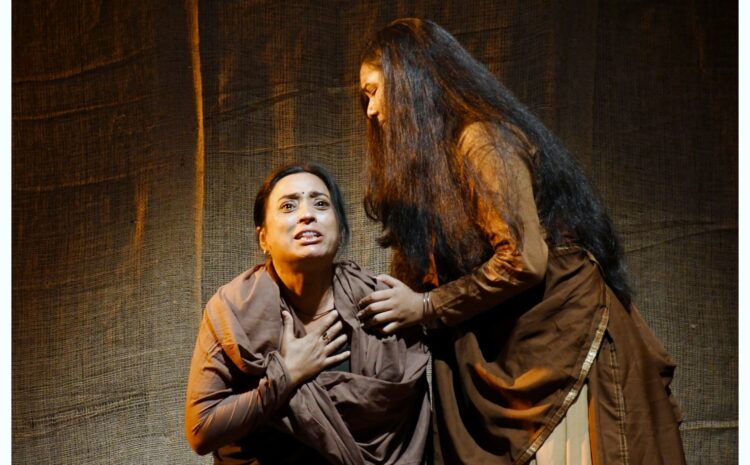
Just as in the original play Kalidas is a writer, similarly in the play Phir Aashadh Ka Ek Din, he is reimagined as a painter Varun Kale, a very good painter, who lives in a village. Mitali, who corresponds to Mallika of the original play, loves Varun deeply. Varun’s work is noticed by Raja Bhau, who is a politician and owns many art galleries. Raja Bhau wants to help Varun win an international award and organize many shows for him knowing that Varun will one day become a very big painter. He wishes to invest in Varun and wants him to come to Delhi. To bring Varun he sends his P.A. but he does not want to go. He wants to continue living in his village. Varun’s mama and everyone else want him to go to Delhi as this would make him a successful person. Mitali also persuades Varun to go. On the other hand, Vibhor, who corresponds to Vilom in the original play, wants Varun to marry Mitali and then go to Delhi. Mitali’s mother (Aai) knows that Varun will leave without getting married. Varun leaves, and does not return for a long time. Varun becomes a successful painter, and marries Raja Bhau’s daughter. Eventually, he leaves painting and joins politics. In the village Mitali is living her life in Varun’s memories. Her Aai has passed away. Like Mallika, Mitali somehow survives her condition, but she never asks Varun for any kind of help. At the end of the play, it is revealed that Raja Bhau has died and opposition has arisen within the party. Varun leaves everything and returns to his village. Varun narrates all the events of his life to Mitali and why he could not come to meet her all those years. He says that now he wants to start life again from the beginning. But he discovers that Mitali has a daughter, and Vibhor lives with Mitali. Varun, who had returned to start a new life with Mitali, leaves again saying that time waits for no one.
Director
Tanaji began his theatre journey at Jawahar Bal Bhavan under the guidance of Guru Shri K.G. Trivedi. He has acted in plays of many eminent theatre directors of the country and have given notable performances in plays such as Oedipus, Skandagupta, Madhyam Vyayoga, Jasma Odan, Seema Paar, Gagan Da Mama Bajyo, Saiyaan Bhaye Kotwal, Waiting for Godot, Ye Aadmi Ye Chuhe, Mad Women, Holi, Babuji, Bali Aur Shambhu, and Rustam Sohrab to name a few. Tanaji has also directed plays like Map of Happiness, Eklavya Uvaach, Bharat Milap, Nirvan (Jatak Katha), Kavita Collage, Jaanch Padtaal, Madhavi, Classroom, Bade Bhai Sahab, and Bin Pate Ki Chitthi. His solo plays Payal Purohit and Kharonch earned him Iftikhar Yuva Abhinay Samman 2011, Krishna Damu Abhinay Samman 2016, Young Theatre Samman 2016, and Vikul Kumar Samman 2017.
Writer
Mohan Rakesh (1925–1972) was a renowned Hindi playwright, novelist, and short-story writer who made a significant contribution to the Nayi Kahani movement. He is considered a pioneer of modern Hindi theatre. His major plays are Ashadh Ka Ek Din, Lehron Ke Rajhans, and Adhe Adhure; novels like Andhere Band Kamre, Na Aane Wala Kal, Antaraal; short stories like Miss Pal, Glass Tank, Jaanwar, and one-act plays like Ande Ke Chhilke, Bahut Bada Sawaal, and other literary genres like essays and Travelogue. He was honoured with the Sangeet Natak Akademi Award.
Translator
Kuldeep Kunal is proficient in writing and directing for both screen and stage. Primarily working in Hindi, his work has been showcased at Bogotá International Festival Colombia, Colours of India Mauritius, Bharat Rang Mahotsav 2010 and 2014, among others. He wrote and directed Poos Ki Raat, screened at the Indo-Russian Friendship Film Festival 2010. His work includes writing numerous advertisements, NAREGA songs, short films, documentaries, and public awareness campaigns for various Government ministries. He has received several awards for theatre writing and direction notably the Ustad Bismillah Khan Yuva Puraskar bestowed by the Sangeet Natak Akademi.
Director’s Note
Phir Aashadh Ka Ek Din operates simultaneously in two time periods. One part of the stage presents the original characters and locale, while the other reflects contemporary characters and times. Dialogues flow between both eras seamlessly, emphasizing that despite the passage of time, emotions, situations, and love remain unchanged, migration of people and compassion exist in the world, Ashadh Ka Ek Din will remain relevant.
Group
The Rising Society of Art and Culture is a non-governmental organization actively engaged in theatre. The organization is committed to staging plays, poetry, and stories, and has participated in prestigious festivals across the country.