
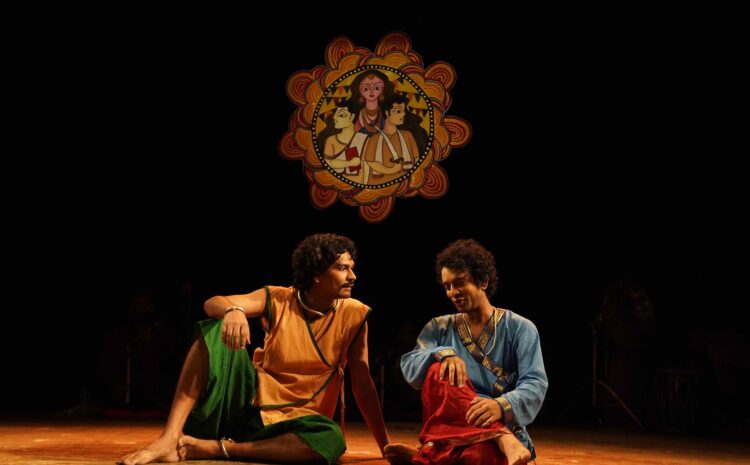
Hayavadanais a two-act Kannada play written in 1971 byGirish Karnad. Inspired by the ancient Sanskrit epic Br̥hatkathā and Thomas Mann’s retelling ‘The Transposed Heads,’ the play explores the boundaries between the human and the divine, the complete and the incomplete. Later, the eminent Bengali poet Shankha Ghosh translated it into Bengali – and from that translation emerges the production, “Ghoramukho Pala.” It is essentially a pala-style folk performance – a blend of narration, music, and movement. Through the voices of the Adhikari, the troupe of actors, and the chorus, unfolds an ancient tale of friendship, love, and identity. At its heart lies the story of two inseparable friends – Devadatta and Kapila – and their shared love for the enchanting Padmini. What begins as a bond of affection soon spirals into a complex web of desire, jealousy, and fate.Amid this human tangle enters a strange figure -a horse-headed man – part human, part beast. Tormented by his divided self, he wanders the world seeking a cure, a way to be whole again. But as his search deepens, the question shifts – can wholeness ever truly be achieved, or does every being remain forever incomplete?Through myth, music, and metaphor, the production is not merely a retelling, but a reflection – a poetic exploration of identity, incompleteness, and the eternal yearning for fulfilment that defines the human soul.
Director
Sayak Mukherjee is a multidisciplinary Bengali theatre professional – director, actor, writer, music director, and designer.His theatre journey initiated under the guidance of renowned director, Manish Mitra. Sayak has a Master’s degree in Drama with a specialization in Direction from Rabindra Bharati University. He has contributed as an actor for groups like Chetona, Kasba Arghya, and the Rabindra Bharati Repertoire. Lately, he has established himself as a prominent director, staging notable works like ‘Dui Sotiner Pala’ – inspired from old Bengali folk form Alkap, Mohit Chattopadhyay’s ‘Phoenix,’ Bratya Basu’s ‘Orkute Jukto Holo Baltimore Ar Nadia,’Ajitesh Bandopadhyay’s plays ‘Santal Bidroho’ and ‘Tamaku Seboner Apokarita,’and his own written play, ‘Magaj.’In his theatrical pursuits, Sayak hasbuilt a theatre Black Box as a space for alternative performance practice.
Writer
Shankha Ghosh (1932–2021) was a towering figure in modern Bengali literature, celebrated both asa poet (nom de plume, Kuntak) and a literary critic. An esteemed academic, he taught at prestigious institutions like Jadavpur University and Visva-Bharati, and was a noted expert on Literature of Rabindranath Tagore. For his literary contributions he was conferred many prestigious awards like the Sahitya Akademi Award (1977), the Padma Bhushan (2011), and the highest literary honour, the Jnanpith Award (2016).
Director’s Note
Girish Karnad’s ‘Hayavadana’ led me back to its ancient sources: the Kathasaritasagara (Ocean of the Streams of Story), the Br̥hatkathā (Great Narrative), and even the moral fables of our childhood, the Panchatantraseeking the universal truths buried beneath layers of myth and folklore.It was during this intensive study that a seemingly casual discovery occurred: a fascinating text by the revered Bengali writer, Shankha Ghosh. His insights provided the final, crucial catalyst, merging the classical Indian narrative tradition with a uniquely Bengali theatrical consciousness. From this confluence of Karnad, the ancient texts, and Ghosh’s perspective, the shape of our new production emerged: The ‘Ghoramukho Pala.’
This thematic urgency dictated our choice of form. We abandoned conventional proscenium drama and deliberately chose the Pala -the ancient, and the vibrant folk theatre of Bengal. Pala is more than just a performance; it is a primal narrative stream, a dynamic and interactive theatrical tradition that allows for spontaneity and direct engagement with the community.Ultimately, the characters of Devadatta, Kapila, and Padmini-and the perennial conflict that defines them-are not just figures from a mythical past. Their problems are our own: the yearning for unattainable perfection, the dissatisfaction with what we have, and the desire to merge the strength of the body with the intellect of the mind. These human dilemmas unfold daily in the lives of every individual watching. The Ghoramukho Pala isa necessary cultural intervention, using the oldest folk form of Bengal to address the newest crisis of the soul faced globally.
Group
Established on 2nd December 2023, ‘Baghajatin Bikshan’ is a group of creative theatre workers who have worked to preserve its connection with Kolkata theatre’s young generation. The members are or have been students of the drama department of Rabindra Bharati University. Bikshan’s current productions are Rater Pore Din, Atonker Dingulo, Orkute Jukto Holo Baltimore Ar Nadia, Magaj, Asttak Pala, Muhurto & Ghoramukho Pala.