
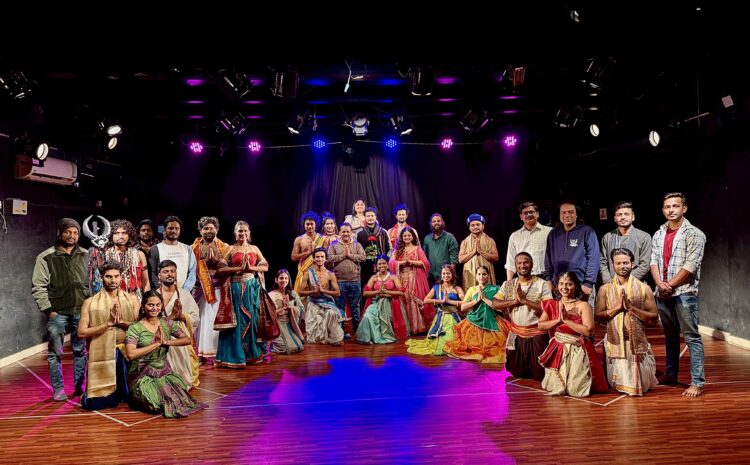
Malati–Madhava is one of the most celebrated Sanskrit plays by Bhavabhuti, The drama is rich in Shringara (romantic sentiment) and Karuna (pathos), portraying intense emotions and the painful conflict between love and social obligation.
The play is set in Padmavati, the capital of Vidarbha. Story begins with a promise made by two Brahmins, Bhurivasu and Devarata. They decide that if, in the future, one is blessed with a son and the other with a daughter, they will arrange the marriage of their children with each other. Malati, the princess of the kingdom, is graceful, intelligent, and emotionally sensitive. Madhava, a learned and idealistic Brahmin youth, arrives in the city with his close friend Makaranda for higher studies.
Malati and Madhava fall in love at first sight. Their bond deepens quickly, marked by sincerity and emotional intensity. However, Malati’s father and the influential minister Bhurivasu arranges her marriage to Nandana, a politically advantageous match, disregarding her feelings.Their love is tested through a series of dramatic events involving separation, danger, abduction, and intense emotional suffering. Despite powerful obstacles imposed by society and politics, courage, friendship, and steadfast love ultimately triumph.
Director
Vivek Emmaneni is an alumnus of National School Of Dram. He has started his theatre journey from his childhood with his father’s group “kalaaranjani” he performed in one act plays, burrakatha, palle suddhulu, street plays, and he also learned kuchupudi three years and performed in t.v reality dance shows. After his completion of two master’s one in Organic chemistry and another one in communication & journalism he worked in T.F.I as an Associate Director and as a script writer, later on he studied Master of Performing Arts from Telugu University, Telangana and after the one year of course complition he got selected in National School of Drama. After the N.S.D he has joined as a professional artist at National school of drama Repertory Company and he has done fellowship research project on the topic “Exploring Stillness”. He has worked 2years as an Assistant professor (Acting) at Ramanaidu film School HYDERABAD. He played major characters in Nearly 50 productions and performed more than 250 shows in a different forms. He has worked with Prof.Vidushi. Rita ganguly ji as an Actor and Associate Director. He participated in the UNESCO Chair on Theatre in Education’s “Asian Traditional Theatre Workshop” at “Central Academy of Drama”, China. He has National level participation in Republic Day Parade at Rashtrapathi Road/Bhawan 26th January 2006 (N.S.S). While he was doing his fellowship research project He has also Participated in the Student Exchange program between the “Royal Academy of Dramatic Art” (RADA), London and the National School of Drama, New Delhi. He got best Actor award in Waikiki international film festival U.S.A and Florida Beach international film festival for his telugu debut film Titled “Screenplay”.
Playwright
Malatimadhava is written by Bhavabhuti, one of the greatest Sanskrit dramatists of the 8th century CE. He received his education in Kashi (Varanasi), where he mastered Sanskrit literature and philosophy. Renowned for his profound emotional depth and intense portrayal of human feelings, Bhavabhuti is often celebrated as the poet of rasa, especially shringara (love) and karuna (pathos). His works combine romance, suspense, philosophy, and dramatic conflict, making Malatimadhava a timeless classic of Sanskrit theatre. His Major Works – Malti Madhav, Mahaviracharita, Uttara-Ramacharita
Director’s note
“In Bhavabhuti’s timeless tale of love and longing, Malati and Madhav’s story unfolds against the backdrop of duty, loyalty, and societal expectations. But beneath the surface, the play reveals a darker truth – the abuse of power and the silencing of voices. King Bhuvanshu’s promise to Nandan, a man driven by lust and entitlement, showcases the ugly face of authority and the objectification of women. Malati, a pawn in the game of power, is denied agency over her own life.
Amidst this turmoil, Kamandaki, the wise and compassionate nun, emerges as a beacon of hope. Her unwavering support for Malati and Madhav’s love, and her bold initiative to unite them, showcases her strength and conviction. Her character is a testament to the power of female solidarity and the impact one person can have in challenging societal norms.
As a part of this student production, we’ve taken some creative liberties to enhance the narrative and explore the themes in a more contemporary context. This project has been a valuable learning experience for our students, allowing them to delve into the complexities of classical theatre while developing their own voices and perspectives.
Through this production, I aim to highlight the timeless relevance of these themes and spark a conversation about consent, power dynamics, and the fight for individual freedom. Join us on this journey of love.
Group
The National School of Drama, Varanasi Centre, was established in 2018 to offer a one-year training course in Indian classical theatre and dramaturgy. This course provides an approach to understanding theatre production and the language of classical Indian theatre. It includes an in-depth study of performance, acting, and other related aspects of theatre, where students are encouraged to develop their own instincts and sensibilities in relation to the demands of the text or performance.
The rigorous full-time program of study aims to broaden students’ performance skills and develop their competence in theatre-making, drawing inspiration from Indian classical and traditional performances. The artist should be proficient in stagecraft and skilled in theatre techniques, possess knowledge of theatre history, be able to sustain individual practice, be critically aware and socially engaged, and be able to work autonomously as a creative individual and artist.