
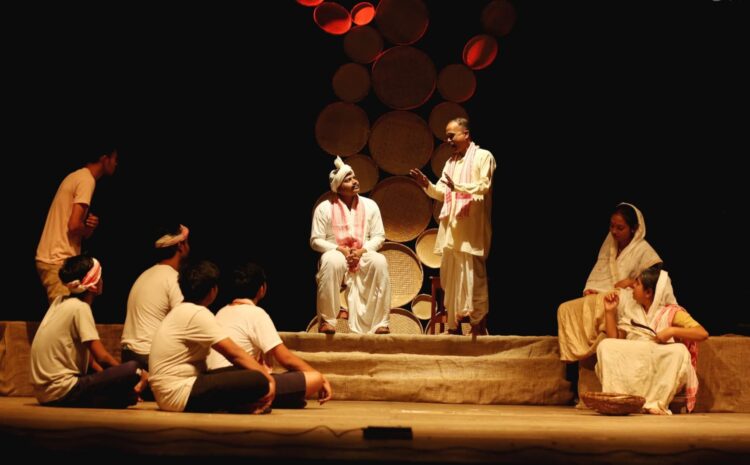
The story portrays the life of a young man – his childhood, youth, love, and neglect – someone not counted among the “important” people of society, yet essential to its very existence. This forms the core of the play Molokhu.
The play’s main character, Biju, lives in a community where he helps everyone – from the oldest man to the youngest boy, from the young women to the elderly ladies. He seems to be the only person who extends a helping hand to all, without expecting or asking for anything in return.
Even in love, Biju’s simplicity and contentment define him. He is happy with whatever life has given him. Instead of leaving his village in search of work, he chooses to stay, creating his own means of livelihood through farming and small-scale self-employment.
Since childhood, Biju has been someone who stands up for what is right – protesting whenever he is denied what he deserves. There are many such Bijus around us – people who serve selflessly, quietly holding our society together – yet we fail to recognize or value them.
Writer and Director
Bhaskar Boruah is an actor,playwright, director, actor trainer and theatre practitioner .He graduated from National school of Drama New Delhi in 2015, specialized in acting. So far he has directed many stage plays like Junakir kothare ,Dhemalir kothare ,xastir xondhanat, Karna ittyadi, Monai, Teton tamuli, Bharmi, Ravan, Hamlet,Rjar deul ,Kekoni, Shankardev, Oi who am I ?, Mur pal aapunar pal tar pal, Kotha kua sobi..|, Bonditta, Dul chinga putala, Enixar apor, Fragmented City, Popiya tara, Aroo Wange etc. He established his group “JOONAK” (a group of little stars) in 2008. He has worked with acclaimed theatre directors from India and abroad. As an actor, he acted in 75 stage plays. He participates in 30 National/International theatre festivals.
Director’s Note
Since we are engaged in theatrical practice, we often read various kinds of stories, novels, and plays. The purpose behind this is to see whether we can find some material or storyline suitable for stage presentation. During one such journey, the idea of “Molokhu” came to my mind – the story of its main character, Biju.
Biju was a living, real person – not a fictional character. In fact, we have lived with, or still live among, such characters in our rural society. Now, who exactly is this Biju, for whom I chose drama as the medium of expression?
Biju represents someone essential to all of us – yet, we only remember him on our needs, and only when we need him again. Biju, though uncounted in the statistics of society, is the one without whom society itself cannot function. And the neglect shown toward him by this motionless society forms the very soul of Biju’s character.
Through drama, we have so far portrayed the lives of many kings, princes, heroes, heroines, landlords, and leaders. But this time, we wish to tell the story of Biju – one who is neglected yet indispensable, uncelebrated yet vital, and whose existence is not considered worthy of discussion in society.
Group
Formed in 2008 by a group of enthusiasts, “Joonak” is trying to visualize the basic idea and concept of Drama in the village level and bring out the hidden talent from the grass root level to the core view. Under the guidance of Bhaskar boruah ,a graduate from National School Of Drama , “Joonak” has successfully implemented and started its beautiful journey through various plans and programmes of drama with its other ethnic-Cultural shows. To create awareness regarding the importance of Drama and to make the village children enthusiastic about it the organization had organized 3 workshops. In 2015 the organization has beautifully step into the National Theatre festival Tirupattur, vellore, Tamilnadu with one of the most beautiful drama “Karna ittyadi”.The group has produced and staged plays namely Junakir kothare ,Dhemalir kothare ,xastir xondhanat, Karna ittyadi, Ravan, CROWNLESS PRINCE (A base on William Shakespeare play “HAMLET”), Rjar deul ,kekoni,Mur pal tar pal aapunar pal Roija boi ja,Anixar apor,Arro Wange.