
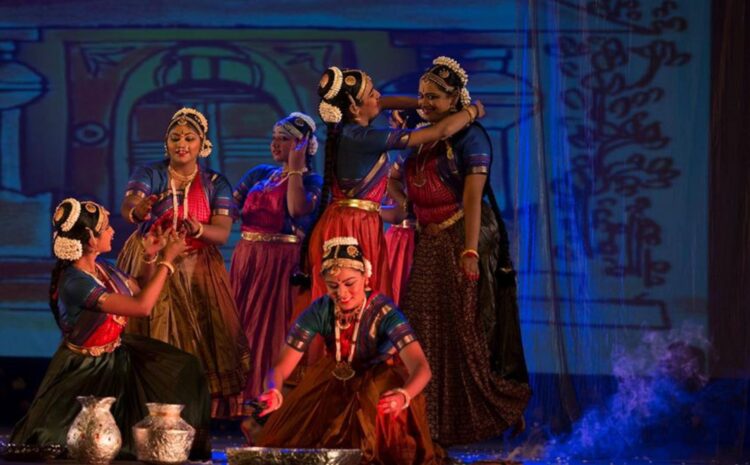
Nammai Marandarai Nām Marakkamāttom: The Unheard Story of Madhavi of Silappadikaram” revisits the Tamil epic through the silenced gaze of the courtesan-danseuse, Madhavi. While the tale of Kannagi’s fiery vengeance and Kovalan’s tragic end in Madurai is well known, this play turns its attention to the forgotten lineage of women whose art and anguish shaped the moral and emotional landscape of the Sangam world.
At the heart of the play lies the great love between Kovalan and Madhavi-woven through the music, dance, and sensual politics of the Neidal (coastal) community in Sangam era. When Kovalan abandons Madhavi to return to Kannagi, it sets in motion a chain of destinies that burn through love, ego, and faith. Madhavi’s daughter, Manimegalai, inherits not only her mother’s beauty and talent but also her burden-a life torn between worldly desire and spiritual renunciation.
Through poetry, dance, and dialogue, the play unfolds as an aesthetic and philosophical inquiry into the nature of art, womanhood, and salvation. The refrain “Nammai Marandarai Nām Marakkamāttom” (“We shall not forget those who have forgotten us”) echoes as both lament and liberation, tracing the transformation of society from Jainism to Buddhism, from art to asceticism, from love to loss.
Nammai Marandarai Nām Marakkamāttom: The Unheard Story of Madhavi of Silappadikaram is not merely a retelling of an ancient story, but a resurrection of the feminine voice-at once rebellious, reflective, and redemptive.
Conceptualised and Choreographed by Dr Swarnamalya Ganesh, dancer and dance historian.
Director
Dr. Swarnamalya is a performing artiste with over 35 years of experience, a scholar of cultural history, choreographer and academician. Her work in the arts is pioneering in the sense that it brings through her practice led research, in–depth and nuanced historical understandings of Cultures back to us, in a conducive yet affirmative way. As an expert in cultures of the Early Modern Period of South India, From The Attic- a performance. Lecture, Exhibtion series is Swarnamalya’s seminal contribution to cultural history of the modern times. She contextualizes the dance now popularly called Bharatanatyam as Sadir, restoring admission of subaltern narratives of hereditary custodians. She tours to festivals around the world with her Reconstructions of performative traditions and histories of Early Modern and Colonial South India, for which she usies source texts, oral traditions, kinaesthetics, archeological and linguistic investigations. Most of all, she continually reflects on the values of multiculturalism in the arts, towards an expanded view of social and political inclusivity towards peace and harmony, particularly between SAARC nations. A Fulbright Fellow, Swarnamalya is the Director of Ranga Mandira Academy of World Dance/ Performance and Indic Studies and Professor of Global Arts, Krea University, India. An invited member on several prestigious academic boards for universities and various state governments in India, she is also a prolific writer and published author. In her other avatars, she is a lawyer, besides also engaging in new media dissemination of cultural histories via her social media pages and YouTube Channel. She is also a well known actor and media person in Indian cinema and television from her younger days. Nammai Marandarai Naam Marakkanattom is a magnum opus production, directed by her where the life of Madhavi of Silappadikaram comes alive through the Sangam imaginings of music, dance and dialogues.
Director’s Note
Nammai Marandārai Nām Marakkamāttōm “We shall not forget those who have forgotten us”, emerges from the silences of Silappadikāram, to reimagine the forgotten voice of Mādhavi, the courtesan-danseuse of Puhār. While Ilango Adigal’s epic immortalized Kannagi’s chastity and rage, it also quietly preserved the lyrical depths of another woman, one who embodied beauty, artistry, and moral ambiguity. This production seeks to bring Mādhavi’s world to life, her birth, training, performance, love, loss, and eventual transcendence.
In concept and structure, the work traces the journey of a woman as artist, where art becomes both her adornment and her awakening. The verses from Silappadikāram and Manimekalai, chosen with careful scholarship, form the dramaturgical spine of the performance. Each sequence, from Mādhavi’s Indra Vizha recital to her poignant lament, unfolds through a tapestry of poetry, music, and movement. The choreography draws from Tamil textual sources and classical treatises, blending Bharatanatyam (Sadir) vocabularies with ancient Karaṇas and Pindi Bandhas. Each gesture is rooted in the grammar of Tamil poetics, where landscape, emotion, and conduct become inseparable.
The music, composed by Sri Shashikiran, evokes the tonal beauty of ancient Tamil pan-s, interwoven with strings, wind, and percussion, conjuring the soundscape of the Sangam age. The visual design recreates the splendour of Puhār, its palaces, moonlit shores, and festive processions, through sketches by the late art director P. Krishnamurthy. The costumes, colours, and jewellery follow earthen hues and historic silhouettes, echoing the sensibilities of a time when art and life were one.
At its core, this dance-drama is a meditation on memory, gender, and transcendence. Mādhavi’s journey from desire to detachment, from art to asceticism, mirrors a woman’s eternal dialogue between the body and the spirit. In remembering Mādhavi, we remember the countless women-artists whose grace and wisdom shaped the cultural consciousness of this land.
Mādhavi’s story is not one of tragedy- it is one of transcendence.
Group
The Ranga Mandira Sadir Melam Ensemble is a collective of young artists dedicated to the revival and reimagining of Sadir, the ancestral form of Bharatanatyam, under the artistic direction and guidance of Dr. Swarnamalya Ganesh. Rooted in rigorous training, historical inquiry, and cultural empathy, the ensemble seeks to embody the living continuum of South India’s performing traditions with intellectual depth and ethical consciousness.
Each member of the ensemble is trained not only in the movement vocabulary of Sadir, but also in its musicality, poetics, and performative ethos. Their education extends beyond technique, into the study of Tamil, Telugu, and Sanskrit literatures, dance treatises, temple and court repertoires, and the social histories of hereditary performers. Through this, they cultivate a memory repertoire: an embodied archive of stories, gestures, and aesthetics that once defined the artistic life of Tamil Nadu.
In performance, Ranga Mandira Sadir Melam functions as a dialogic space, where music, poetry, and movement converse across time. The ensemble’s practice foregrounds collaboration between dancers, musicians, and scholars, merging fidelity to tradition with contemporary sensitivity. Their work is not a reconstruction of the past, but a reclamation of context, re-inscribing the voices of women, courtesans, and artistes who once shaped the ethical and aesthetic foundations of Tamil performance culture.
At its heart, the ensemble stands for art as inquiry and conscience. Guided by Dr. Swarnamalya’s vision, Ranga Mandira Sadir Melam nurtures a generation of performers who understand that dance is not merely an act of beauty, but an act of remembrance, resistance, and renewal.