
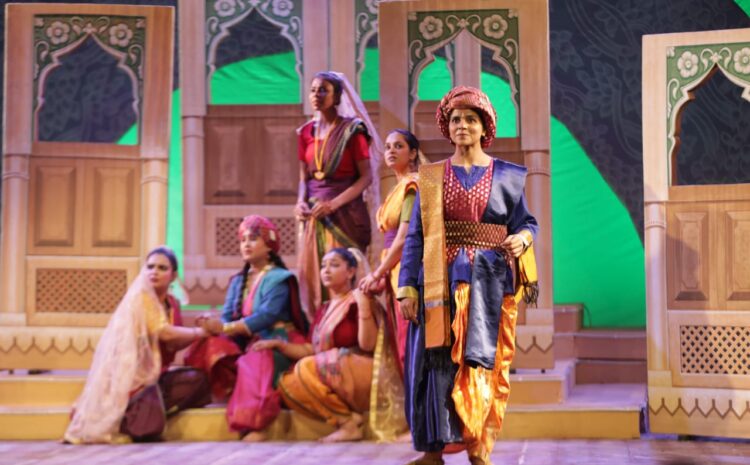
Nirmaan se Nirvaan Tak is based on ‘Tat Niranjana,’ written by Bijay Mishra, a renowned Odia playwright. In this play, the author constructs the narrative metaphor of “River Geomorphology,” unfolding scenes corresponding to different sequences- the first stage of the river (young stage), the second stage of the river (mature stage), and the third stage of the river (old stage). Neelalohit and Echchhamati, the characters in the play, represent the youthful thoughts of Gautam Buddha and depict different stages of Buddha’s mind. In the first stage of the river, the water velocity is too high, Neelalohit in caught between monk Anand’s ‘rules and regulations’ and ‘strong and free thoughts’ of Echchhamati. In the final scene, Gautam Buddha imparts a valuable lesson to his son Rahul, to forge his own path in life and define his purpose. This echoes Echchhamati’s advice to Neelalohit in the first scene, urging him not to blindly follow anything but to introspect and discover own unique journey. Buddha, having embraced complete silence, attains Nirvana, thus the reason of renaming the play as “Nirmaan Se Nirvaan Tak” symbolizing how a river accumulates sediments throughout her journey and lose her whole existence when she meets the ocean.
Writer
Dr. Bijay Mishra, born in 1936 at Santaragadia, Balasore, Odisha, wrote numerable plays, Odia films, TV serials, and documentaries. His play Taj Niranjana has been translated into many Indian languages and earned him a National award from A.I.R.; and for his play Banaprastha he was bestowed the kendriya Sahitya Academy Award. His other plays are Saba Bahaka Mane, Janani, Yayavar, Jeevan Mrityu, Asanta Graha, Asatya Sahara, Parsuram, Jajabara, Timira Tirtha, etc. Some of his plays and stories are in syllabus of many schools, Colleges, and Universities.
Director
An alumnus of the National School of Drama, 1987, Bipin Kumar has received several awards and accolades for his contribution to theatre such as the Sangeet Natak Akademi Award (2016), Jharkhand State Award (2016), and Sikkim State Award (2017).
His directional repertoire includes works life Yatri, Pagla Ghoda, Ashadh Ka Ek Din, Biyaban Mein Ugte Kinshuk, Trishanku, Jati hi Pochho Sadhu ki, The Lower Depths, Us Raat ke Baad, Safed Lakeer, Sabhya Saanp, Romeo & Juliet to name a few. Presently, Bipin Kumar is the Director of Bhartendu Natya Akademi, Lucknow.
Director’s Note
Nirmaan se Nirvaan Tak highlights the instability, dilemma, and uncertainty of today’s individual through the reaction of past. In the play, man-woman relationship is shown at two levels. First, Neelalohit and Echchhamati transcend to worldly plane of man-woman love and dedicate themselves to Buddha and his Sangha. Second, it illustrates Gautam Buddha’s relationship with Gopa (Yashodhara), Sujata, and Echchhamati. Rather than confronting them, Gautam chooses to run away and ultimately experiences a sense of defeat. In this way, the iconoclastic Buddha himself becomes an idol, or, made into an idol through the collective efforts of society. Although the play has conclusions, for me there is still question mark.
Group
Bhartendu Natya Akademi (erstwhile, Bhartendu Natya Kendra) was established by the Culture Department, Uttar Pradesh in August 1975 in the memory of the father of modern Hindi drama, Bhartendu Harishchandra. From 2022-23, the Akademi has been made a constituent of Bhatkhande Culture University and can award postgraduate degrees in Dramatic Arts. To promote theatre in the remote areas of Uttar Pradesh and the country, the academy established a professional Repertory Company in the year 1988, in which the ex-students of the Academy and other talented artists from across the country are given an opportunity to showcase their talent.