
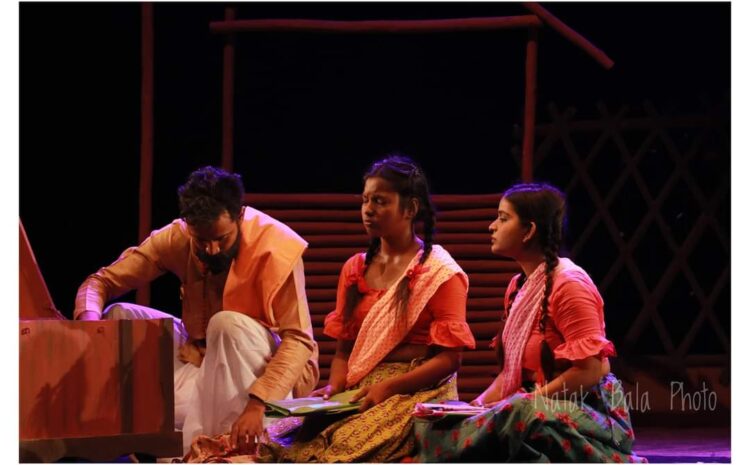
Kathasar Mimi in the early twentieth century in Bihar
The ill effects of the prevailing evils are poignantly depicted in the play. For adolescent girls like Paro, marriage has been compared to a terrible ordeal. In order to cross this Styx, the heroine has to lose her life.Through the medium of Brajakanta The life of Paro has been described through the medium of Brijkant. Though sentient towards Paro, Brajkant is sensitive towards Paro but is unable to help her. A strange relationship develops between the two but they do not dare to express this relationship to their parents. Poverty, lack of education and a patriarchal society force adolescent girls like Paro to marry. The marriage of an adult groom and a girl like Paro was considered a normal event in the society. Given/In the face of the helplessness of her widowed mother, Paro is finds herself unable to resist this incompatible marriage.The end result of marriage at a young age is very tragic.
The play is set in a magical milieu. The smell of the soil of Mithila has been attemptted to be established through Maithili folk songs and Maithili poems. All the characters belong to rural background.The innocence of the rural characters is also an important entertaining aspect of the play.The language of the narration is simple and the situations, though normal, sometimes seem tragic. Attempts have also been made to present traditional Maithil rites, and songs in a theatrical style.
Director
Sharda Singh was born in 1977 and received her postgraduate degree in History and Dramatic Arts from Patna University, Bihar. She has acted in more than 50 plays and received numerous awards. She was also conferred with the Best Actress award for her acting. She was associated with Doordarshan Patna and All India Radio Patna and worked on several serials, telefilms, and radio plays. She has worked with renowned theatre artistes like Satish Anand, Sanjay Upadhyay and Vijay Kumar. She was awarded a National Scholarship for Acting in 1998. In the year 2012-13, she was awarded a Junior Research Fellowship for Theatre by the Ministry of Culture, Government of India. She has directed several street plays as well as stage plays such as Mati Gaadi, Ekla Chalo Re, Ashadh Ka Ek Din, Lahron Ke Rajhans, Lal Pan Ki Begum, Ratinath Ki Chachi, and manymore. She received the Shailbala Mishra Acting Award in 1992, 1994 and 1995 in 1995 and further received the Kalashree Award for acting also in 1995. In the year 2003, she was awarded the Bhikhari Thakur Samman; the Noor Fatima Smriti Samman in 2009; the Purnank Rang Samman (Ujjain)in 2010; the Abhinav Rang Samman in 2013, and was conferred with the Bhikhari Thakur Yuva Samman (Government of Bihar) alsoin the year 2013. She has also been honored with the Women Achiever Award and the Shiksha Ratna Samman. Currently, she is actively involved in theatre.
Director’s Note
The play Paro, set against the rich backdrop of Maithili culture, marks Nagarjun’s first foray into the field of Maithili literature. Through this poignant story, we witness the painful journey of a young girl, Paro, who finds herself trapped in a society where marriage is depicted as a form of torment/curse. Paro’s plight becomes even more complex when she is married off to a middle-aged landlord. While her true emotional attachment is to Brajkant, who embodies her thoughts and feelings. The play starkly exposes the harsh realities of poverty and lack of education, as it forces young girls like Paro into the crucible of early marriage in a patriarchal society- a damning reflection of social norms. Despite the immense progress in education and science in today’s world, this story by Nagarjun remains surprisingly relevant till date, highlighting the endless struggles faced by women.
Thus, Paro is not merely a story of any individual sufferings, but a timeless commentary, on social issues, that needs to be continuously staged, ensuring that its powerful message resonates with audiences across generations.
The group Prastuti is a well-known cultural organization from Bihar, actively involved in the field of arts for the past 15 years. The group was founded with the aim of serving society through art forms such as theatre and music. It has presented several full-length plays to date, including Mati Gaadi, Ekla Chalo Re, Ashadh Ka Ek Din, Lahron Ke Rajhans, Renu Mama, Lal Pan Ki Begum, Bakri, Ratinath Ki Chachi, Yakshini, Paro, Bhagi Hui Ladkiyan, Red Frock, Bharat Charitam, and Dhurt Samagam. These productions have been staged not only throughout Bihar but also in some major theatre festivals in cities like Delhi, Kolkata, Bhopal, Jabalpur, and Prayagraj, including prestigious festivals like Bharat Rang Mahotsav and Minerva Theatre Festival. For the past two years, the group has been organizing ‘Prastuti Utsav – Akeli Aurat Ka Natak, a theatre festival featuring solo performances by renowned Indian theatre and film actresses such as Himani Shivpuri, Mita Vashisht, and Jyoti Dogra. This is a unique theatre festival of its kind, entirely dedicated to female-centric characters. With the aim of creating awareness among the general public, Prastuti has been uninterruptedly producing street plays, stage plays, and folk songs on prevalent social evils in society, such as dowry, illiteracy, child labor, superstition, and corruption, as well as on issues like AIDS, polio, hepatitis, and global warming.
Aming to expand the reach of theatre and connect young people with theatrical activities, and provide them with proper opportunities, the group conducts theatre workshops at regular basis. In these workshops, young people interested in theatre, are guided and trained by experienced experts to bring out their hidden artistic potential. As a result, they are able to pursue theatre as a livelihood and also contribute to the development of theatre.
The group has received a Repertory grant under the Guru-Shishya tradition from the Ministry of Culture, Government of India, New Delhi, and has also received financial assistance from time to time for organizing theatre performances and theatre festivals. In addition, it has also received financial assistance from the Government of Bihar and the Sangeet Natak Akademi. We are continuously progressing in the field of theatre, and our main objective is to connect young people with the world of theatre, guide them, and provide suitable opportunities to new theatre artistes. By providing them with a platform to hone their talent, our aim is to inspire them to lead an ideal and meaningful life.