
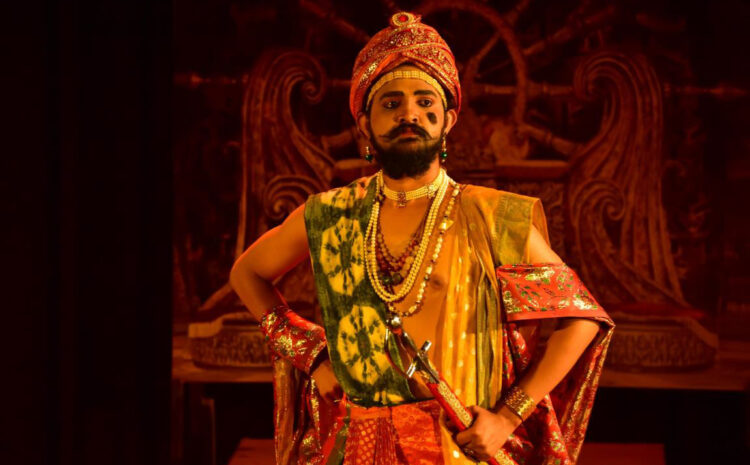
Samrat Ashok is a powerful historical drama that explores the life of Emperor Ashoka beyond legend and glorification, presenting him as a ruler caught in profound moral conflict. Set during the height of the Mauryan Empire, the play traces Ashoka’s journey from an ambitious and ruthless conqueror to a leader transformed by conscience and inner awakening. The devastating Kalinga War forms the emotional and philosophical core of the narrative, confronting Ashoka with the immense human cost of power, ambition, and violence. This moment of reckoning leads him toward the path of Dhamma—compassion, responsibility, and non-violence. Rather than portraying Ashoka as an idealized historical icon, the play emphasizes his inner struggle, guilt, and gradual realization, making him deeply human and relatable.
Writer
Born 2 May 1935, Kasganj, Uttar Pradesh Shri Daya Prakash Sinha is a towering figure in Indian theatre, renowned as a playwright, cultural administrator, and visionary thinker. His creative legacy includes thirteen seminal works on theatre, along with critical volumes written by eminent scholars on his contribution.
He has served in key cultural leadership roles including Secretary, Sahitya Kala Parishad, Delhi; Controller of Cultural Affairs during the Asian Games 1982; Director of the Indian Cultural Centre, Suva (Fiji); Director of Culture, Government of Uttar Pradesh; and Director and Chairman of Bharat Bhawan, Bhopal. He also served as Vice President of the Indian Council for Cultural Relations (ICCR), New Delhi.
He has been honoured with the Padma Shri, Sahitya Akademi Award, and Sangeet Natak Akademi Award, and is an elected Fellow of the Sangeet Natak Akademi, recognising his outstanding contribution to Indian theatre.
Director
Raj Kumar Upadhyay is a noted theatre director, actor, acting teacher, and child drama expert, with a distinguished career spanning theatre, television, radio, education, and research. He is a Governing Council Board Member of the Ministry of Art and Culture’s Children Academy, New Delhi, and has contributed to the design of the CBSE Theatre syllabus. He produced and directed the radio serial Vishwa Katha Collage for All India Radio, Delhi.
A graduate in Philosophy from the University of Allahabad with a postgraduate degree in History from Himachal Pradesh University, he received professional training from the Bhartendu Academy of Dramatic Arts, Lucknow. He has worked with eminent theatre personalities and acted in acclaimed plays such as the Exception and the Rule, Kavikahani, and Ek Qurbani Gumnaam.
As a director, his notable works include Gandhi Tum Zinda Ho, Jan Se Man Ki Jai Ho, Bhagat Singh – Ek Soch Ek Baar Phir, Netaji Subhash Chandra Bose, and #Gaddhagate. He has directed Bollywood’s comedy king, Asarani ji in the comedy play “Kya Family Hai”, Padmashri Tom Alter in “Delhiciously Chekhov” and “Ye Jo Mohabbat
Hai”. He has also directed commercially hit comedy plays Jaisa Filmo
Me Hota Hai, “Mera Pati Salman Khan” and “Are Gadbadi ho gayi” etc. He has also been a part of several television as well as film projects. His proposed film script ‘PURVAAI’ was selected and awarded as the best entry out of 300 scripts in 2006-07 by Smt. Jaya Bachchan, Chairman of Film Vikas Development Board [Film Bandhu] Uttar Pradesh. Currently, he heads the Theatre Department at Modern School, Barakhamba Road, New Delhi.
Director’s Note
The decision to stage Samrat Ashok emerged from a shared creative and emotional journey. This play was chosen not merely for its historical significance, but for its deep human questions that remain relevant today. The production has been shaped collectively, with artists, designers, and collaborators working together in a spirit of trust and commitment.
This play holds special emotional value for me because of my association with Shri D. P. Sinha. When I met him, he expressed his wish that I should direct this play. That conversation became a guiding force for this production. In many ways, Samrat Ashok stands as our humble tribute to his vision, faith, and immense contribution to Indian theatre.
I am deeply grateful to the National School of Drama for understanding the emotional intent behind this work and for providing a platform where such tributes can be meaningfully expressed. This production is our offering of respect, remembrance, and belief in the transformative power of theatre.