
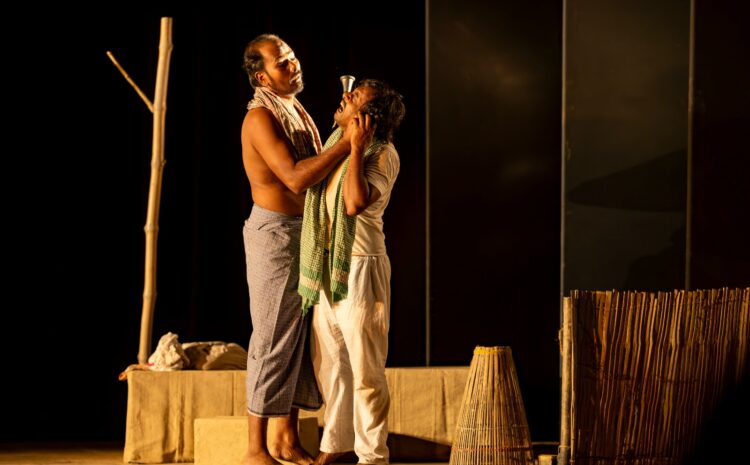
Dukhi and Chidem are two brothers. They works in Zamindar’s field. They are very poor. Radha and Chandara are wives of them. They quarrel all the day. Even the villagers also know that. Dukhi and Chidam are forced to do voluntary for zamindars even being poor! One day Dukhi and Chidam returned home being very hungry. Dukhi wants food to his wife Radha. Then Radha blows up to Dukhi and says he didn’t left any food for feeding! Tired, hungry Dukhi became very angry and killed his wife unintentionally by his sickle.
In that time sudden Ramlochon the rent collector of Zamindar has come and get knows everything. Then Chidam asked to him that how will they all can be safe? Ramlochon gave adviced, that to tell the court, Dukhi was hungry and Radha does not gave food. So, quarrel has started and Dukhi killed Radha.Then Chidam thought and said that, his brother will hang if hecsay this reason.
Then he finally put in all the blame on his wife Chandara. Because he think, if he loss a wife, then he can get another one. So, insulted, self-respectful Chandara decides to take all the blame on her own. Finally, Chidam felt the reality and break down, and understood his fault but Chandara gets hanged!!
Director
Bidhan Chandra Halder grown up at the place, which is known as village of Theatre. He was born on 4th July 1989 in Gobordanga, West Bengal. He passed Graduation and Masters(in Fine Arts, Drama) From Rabindra Bharati University and completed a one year residential certificate course on theatre from National School of Drama, Sikkim. He also got Young Artist Junior Scholarship honor and Awarded in Junior Fellowship Award in The Field of Theatre (Ministry of Culture, Govt. of India)
After completing education he establishes a Theatre group Gobardanga Rangabhumi by his own effort, on 9th may 2013. From then he is continuing his Theatre journey about 23 years. He directed about 36 plays and acted more than 18 plays. He travelled with his productions across the country.
He has trained under renowned theatre personalities, such as Late Tripurari Sharma (SNA Awardee), Pranjal Saikia (SNA Awardee) Samik Bandyopadhyay, Ajay Malkani (SNA Awardee) Jamil Ahamedh, Late Afsar Hussain, Rudra Prasad Sengupta (SNA Awardee) Arun Mukherjee, Late M. Jadumani Sing (SNA Awardee) Govind Pandey, Mridul Baruah, Biplab Barkakati, Pabitra Rabha, Ashok Mukherjee, Dr.Tarun Pradhan, Late Usha Ganguly (SNA Awardee),Gautam Halder, Ashis Chattyopadhyay, Sandip Bhattacharya, Biswajit Biswas, Dipankar Paul, Debashis Majumder (SNA Awardee) Bipin Kumar (SNA Awardee)
Now he is working with children in many school, villages, neighbor Theatre groups including his own. Another side he found a new root to deliver Theatre to the general public. That is Rooftop Theatre. His aim of this is bring theatre to everyone.
Director’s Note
The play Shasti was first published in Sadhana Patrika in bengali, in 1300 by renounde poet Rabindranath Tagore. Tagore is relevant to every ages, therefore I am not capable enough to put relevance separately in Tagore’s work. In the play Shasti, Tagore has drawn the line between upper Zamindari Pratha and their deeds and its impact in the lives of the farmers of that time. How they used to make the farmers penniless or poor by enforcing them with huge taxes. We can also see the situation of women of that time we can also see the depth of women’s heart of their self respect and their determination. And only for that reason I have always found Shasti to be very relevant in this age. And I believe upto the time in memorial the society persists this story will always find it’s relevants. At that time Zamindar Pratha was there and at present time the government system.
Where democracy is only a reflection.At that time the women education was shallow, the time has changed.now the women education has grown to its limit but the story remain the same in every society.
Still in this modern society how many women can actually live freely of their own?
So, this play is for our mothers and daughters. Thats like Chandara, they might have loss their lives, but they will never loss their determination and self respect. For all these reason Shasti is still relevant to this day.
Group
The village of theatre of West Bengal is Gobardanga. Almost 140 years ago in 1878 the first theatre group of Gobardanga ‘Arya Rangabhumi’ was established. Gobardanga Rangabhumi was established in the year 2013, 9th May. Besides drama, Gobardanga Rangabhumi also organized dance, recitation, theatre workshop (school based), theatre seminar, book publishing, theatre festival, producing dramas and many others things like Rabindranath Tagores birthday celebrations, Rakhi bandhan utsab celebration.Six Month Children Theatre Workshop (In House), Village Based Theatre Workshop, Rooftop Theatre Festival, Seminar, They published a book which contained the practice of theatre from the year 1878 to 2014 in Gobardanga.
The productions of Gobardanga Rangabhumi are Devi, Somajer Antorale, Pindare Polasher Bon, Eke Oporer, Kursi, Ajob Desh, Vabnay Gandhi ( Based On Gandhi Ji Story ), Durbuddhi, Rajar Khoje, Shasti, Patthar Pe Fool, Among these productions they done stage performance of ‘Abu O Juto’ in 7th January 2017 at West Bengal Sishu Kishore Natya Mela and also National Theatre Festival organized by Shohan at Minerva Theatre, and in EZCC Kolkata Theatre festival.
Every year they facilitated famous personalities belonging from various types of cultural world.