
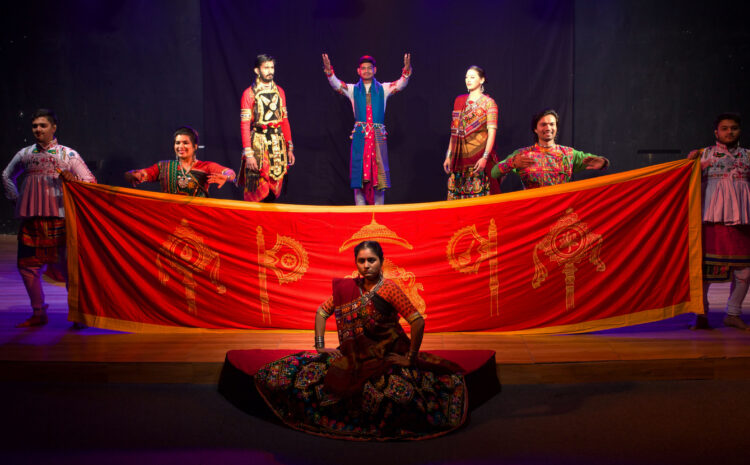
The play, inspired from Uttararamacharitam, explores events following the coronation of Rama. Centered on ‘Sita and Chhaya Sita’, it intertwines two narratives: the washer-man (Dhobi) expelling his wife Chhaya Sita, and the same washer-man casting doubts upon Sita’s chastity. Through this intertextual structure, the play delves into themes of morality, social perception, and the complexities of righteousness.
Scene 1: During Rama’s coronation, Sita is disturbed by the washer-man’s unjust act. To comfort her, Rama revisits pictures from their past, re-enacting the Ramayana. However, upon hearing society’s accusations from his spy Durmukh, an unwilling Rama banishes the pregnant Sita into exile.
Scene 2: As preparations for the Ashvamedha Yajna commence, Rama arrives at Panchvati, where an idol of Sita is being sculpted. Sita’s idol comes to life; she can see Rama, though Rama cannot see her. The two relive their past moments of love.
Scene 3: The Yajna horse reaches Valmiki’s hermitage, sparking a clash between Luv and Chandraketu. Rama arrives as Kush stages “Sita No Vesh”, bringing emotional resolution through the symbolic reunion of Rama and Sita.
Writer
Mahakavi Bhavabhuti was a renowned Sanskrit poet and dramatist who lived during the 8th century AD. His artistic approach was characterized by his deep understanding of human nature and his ability to capture the essence of complex human emotions in his writing. His most celebrated works are Mahaviracharitam, Malatimadhava, and Uttararamacharitam.
Director
Dr. Pramod is a ‘Theatre Director and Academician’ specializing in classical Indian dramaturgy, postcolonial theatre, and intercultural performance. He is a recipient of ‘Ustad Bismillah Khan Award in Theatre Direction’ from SNA, Delhi, and ‘Gujarat Gaurav Award’ from GSNA. He is currently a Post-Doctoral Fellow (ICSSR), with twelve years of teaching experience at the Department of Dramatics, Maharaja Sayajirao University of Baroda.
He has served as a ‘Visiting Fellow’ at The University of Texas at Austin, USA. He was selected for a ‘Theatre Residency’ at National Theatre Marin Sorescu, Romania, and awarded the Korean Arts and Cultural Research Fellowship by Ministry of Culture, South Korea. His training includes Suzuki Method under Suzuki Tadashi (SCOT), Japan and Peking Opera at Shanghai Theatre Academy, China.
He has directed eighteen major productions and presented at prestigious festivals including International Theatre Festival of India (NSD), META Festival (Delhi), Minerva Theatre Festival (Kolkata), SNA Festival (Manipur), Goa Theatre Festival, and Vasant Theatre Festival (Mumbai).
He has served as ‘Guest Editor’ for a ‘Special Issue on K.N. Panikkar’ in Sangeet Natak and authored the book ‘Rang Saptak’, by Rajkamal Prakashan, Delhi. He has also worked as a Resource Person/Coordinator for the UNESCO nomination of ‘Garba of Gujarat’.
Director’s Note
Dr. Chavan’s creative pursuits primarily engage with ‘Classic Texts’ and their contemporary interpretations. Play ‘Sita No Vesh’ particularly examines womanhood by reflecting upon the existence, role, and rights of women. It reinterprets the Ramayana through a contemporary lens, thereby reaffirming its timeless relevance and socio-philosophical depth.
Society possesses the right to question; however, with rights come responsibilities. The questions raised must aim toward cultivating a cultured and conscientious society rather than fostering distortion or moral decay. Dr. Chavan’s works recurrently probe dilemmas such as: for a ruler, what holds greater importance – ‘Society’ or ‘Family’? Is the ruler’s ‘Dharma’ towards his ‘Praja’ more significant than his affection for his ‘Priya’? These questions resonate profoundly within the context of a democracy like India. The equilibrium between Society and Family, when achieved, symbolically manifests as a balance between Purusha, Prakriti, and ‘Purukriti’, leading ultimately to the creation of a cultured and responsible social order.
Group
Upasana School of Performing Arts is an initiative of Gujarat University, established in 2011. The institution provides a comprehensive academic platform for young and aspiring artists to pursue undergraduate, postgraduate, and doctoral programmes in Hindustani Classical Vocal Music, Tabla, Sitar, Theatre, Kathak, and Bharatanatyam.
Upasana is headed by Dr. Viraj Amar, a distinguished Hindustani Classical vocalist and a disciple of Padma Bhushan Pt. Rajan–Sajan Mishra. Under her leadership, the department has been nurtured and developed since its inception. The core objective of Upasana is to foster “literacy in culture” through structured and rigorous training. Its pedagogy uniquely integrates the university education system with the traditional Guru–Shishya Parampara. The faculty comprises accomplished Gurus and experienced teachers, ensuring excellence in both theoretical and practical instruction.