
The Wild Duck (1884) by Henrik Ibsen is a tragic drama that explores the danger of idealism and the role of illusion in human life. The play centres on the Ekdal family – Hjalmar, his wife Gina, and their daughter Hedvig—who live modestly but peacefully, sustained by comforting lies. Their fragile happiness is disturbed by Gregers Werle, an idealist determined to expose truth at any cost. Gregers reveals that Hedvig may be the illegitimate child of Hjalmar’s former benefactor, Hakon Werle. Shattered by the revelation, Hjalmar rejects his family and demands absolute truth. Gregers believes that moral awakening will strengthen them, but instead it destroys their emotional balance. Hedvig, deeply attached to her father, is urged by Gregers to sacrifice her beloved wild duck as proof of love. Misunderstanding this demand, she sacrifices herself instead. The play suggests that illusions, though flawed, may be necessary for survival.
Writer
Henrik Ibsen (1828–1906) was a Norwegian playwright and poet, widely regarded as the father of modern realist drama. Ibsen explored themes such as individual freedom, moral hypocrisy, gender roles, and the conflict between society and the individual. Plays like A Doll’s House, Ghosts, An Enemy of the People, Hedda Gabler, and The Wild Duck challenged traditional values and provoked intense public debate, especially for their bold portrayal of women and critique of social conventions.
Director
Dakshina Sharma is an alumna of the National School of Drama. She has worked as an artist in NSD Repertory Company and performed in almost all over India and abroad. She is well trained in Sattriya dance, Borgeet, and has also trained in Odissi dance. For her contribution as a theatre artiste, she has been awarded with several awards especially the Sangeet Natak Akademi’s Bismillah Khan Yuva Puraskar in 2010. She conducts theatre classes and workshops with various prestigious institutions primarily the NSD, Jamia Milia Islamia university, Madhya Pradesh School of Drama to name a few.
Director’s Note
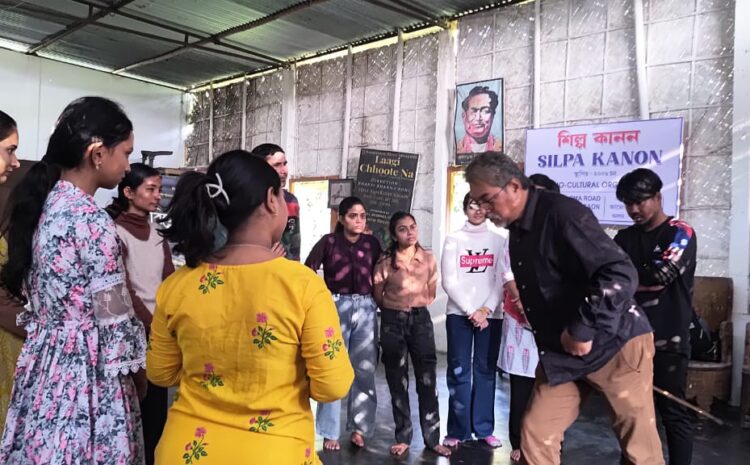
I first saw The Wild Duck by Henrik Ibsen when I was a first-year student at the National School of Drama. The play fascinated me deeply, though at that time I could not fully explain why. Its emotional depth and complex human relationships stayed with me over the years.I always dreamed of staging this play in the Assamese language. Although Satya Prasad Barua had translated it in 1961, the script is no longer available. As a result, I translated the play myself and planned this production to bring Ibsen’s work closer to Assamese audiences. This is a workshop production with mostly fresh and new students. Since The Wild Duck is a complicated and psychologically demanding play, I invited a few senior and experienced actors to be part of the production for guidance during the rehearsal process.
Group
Silpa Kanon, established in 2006, is a socio-cultural organization located in Amolapatty, Nagaon, Assam. The group has successfully staged about 40 plays including Jyotir Jolongar Emuthi, Ram Vijay (Ankia Nat), Charan Das Chor, Barshun, Jerengar Sati, Kajirangat Hahakar, Prem Bine Nahi Dharma Aan, Tadanta, Bidrohi Jona to name a few and many plays have participated in the state and National Drama Festivals of India. Another notable event of Silpa Kanon is the Bohag Bihu Husori event it organizes celebrated every year.