
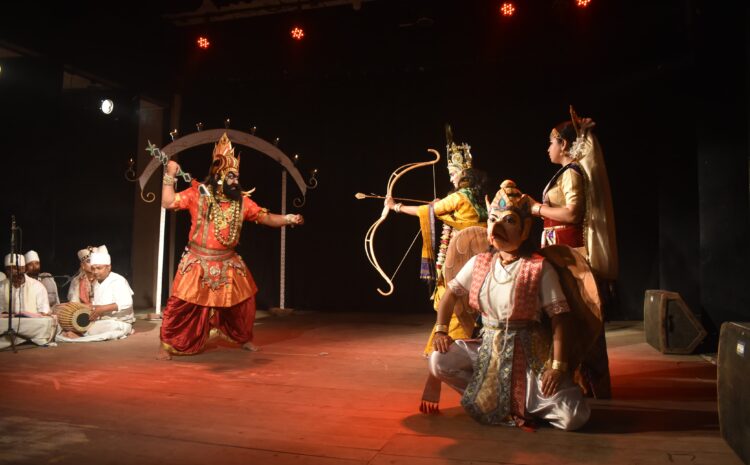
The performance opens with Gayan–Bayan, filling the space with devotion, followed by the Sutradhara’s introduction. Krishna appears with Rukmini and Satyabhama. When Satyabhama exits, Narada enters, describes the celestial Parijata flower, and offers it to Krishna, gently drawing Rukmini’s attention.
Soon, Indra arrives with his wife Sashi, pleading for Krishna’s help against Narakasura. Krishna promises to protect Heaven. Narada then playfully tells Satyabhama that Krishna has gifted the flower to Rukmini. Hurt and angry, she confronts Krishna, who consoles her by promising the entire Parijata tree. Her sorrow turns into joy.
Satyabhama insists on joining Krishna in battle. Narakasura is defeated, Bhagadatta is crowned King of Kamrupa, and Indra’s kingdom is restored. On their return, Satyabhama demands the Parijata tree. When Sashi refuses, Krishna and Satyabhama uproot it themselves. A conflict follows between Satyabhama and Sashi, and then between Krishna and Indra. Realizing Krishna’s divine supremacy, Indra repents and offers the tree and treasures.
Later, Satyabhama proudly shows the tree to Rukmini. Rukmini gently replies that with Krishna by her side, no heavenly gift could bring greater joy.
Director
Dr. Ruplekha Borbora Das is a Satriya dancer, choreographer, teacher, and researcher, currently serving as Assistant Professor of Satriya Dance at the Dr. Bhupen Hazarika Centre for Studies in Performing Arts, Dibrugarh University. She believes tradition survives only when it is lived, practiced, and passed on with sincerity.
Born in Dibrugarh to Late Jagannath Borbora and Mrs. Kumali Borbora, her artistic journey grew from cultural immersion into a lifelong dedication to Satriya dance, Ankiya Bhaona, and the philosophy of Srimanta Sankardeva. She shares her creative life with her husband, Mr. Dilip Chandra Das, an AIR B+ graded tabla artist.
She is a disciple of Guru Khireshwar Hazarika and Late Guru Rameshwar Khatoniar Borbayan, and received Bhaona training from Late Dr. Jagannath Mahanta, Haricharan Bhuyan Borbayan, Manik Borbayan, and Dr. Bhabananda Hazarika Borbayan.
Dr. Das holds Master’s degrees in Assamese Literature and Performing Arts, and a PhD on Sattriya Matiakhara based on Natyashastra. A Doordarshan B-grade artist, National Scholarship recipient, and Youth Festival awardee, she has guided nine students to CCRT scholarships.
In 2014, she founded Srimanta Nrityapith, nurturing Satriya Nritya, Khol, Ankiya Bhaona, folk, classical percussion, and creative dance with equal respect.
Director’s Note
In medieval India, Vaishnavism spread across many regions, and in Assam it found its most artistic and human voice through Srimanta Sankardeva, the pioneer of Neo-Vaishnavism. He chose to preach devotion not only through words, but through living art — music, movement, and drama. From this vision was born Ankiya Bhaona, the first set of scripted regional plays in India written in a regional language, created to spread Krishna Bhakti.
Parijat Haran, drawn from the Bhagavat Purana, Hari Vamsa, and Vishnu Purana, stands as Sankardeva’s dramatic masterpiece. Its dialogue is bold, its characters strikingly human, its plot finely developed, and its humour woven naturally into action. Though divine in setting, the emotions remain deeply human — desire, pride, surrender, grace, and longing.
Following the Natyashastra while enriching it with regional aesthetics, Sankardeva created a theatre where music, slokas, bhatimas, geets, dialogue, and dance merge into one expressive language. The Brajawali dialect gives this form its poetic rhythm and accessibility.
As a director, I approach Parijat Haran not as history, but as a living voice. Because Ankiya Bhaona is not only theatre — it is prayer that learned to speak to people. And if even one moment stays with you, Sankardeva’s voice has reached where it belongs: within you.
Group
Srimanta Nrityapith, established in 2014 in Dibrugarh, Assam, is a dedicated cultural and educational institution committed to delivering high-quality, comprehensive training in the performing arts. It offers structured theoretical and practical education in classical music and dance, traditional Assamese theatre, folk dances, and other indigenous art forms of the region.
Students of Srimanta Nrityapith have performed extensively, participating in numerous prestigious events both within Assam and across India, thereby gaining valuable stage experience and exposure.
The institution plays a particularly significant role in the revival and dissemination of classical Sattriya traditions as propagated by the Vaishnava saints Srimanta Sankardev and Madhavdev. This includes specialized training in Sattriya dance, Associated yoga practices, Traditional mask making (mukhā), Khol (percussion instrument) playing and the performance of Ankiya Bhaona (devotional one-act plays with music and dance).
Through its systematic curriculum, expert guidance, and focus on both artistic excellence and cultural rootedness, Srimanta Nrityapith maintains university level standards in discipline, pedagogy, performance quality, and cultural scholarship. It continues to inspire and shape the new generation, ensuring that Assam’s rich mythological, spiritual, and artistic legacy remains vibrant and relevant in contemporary times.