
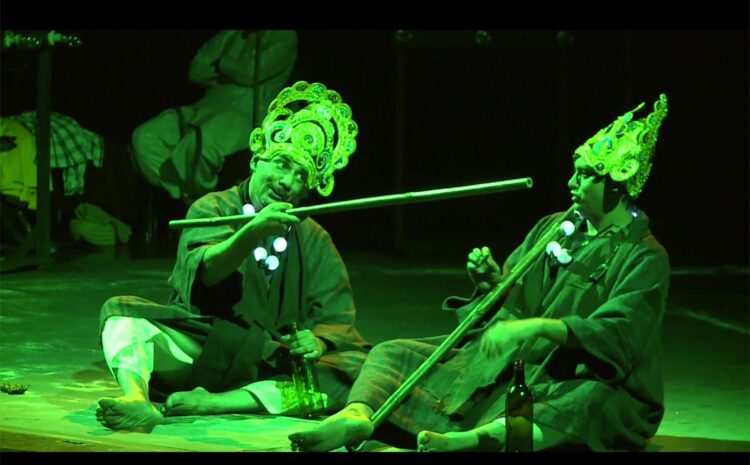
Kaumudi (Moonlight) – a play in Hindi – is about a rite of passage. Using the moonlit timeless night on which Krishna delivered knowledge to Arjuna as its central trope, it explores the dynamics between an estranged father-son duo who play Eklavya’s ghost and Abhimanyu respectively. Staged in a theatre in late 1960’s Allahabad, over three days – it acts as the last three performances of a great actor who has nearly lost his sight. The play brings to light the ghosts of caste-based injustices, the passing over of knowledge from a father to a son, a thespian to an upstart, the banality and beauty of art, and how an efficient mode of production ultimately replaces a lesser efficient mode. The play is inspired by two texts: Anand’s Malayalam Novel Vyasam Vigneswaram, and Jorge Luis Borges’ essay Blindness.
Director :
Abhishek Majumdar is a Bangalore-based playwright, theatre director, teacher, and actor who writes in English, Hindi, and Bangla. His early plays include Pratidwandi (adapted from Sunil Gangopadhyay), Niharika, and Lucknow ’76. His major awarded works include Harlesden High Street (Hindu Metro Plus Playwright’s Award), An Arrangement of Shoes (TFA Writer’s Award), The Djinns of Eidgah (Royal Court Theatre residency), A Small Small World, Afterlife of Birds, Waterlines, Gasha (META Awards 2013), Rizwaan, and Thook. His plays have been staged across India, the UK, Europe, USA, and Bangladesh, and several are published by Oberon Books and Penguin India. Abhishek has been part of the Royal Court International Playwrights’ Residency and is a recipient of the Inlaks and Charles Wallace scholarships. He has taught theatre at leading institutions including NSD, FTII, IIM Bangalore, NYU Abu Dhabi, and other prominent educational and cultural organisations.
Director’s Note
Kaumudi – using the “moonlit timeless night” when Krishna delivers his sermon to Arjuna as its central trope – explores the dynamics between an estranged father-son duo who play Eklavya’s ghost and Abhimanyu respectively, in a theatre, in late 1960’s Allahabad. The father, Satyasheel, who is a great actor and has almost lost his sight, is at his final three performances. Thus son, Paritosh, who grew up with the void of not having a father by his side, has come to challenge not only the father but also his entire school of thought. Kaumudi is hinged on three central questions: Whose life is more valuable, an older or a younger person’s? Is personal ethic more important than public ethic? Does art have a function, and do we make art or does art make us? It also holds up a mirror to it and questions theatre: Does theatre have a meaning or is it our ego being massaged? Whose theatre is it – that of the audience or of the practitioner?
Group :
D for Drama was formed in 2013 by Kumud Mishra & Ghanshyam Lalsa. Unlike traditional theatre groups where writers and directors invite actors to act with them, D for Drama’s vision is to collaborate with a plethora of different writers and directors, creating unique works of theatre each time these efforts come together.