
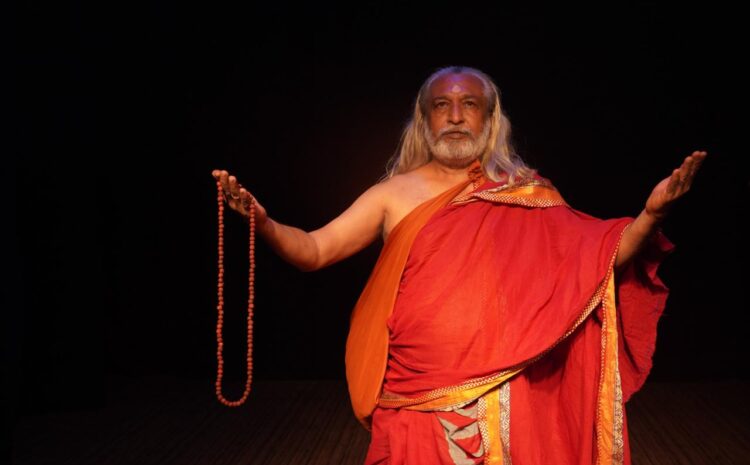
The play is set amid the ruins of medieval Matiyaburj, where various characters take shelter to escape a storm. The central incident revolves around a feudal lord, his wife, and a bandit (Tajomaru). The feudal lord has been murdered and his wife has been dishonoured, but there are four different perspectives on these events: that of the bandit, the wife, the dead feudal lord (speaking through a medium), and a woodcutter who claims to have witnessed everything. Each character’s account differs from the others. The bandit claims that he killed the feudal lord, while the wife presents herself as the victim. The dead feudal lord asserts that he committed suicide. The woodcutter says that all three of them are lying. The ruins of Matiyaburj symbolize the moral decay of society, where truth is elusive and every individual is flawed.
Writer
Author Ramesh Chandra Shah was born on November 15, 1937, in Almora, Uttarakhand. His novels are Gobhar Ganesh, Utkal Ghulam, Pooja Par, Chak Par Ganesh, and Swanayak for which he received the Sahitya Akademi Award in 2014.
Director
Jayant Deshmukh began his journey in theatre in 1971 in Raipur, Chhattisgarh. From 1982 to 1995, he was a regular member of the Bharat Bhavan Rangmandal, Bhopal. He has worked with renowned theatre directors from India and abroad, including B. V. Karanth, Barry John, Fritz Bennewitz, E. Warwa, Peter Brook, Irshad Panjatan, Habib Tanvir, Ratan Thiyam, Bansi Kaul, Alkanandan, Robin Das, K. N. Panikkar, Badal Sircar, among others. He founded his own organization, Ekrang, in Bhopal. He has directed several plays like Nat Samrat, Surya Ki Antim Kiran Se Pehli Kiran Tak, Mrityunjay, Adhe Adhure, Jis Lahore Nai Dekhya, Sakubai, Skandagupt, Sakharam Binder, Ek Madhur Prem Kahani Urf Pagla Ghoda, Mariyaburj, Andher Nagri, Maya Maha Thagni, etc. He has worked extensively as a designer in films and television. He has been honoured with the Chhattisgarh Government’s art award “Chakradhar Samman.”
Director’s Note
This is the story of three individuals who each consider themselves guilty of the murder. We see the events in flashback, presenting both truth and falsehood side by side. Akira Kurosawa wrote in his autobiography, “Human beings are incapable of being honest with themselves; they cannot talk about themselves without embellishment.” This play is based on the story of the film Rashomon, which Dr. Ramesh Chandra Shah adapted into a script for the Bharat Bhavan Rangmandal at the request of late Shri B. V. Karanth. I have presented this Japanese tale in an Indian context. The “Rashomon Gate” here is Matiyaburj, where a monk, a woodcutter, and a wigmaker discuss the incident, while on the other side the incident unfolds. For me, it has been a gratifying realization that we should even doubt what we believe we have seen.
Group
Ekrang was established by Shri Jayant Deshmukh in 1990 in Bhopal, Madhya Pradesh. Since then, the group has continuously experimented with theatre and successfully staged plays such as Mrityunjay (Hindi and Marathi), Maya Mahathagini, Skandagupt, Latak Malcolm, Andher Nagri, Chaupat Raja, Nyay Dekho Nyay, Surya Ki Antim Kiran Se Pehli Kiran Tak, and others. Later, in Mumbai, under the banner of “Ekrang Theatre Group,” productions such as Govinda, @Khajuraho, Sakubai, Nat Samrat, Ek Madhur Prem Kahani Urf Pagla Ghoda, and Matiyaburj were staged. The group’s productions have been presented at renowned festivals across the country.