
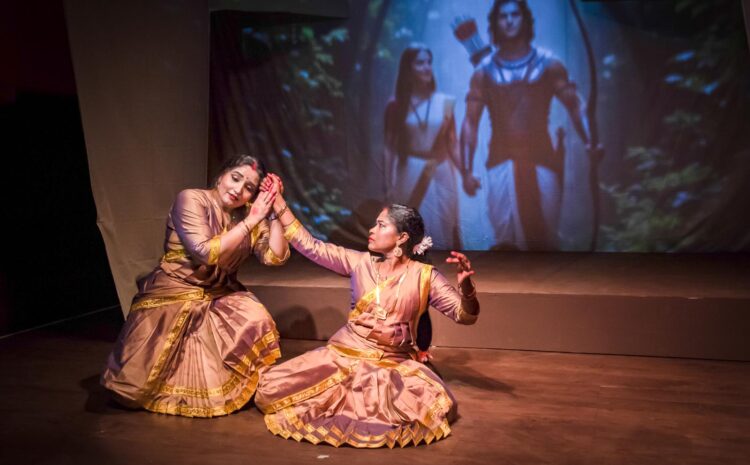
This is not a play but a long poem, written by Nand Kishore Acharya. Panchali, a mythological character, has been portrayed in many ways. When this poem was first recited, the scenes automatically unfolded before our eyes. That’s when we decided that we should stage this play.
Panchali says that she was merely an object of consumption and use. Even after so much time has passed, the condition of women remains the same. In her final journey, Panchali introspects and asks herself burning questions, the same questions that stand before the modern woman of today like enigmatic riddles. In fact, Panchali’s questions are the questions of today’s woman.
This performance is an attempt in that direction.
Writer
Born in Bikaner in 1945, Nand Kishore Acharya, after retiring from Rampuria College, Bikaner, worked as a guest writer at Mahatma Gandhi International Hindi University, developing and teaching a course on non-violence and peace, and edited the ‘Encyclopedia of Non-Violence’ for Prakrit Bharati Academy, Jaipur. Currently, he is working as a ‘Professor of Eminence’ at the Humanities Center of IIT Hyderabad. A prolific writer in many genres, Mr. Acharya has been honored with numerous awards including the Meera Award, Bihari Award, Bhubaneswar Award, Rajasthan Sangeet Natak Akademi Award, Naresh Mehta Smriti Samman, etc.
In the words of Agyeya, Nand Kishore Acharya, the “unique poet of the beauty of the desert,”‘s poetic journey is a quest for water in the desert, for love in interpersonal relationships, for free choice in God, and for nuances of meaning in words. And in this process, he invents and makes possible those possibilities even where they did not exist. In this sense, his poetry is hermeneutic poetry, where an interplay of object and image, content and metaphor is created, which makes possible a completely new and different poetic process – a new and different epistemology. Even his poems that appear to be love poems are a unique discourse in which the act of love and the act of meaning-making explore each other, revealing numerous implications.
Director
Born in 1959, Prof. Suresh Sharma completed his education in Lucknow. After obtaining diplomas in acting from the ‘Bhartendu Natya Akademi’ and the ‘National School of Drama’, he began working as a freelance theatre artist with the ‘Sambhav Group’ in Delhi. In 1985-86, he undertook a fellowship on the folk theatre of Uttar Pradesh, ‘Nautanki’, under the guidance of Ms. Gulab Bai and Mudrarakshas. Later, he established a non-governmental theatre group in Mandi, Himachal Pradesh. Soon, he expanded it into a full-fledged residential theatre training academy.
An experienced translator, director, and actor, Prof. Suresh Sharma translated Stanislavski’s book ‘Stanislavski System’ into Hindi as ‘Abhinay ke Siddhant’ (Principles of Acting). Prof. Sharma has served as the Artistic Director of the ‘Shri Ram Centre for Performing Arts’. He worked as the head of the ‘National School of Drama Repertory Company’ from 1999 to 2021. Subsequently, he served as the Director of the ‘National School of Drama’ for three years. From 2021 to 2023, he was the Director of the ‘North Central Zone Cultural Centre, Prayagraj’. During this period, he also held the charge of the ‘South Central Zone Cultural Centre, Nagpur’.
He was awarded the ‘Uttar Pradesh Sangeet Natak Akademi Award’ in 2019 for his commendable work. And in 2021, he was honored by the ‘Central Sangeet Natak Akademi, New Delhi’. In addition, he has also been honored with several other prestigious awards in the country. He has directed more than 50 plays and acted in more than 70 plays.
Director’s Note
This is not a play, but a long poem, written by Nandkishore Acharya. Panchali, a mythological character, has been portrayed in many ways. When I first read this poem, the scenes automatically unfolded before my eyes. That’s when I decided that we should stage this play.
Panchali says that she was merely an object of consumption and use. Even after so much time has passed, the condition of women remains the same. In her final journey, Panchali introspects and asks herself burning questions, the same questions that stand before the women of today’s modern era like enigmatic riddles. In fact, Panchali’s questions are the questions of today’s women. This performance is an attempt in that direction.
Group
The ‘Himachal Cultural Research Institute and Repertory’ was established in 1989. Since then, it has been continuously active. This repertory has made a significant contribution to promoting the theatre movement throughout Himachal Pradesh.
This is the only non-governmental repertory in North India that has been conducting a one-year full-time residential training program for the past 27 years. Students from all over India come to participate in this program.
The institute has its own well-developed campus: auditorium, mess, library, hostel, classrooms, etc. In addition to all this, the institute also has its own publishing house.