
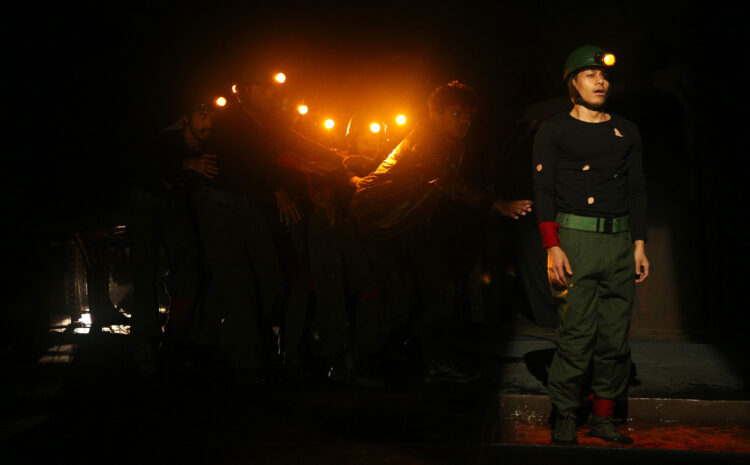
Shabdangal deeply portrays the human inner world, the impact of words, and the protagonist’s identity crisis. Although the protagonist lives amidst society, the sounds he hears – people’s words, judgments, noise, and echoes of memories – slowly shatters him from within. These sounds give rise to haunting questions: “Who am I?” and “What is the meaning of my existence?” He becomes trapped in an intense conflict between the identity imposed on him by society and his true self. When the protagonist tries to speak, words misrepresent him; when he remains silent, his very existence is forgotten. Caught in this dilemma, his identity crisis deepens. He is unable to find himself either in words or in silence, eventually reaching a state where he loses himself in both. In the play, sounds are used as symbols of social pressure, expectations, and judgment. This inner conflict within the protagonist reflects the existential crisis of the modern human being. The play conveys that a person’s real identity does not lie in external noise, but in the silence within.
Writer
Vaikom Muhammad Basheer (1908–1994) was a legendary Malayalam writer known for his simple, lyrical, and deeply human stories. He wrote about ordinary people, love, poverty, freedom, and compassion with gentle humour. His famous works include Balyakalasakhi, Pathummayude Aadu, and Ntuppuppakkoranendarnnu.
Director
Salma Dandin is theatre practitioner from Kalas village in Karnataka. She studied at Ninasam theatre institute and NSD, and has worked with many theatre groups. She has directed plays like Nagamandal, The House of Bernarda Alba, The Trial to name a few.
Director’s Note
Shabdangal, written with a deep sensitivity to spoken and unspoken language, forms the core of my physical approach. The writer’s words act as impulses rather than explanations. I translated the text into movement, rhythm, and spatial tension. The body becomes the primary storyteller, carrying the writer’s intent. Silence and pauses amplify the written word through physical presence. The play explores how language lives inside the body before it is spoken. Actors engage with the text physically, not psychologically alone. This method honours the writer by expanding the text beyond speech. Meaning emerges through action, breath, and collective energy. Thus, Shabdangal exists between writing, movement, and lived experience.
Group
This is a presentation of the Graduate Performance Wing of the National School of Drama. Its objective is to provide a platform to emerging artists to present their work to a wider audience.