
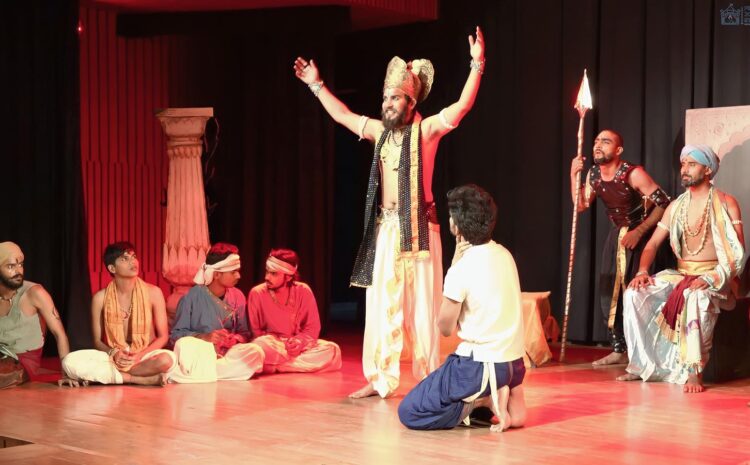
Raja ki Rasoi is a thought-provoking production, written by late. Dr Mohan Maharishi based on a fictional legend. Exhibiting a royal coronation ceremony of a ‘Yuvraj’, it proceeds to debate on several contemporary issues through various situations. Through the dilemma of a royal cook, Pakanak, the playwright had brought into focus the decaying moral ethics, especially in governance, when upholders of the law become tormentors of submissive people. Pakanak is worried about serving fresh meat to the crowned King as meat suppliers remained busy in festivities. Provoked by the dire urgency and fear of execution, the cook ends up murdering an innocent brahmin and cooking his meat for the new king. But it compounds his problems as the king then asked the cook to serve him with the same meat daily.
Writer:
Mohan Maharishi was a prominent figure in Indian theatre, renowned for his contributions as a director, playwright, and academic. Maharishi’s work often delves into socially relevant themes, exploring complex issues with a keen eye for detail and a deep understanding of human psychology.
Director:
Neeraj Singh Rawat, has received a national scholarship for theatre from Ministry Of Culture, Govt. Of India, and has worked as a summer workshop director for Sahitya Kala Parishad, Govt. of Delhi. he has directed many other plays like Til ka Taad, look Back in Anger, Ande ke Chilke, Hawalaat to name a few. He has conducted workshops in many schools and colleges and worked as an actor with Rummy Circle, Discovery+, PTC Punjabi, D.D National, D.D Bharat, D.D IGNOU and many TVC.
Director’s Note
This production treats the “royal kitchen” as a metaphor for the state — where policies are cooked, hierarchies stir the pot, and truth is sacrificed for spectacle. We use satire, choreographed movement, and sharp vocal patterns to expose the ridiculous seriousness of power. No realism. No glorification. Just honest theatre peeling the hypocrisy beneath authority. The stage remains mostly bare — because power thrives not on resources, but on perception. Props are symbolic: empty utensils, oversized ladles, royal drapes hiding moral emptiness. The performers shift from citizens to courtiers to critics, revealing how quickly people bend to power when offered titles instead of justice.
My intent is simple: to force the audience to confront the systems they silently enable.
If they walk out feeling “this is not just theatre, it is us”, the play succeeds.
Group:
Performers journey studio was started in 2017 as a collaborative space for trained theatre professionals. The members include actors, directors, designers, and teachers, and produce devised theatre, classical plays, and contemporary stories.