
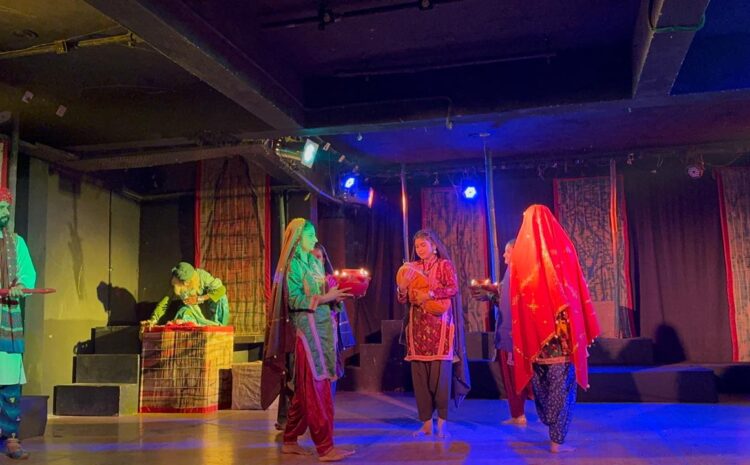
‘Sandal Baar’ is the tragedy of the natives, who were displaced by the British government to give land to their backers. The British government displaced, these who were blessed by God, enjoying their ancestors, eating, drinking, and living their lives on the banks of rivers, by claiming they had no proof of ownership of the land.
In the undivided Punjab, there was a fertile area between the sandalwood, the Ravi river and the paddy fields, covered with dense forests. In these forest areas lived tribal people who raised herds of camels, buffaloes, cows, horses and sheep and goats. They were called ‘Janglis’ as they lived in the forests. The ancestors of these foresters are said to have migrated from the deserts. It was also said that they had batted against the armies of Alexander. There was no religious fanaticism among these foresters – the, gods and goddesses, saints and prophets and rituals were all common here. Foresters living on this land, the creation of nature, these foresters lived at the will of God. A sudden storm struck their centuries-old peaceful life and these wild animals were forever lost to their forests, rivers and jungles. To find out how and why this devastation happened to the wild animals, we will have to visit Sandalbar and re-grow the forests by planting trees of memories.
The tragedy of the natives of ‘Sandal Bar’ gives a glimpse of the fate of minorities in today’s minority India. When the British government, after occupying India, asks for proof of land ownership from the natives, living there for centuries, in order to grab their land, it seems this is not the case of the past, but of today as well. ‘Sandal Bar’ also makes us realize the tragedy of man, which he has suffered in name of civilization and industrialization.
Director
Born on 7 October 1964 in Amritsar, Shri Kewal Dhaliwal is one of the most influential theatre directors in contemporary Indian theatre and a key figure in the development of Punjabi theatre. A graduate of the National School of Drama with specialization in design and direction, he has dedicated his career to artistic creation as well as the training of young theatre practitioners across Punjab. Currently serving as the Chairman of the Punjab Sangeet Natak Akademi, Shri Dhaliwal has directed more than 150 theatrical productions and has also acted in numerous plays. His work is marked by experimentation and depth, drawing inspiration from the poetry of Surjit Paatar, Pash, and Hasham, as well as the visual art of masters such as Van Gogh, Dali, and Munch. He has designed sets, lighting, and costumes for over seventy major productions, including works by Mohan Rakesh, Federico García Lorca, Shiv Kumar Batalvi, Eugene O’Neill, Shakespeare, and Dostoyevski. A prolific theatre writer, he has authored several books for children and adults, with his play collection Natrang included in the M.A. Punjabi syllabus at Jammu University. Through extensive national and international workshops and festivals organized by his group Manch Rangmanch, Shri Dhaliwal has made a lasting contribution to Indian theatre, earning numerous prestigious national honours.
Director’s Note
‘Sandal Baar’ is the tragedy of the natives, who were displaced by the British government to give land to their backers. The British government, who were blessed by God, enjoying their ancestors, eating, drinking, and living their lives on the banks of rivers, displaced them by saying that they had no proof of ownership of the land.
In the undivided Punjab, there was a fertile area between the sandalwood, the Ravi river and the paddy fields, covered with dense forests. In these forest areas lived tribal people who raised herds of camels, buffaloes, cows, horses and sheep and goats. They were called ‘Janglis’ because they lived in the forests. The ancestors of the Janglis were said to have come from the deserts. It was also said that they had fought against the armies of Alexander. There was no religious fanaticism among these Janglis – here, gods and goddesses, saints and prophets and rituals were all common. These Janglis, living on this land, the creation of nature, lived in the will of God. A sudden storm struck their centuries-old peaceful life and these wild animals were forever lost to their forests, rivers and jungles. To find out how and why this devastation happened to the wild animals, we will have to go to Sandalbar and re-grow the forests by planting trees of memories.
The tragedy of the natives of ‘Sandal Bar’ gives a glimpse of the fate of today’s minority Indians. When the British government, after occupying India, asks for proof of land ownership from the natives who have been living there for centuries in order to grab their land, it seems that these things are not of the past but of today as well. ‘Sandal Bar’ also makes us realize the tragedy of man, which he has suffered due to civilization and industrialization.
Group
Manch-Rangmanch, founded in September 1991 by Kewal Dhaliwal, is a prominent cultural action organization dedicated to social awareness and transformation through theatre. Established with the aim of addressing social evils and supporting people’s movements, it functions as both a creative platform and a resource centre for mass awareness, blending artistic practice with strong social responsibility. The group promotes quality Punjabi theatre by integrating traditional performance forms with modern theatrical techniques, ensuring that its productions remain socially relevant and meaningful. Recognized as one of the most dynamic cultural spaces in North India, Manch-Rangmanch is equipped with strong infrastructure and skilled human resources capable of hosting national and international theatre events. It serves as a creative hub for artists, writers, intellectuals, and children, encouraging collaboration, research, experimentation, and imaginative expression. Emerging during a period of intense social and political crisis in Punjab, the group played a crucial role in carrying theatre to interior regions, spreading messages of peace, brotherhood, and democratic values. With around forty associated artists, Manch-Rangmanch has staged nearly 250 plays in India and abroad, performing in countries across Europe, North America, and South Asia. The organization conducts regular workshops, hosts annual theatre festivals, and operates from its own Rangmanch Bhawan, firmly establishing itself as a leading institution in Punjabi theatre.