
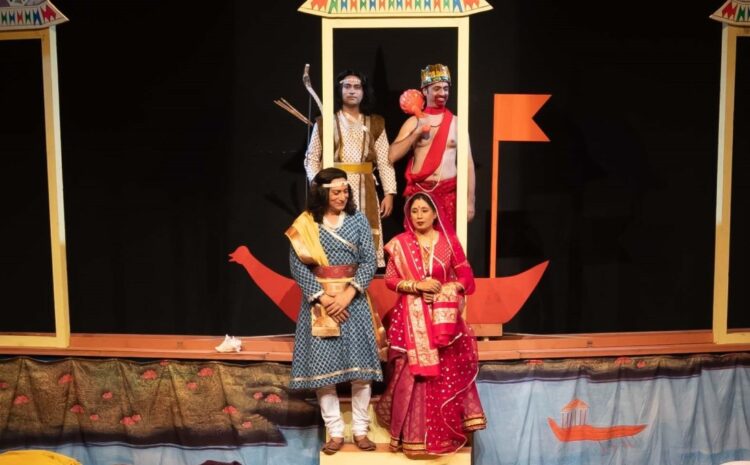
This iconic play, in a retelling of Uttar Ramayan, the banishment of Sita, explores the complexities of love, duty, and justice. The pain of Sita’s banishment, her search for her liberation and her children’s quest for identity leads to a most dramatic climax in Ram’s Darbar. With live music and dance, painted curtains and magnificent props, it is a fresh take on this theatre classic, blending elements of Parsi drama with a modern twist.
Writer
Mohamad Shah aka Agha Mohammad Shah Banarsi aka Agha Hashar Kashmiri was a poet, playwright, and dramatist par-excellence. He wrote scores of plays, songs for plays and films and later the ‘scenarios’ (the screenplays) for dozens of films. He was also a director of many of his plays. He based many of his plays on Shakespeare’s classics but also dipped into Indian and Persian mythology for the plots of his plays. He at times wrote predominantly in Hindi, as well as in Sanskrit language.
Director
Atul Tiwari is a multifaceted artist – a playwright, director, scriptwriter, and actor. Trained at the National School of Drama and Berliner Ensemble, Atul has worked in various capacities, from theatre to film. Atul’s scripts have been featured in numerous award-winning films, including Yeh Woh Manzil To Nahin, Dharavi, Mission Kashmir, and Vishwaroop. He has acted in films like Akrosh, 3 Idiots, and PK. Atul has also created immersive experience museums, known as “Anubhuti Sangrahalaya”, in several cities across India.
Director’s Note
Goswami Tulasi Das, the poet who brought the story of ‘Ramayan’ – originally written in Sanskrit by Rishi Valmiki – to Hindi in his re-telling, created an epic that has been a best seller in the world for 200 years. Tulasi himself says,
“Ram had many myriad manifestations,
and Ramayan, a thousand distinct narrations!”
Staging Sita Banbas today is very topical and important. Today, where Lord Ram is in every heart, and on every lip, and every ‘agenda,’ sometimes we tend to forget Sita, though her devotion, dignity and dedication is the ultimate sacrifice that a woman can do towards her spouse. Also, in these times it is important to look at the story of Ram and Sita from all the angles, and only after having this 360-degree view, can we understand the import of the multifaceted-intricate relationship that Ram-Sita had between themselves. While in theproduction I have sought to blend traditional Parsi theatre styles with modern tools, aiming to evoke laughter, tears, and reflection, by re-examining the Ramayan through a feminist lens, I have also sought to provide a thought-provoking experienceto consider the complexities of the epic tale.
Group
Ank, a Hindi Theatre group based in Mumbai, has completed 49 years of regular theatre activity in Hindiwith morethan 7500successful shows of 88 quality plays all overthe countryas wellas overseas, making it one of thelargest performingteams inHindi inthe country. The groupwas created by Dinesh Thakur who continued to bring a unique vision to theatre.Ank’s repetoire hasrun the entire gamut from originalworks inHindi tothe best in national andinternational theatre, and across genres. The groupnowunder thestewardship ofPreeta Mathur Thakur, organize a number of Theatre festivals in collaboration with local Theatre Groups at Bhopal, Jabalpur, Jodhpur, Jaipur, Dehradun, Bikaner, Bhilwara, Ajmer, Ranchi, Amritsar, Delhi and Agra, produce children’s plays and even Shakespeare in English along with continuously seeking new horizons of growth through original writing, new formats and different directors.