
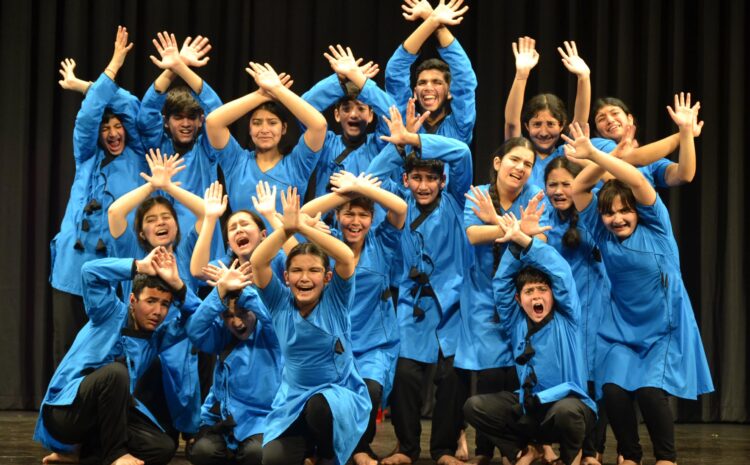
The play Aap Hamare Hain Kaun jolts parents, educationists, and guardians out of their deep reverie of materialism, consumerism, and unbridled ambition. It urges elders to pause, look around, and confront the emotional and moral chaos they themselves have created in the pursuit of personal aspirations and social prestige. Parents often see their children as extensions of their own unfulfilled dreams, forcing them into rigid stereotypes and, in the process, extinguishing the bountiful charm, curiosity, and individuality inherent in them.
In the relentless race to turn children into doctors, engineers, lawyers, or civil servants, they are subjected to subtle and overt forms of cruelty – emotional pressure, comparison, and denial of choice. Gradually, children turn mechanical, reduced to exam-scoring machines, with little time or freedom to discover their true selves.
The prevailing education system, further complicated by the advent of AI and technology-driven learning, adds insult to injury. Creativity is scuttled, critical thinking is stifled, and values are sidelined in favor of performance and productivity. As a result, children grow up disconnected from empathy, purpose, and self-awareness.
The play powerfully addresses these contemporary challenges faced by the younger generation – pressures imposed not by enemies, but by their own loved ones and immediate surroundings – making it both a mirror to society and a call for introspection and change.
Director
Born in 1960, Balwant Thakur is among India’s most visionary and influential theatre directors, credited with redefining contemporary Indian theatre through path-breaking creativity and innovation. Honoured with the Sangeet Natak Akademi Award for Theatre Direction, he is regarded as the youngest Indian director to have participated in over 300 national theatre festivals and to have conceptualized and directed more than 6,000 cultural events, a record unmatched in the country. Popularly known as the “Magic Man of Theatre,” his visually powerful productions such as Ghumayee, Bawa Jitto, Suno Eh Kahani, Chauraha, Mata Ki Kahani, and Mahabhoj transformed the theatre landscape of North India and brought Dogri theatre to national and international prominence.
In 1983, he founded Natrang, a pioneering cultural institution that has emerged as one of India’s finest professionally managed theatre organizations, running repertory theatre, children’s theatre, folk and tribal wings, theatre-in-education programmes, and music and dance repertories. His contribution to children’s theatre is equally revolutionary, with landmark productions like Aap Hamare Hain Kaun, Mere Hisse Ki Dhoop Kahan Hai, and Bhag Beta Bhag gaining nationwide acclaim.
As a playwright, he has authored 27 original plays, making a significant contribution to post-Independence Indian theatre. His landmark initiative “Theatre for Social Change” brought transformative cultural engagement to border and remote villages of Jammu & Kashmir. His creative excellence has been recognized through numerous national and international honours, including the Padma Shri (2013), Sanskriti Award, Tagore Sammaan, Maharaja Gulab Singh Memorial Award, and several lifetime achievement awards.
Beyond theatre, Balwant Thakur has served as Secretary, J&K Academy of Art, Culture and Languages, Regional Director, ICCR, and Cultural Ambassador of India to South Africa and Mauritius. A widely travelled cultural ambassador, he has represented Indian theatre in over 100 international cities, making him one of the most globally visible voices of Indian performing arts.
Director’s Note
Although Natrang has been engaged with children’s theatre since 1990, this production marked a turning point-a conscious departure from inherited models of theatre-making and a bold step toward reimagining what theatre for and with children could truly be.
We came to recognize a fundamental contradiction at the heart of children’s theatre practice: children were often being asked to inhabit theatrical forms, training methods, and textual structures originally conceived for adults. Such approaches, however well-intentioned, overlook the distinct physicality, emotional rhythms, imagination, and cognitive landscapes of childhood. Theatre designed about children was being mistaken for theatre created from within their world.
This realization compelled us to question prevailing conventions. Why should children carry the weight of dense texts, abstract themes, and rigid performance vocabularies far removed from their lived realities? Why not allow their instincts, playfulness, curiosity, and intuitive intelligence to shape the theatrical language itself?
Aap Humare Hai Kaun emerged from this inquiry. The process was not one of instruction but of exploration. We consciously dismantled established hierarchies and methodologies, choosing instead an evolutionary, participatory approach – one that treated children as co-creators rather than performers in training. Improvisation, play, movement, and collective imagination became our primary tools, enabling a theatrical form that grew organically from the children’s own sensibilities.
The journey was challenging, exhilarating, and deeply transformative. Every participant – child and adult alike – became an active contributor to a shared creative ecology. The joy of discovery replaced the pressure of performance, and theatre reclaimed its most elemental function: play with purpose.
Today, Aap Humare Hai Kaun stands as more than a production. With over 300 performances across the country, it has become a living testament to an alternative vision of children’s theatre – one rooted in respect, collaboration, and innovation. The children who formed the first batch in 1994 are now accomplished actors and practitioners, carrying forward this ethos into Indian theatre and cinema.
In many ways, the play has evolved into an institution – not because it repeats itself, but because it continues to affirm a belief: when children are trusted as creators, theatre renews itself.
Group
Natrang is the first full-time professional cultural institution of Jammu & Kashmir, established in 1983 by eminent theatre personality Balwant Thakur. Registered as a non-profit organization, Natrang has emerged as one of India’s leading performing arts institutions, with over 450 new productions and 7,600+ performances to its credit, and participation in more than 250 national and international festivals over the last four decades.
Headquartered in Jammu, Natrang operates from its own fully equipped Studio Theatre, library, and resource centre, and runs multiple wings including the Theatre Repertory Company, Children Theatre, Rural Theatre, Music and Dance Repertory, Mega Events Wing, Sunday Theatre, Theatre Laboratory, Documentation Centre, Extension Programmes, and Scholarship Programmes. The repertory company has presented acclaimed productions such as Bawa Jitto, Ghumayee, Mahabhoj, and Andhon Ka Haathi, and has represented India at international festivals in countries including Russia, Germany, UK, Italy, Thailand, and UAE.
Natrang pioneered Children Theatre in Jammu in 1990 and has trained over 10,000 children, reaching students across India through performances and Theatre-in-Education initiatives. Its Rural Theatre Wing actively engages communities in remote areas through socially relevant productions in regional languages.
The organization is also renowned for producing large-scale mega cultural events involving hundreds of artists, drawing audiences of over 20,000 per show. With a strong focus on training, documentation, and cultural preservation, Natrang continues to play a vital role in promoting the rich artistic heritage of Jammu & Kashmir at national and global platforms.