
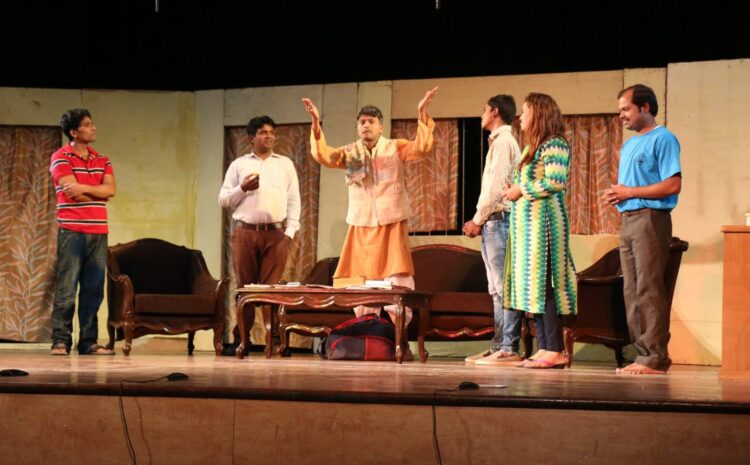
Gobardhan, the beloved son of the village headman, comes to Delhi from a village in Bihar after completing his B.A., hoping that his brother-in-law, who holds a high-ranking position in Delhi, will help him get a good job through connections or money. He even cites examples of others who have obtained jobs in this way. However, his father and experienced brother-in-law recognize his potential and encourage him to become an entrepreneur. Ultimately, Gobardhan becomes a successful entrepreneur and announces his intention to establish a business in his village.
Director
Dr. Mahendra Prasad Singh, the founder of Rangshree and editor of Vibhor, the only irregular journal of world Bhojpuri theatre, is a renowned Bhojpuri playwright, actor, and theatre director. He has written 11 full-length plays in Bhojpuri and 3 in Hindi, 7 short plays/one-act plays, and 18 street plays, of which four Bhojpuri plays – Birju Ke Biyah, Kachot, Basmatiya Chaur, and Babua Gobardhan – have been published after numerous performances. ‘Birju Ke Biyah’ and ‘Basmatiya Chaur’ are taught at the undergraduate level in several universities in Bihar, and “Kachot” is taught at the postgraduate level.
He has received several national and international awards from various voluntary literary and cultural organizations for his work in playwriting, direction, acting, and performance.
Dr. Singh is a ‘B High Grade’ artist of All India Radio and is recognized as a theatre guru under the Guru-Shishya tradition by the Ministry of Culture, Government of India, and the ICCR.
He has conducted and presented more than five hundred theatre workshops in 9 states of India and in Mauritius, and has given more than 1000 street theatre performances. He was born on July 31, 1952, in Chandi (Narhi), a village in Bhojpur (Bihar). He inherited his acting skills from his mother, the late Jonha Devi, and his elder brother, Dr. Nagendra Prasad Singh.
Dr. Mahendra Prasad Singh has served as an expert for NCERT on the role of folk theater in language teaching and for UNICEF, Bihar, on the role of drama in behavioral change communication and developing interpersonal skills. At the invitation of the Bhojpuri Speaking Union, Ministry of Arts and Culture, Republic of Mauritius, and with the support of ICCR, he conducted a 21-day training program (August 3, 2017 to August 23, 2017) for various theater groups, schools/colleges, and folk music troupes to strengthen Bhojpuri theater there.
Director’s Note
Graduates like Gobardhan, who aspire to get a job through money and connections, can be found in every household today. This play subtly conveys a message to all young people: don’t just be degree holders, but become competent and hone your skills. Become job creators instead of job seekers.
This is only possible when the inherent talents of every young person are recognized and they are motivated to receive appropriate training. This play inspires all young people towards entrepreneurship. Today, it is essential that this play be staged in all schools and colleges across the country to instill an entrepreneurial spirit in young people.
Group
Rangshree was established in 1978 in Bokaro Steel City, the steel city of undivided Bihar (now Jharkhand), and in 1994 in Delhi, the capital of India, under the leadership of Mr. Mahendra Prasad Singh. Its objective is to strengthen Bhojpuri theater, enrich Bhojpuri dramatic literature, and create awareness among the public about various social issues and inconsistencies through theatrical performances, seminars, lectures, etc. Since its inception, the organization has continuously strived to awaken public awareness regarding literature, social issues, education, economics, health, and other areas through plays, lectures, seminars, training programs, and workshops.
The organization has been organizing a five-day Bhojpuri theatre festival in Delhi and other regions since 2013.
The organization has staged contemporary plays in Bhojpuri, Hindi, Urdu, and English in 9 states of the country. In 2010, the organization formed 10 folk theatre groups of Dalit women in Bhojpur district of Bihar and trained them in the *Domkach* theatre performance, making it a means of income generation.
For social behavior change, the organization developed street plays on various issues for UNICEF Bihar and other government and non-governmental organizations, and trained hundreds of artists. In addition, the organization trained 574 block coordinators in Bihar, teaching them how to effectively use theatre as a communication tool. With the support of the National School of Drama, the organization presented the play Babua Gobardhan in Hindi in Assam and Arunachal Pradesh.