
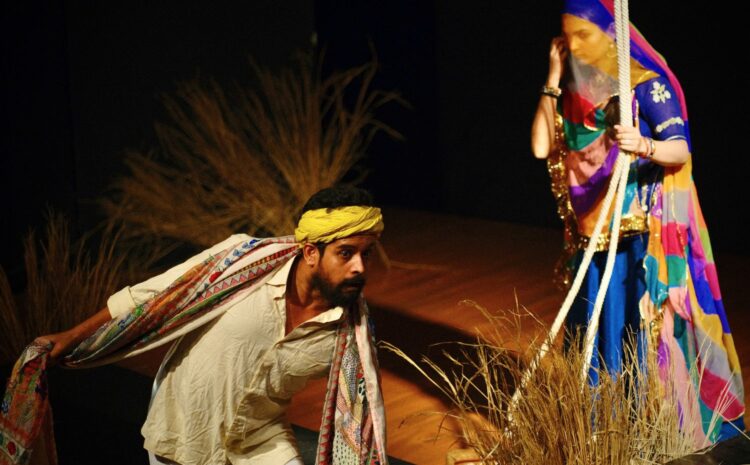
Desert Bloom opens on a starkly real note – women labouring relentlessly in the desert, while a young girl quietly experiences her first menstruation. Saroj, a spirited young girl befriends a Behrupia, breaking through the unspoken boundaries of her conservative surroundings. At the village well, a group of paniharins (water-bearing women) await the arrival of Lajwanti. When Lajwanti finally arrives, her veil reaches down to her navel — a symbol of modesty and restraint. As they move towards the well, the women sing and dance, briefly liberating themselves by removing their veils. All except Lajwanti, who stubbornly refuses. Out of curiosity, they lift her veil themselves and are struck by her beauty, prompting an uneasy conversation about female desire, vanity, and freedom. Their attention shifts to the Kabootarwala. His distant presence becomes the object of fascination hinting at their repressed longing. Saroj secretly replaces her school book with an adult novel, awakening new sensations and curiosities. The next day when she visits Behrupia during his rehearsals, a casual touch between them stirs new emotions. Their innocent connection is soon discovered by the village women and Lajwanti (Saroj’s sister-in-law) becomes the target of gossip. Defiant, Lajwanti vows to fetch water alone, declaring that a woman who means no harm has nothing to fear. Days later, she meets the Kabootarwala, who does not even look at her. Accustomed to admiration, his indifference unsettles her. The next day when she lifts her veil before him, he is momentarily captivated but remains detached. That night, she dreams of him. The next morning, she subtly probes Saroj about the Kabootarwala. Further, Behrupia enacts the mythological story of Ahilya and lord Indra’s deceit and Maharishi Gautam cursing Ahilya. In the performance, Saroj plays Ahilya, with Behrupia placing a veil over her. The act deeply disturbs Lajwanti who removes her veil. Later, she asks Saroj to take her to the Kabootarwala’s birdhouse where Lajwanti confronts the man, only to realize that his world revolves solely around his pigeons. Saroj pleads to her mother of her innocence. Behrupia reveals that the villagers, offended by his performance, had attacked him and burned his ancestral book and props. They reflect on the nature of their world – a desert where tenderness finds no place. Lajwanti overhears them. At the well, she meets the Kabootarwala again. After knowing that he plans to reunite with his female pigeon she challenges him, asking why he visits her if his devotion lies elsewhere. In the final moments, the women gather at the well as they always do. Lajwanti joins them, wipes her face, and, in a quiet gesture of emancipation, removes her veil.
Director:
Mahadev Singh Lakhawat is a National School of Drama alumnus who has directed plays like D-class, Aladdin in Mumbai, Kala Khatta, An evening with Chekhov, Muavze and others. His writing works include Muktibodh, Yaaro ka Tamasha, Main Bhi Bachhan & many more.
Director’s Note
I grew up in a small village Rendri in Pali district of Rajasthan. From childhood, I saw women living behind the ghoonghat, their identities hidden, their silences normalized. At the National School of Drama, I encountered new worlds of thought and practice and started questioning not only the social systems I grew up in but also the masculinity I had internalized — my anger, my entitlement, my unquestioned acceptance of things as they were. When I first read Vijaydan Detha’s Lajvanti, I remembered hundreds of women I had seen in ghoonghats without ever truly knowing who they were, what they looked like, or what they dreamed of, including some of my closest aunts. The story awakened something long dormant in me. I knew that staging this work could not just be about words; it had to be about human beings on stage, about presence, about something lived. Desert Bloom is an exploration of a small yet radical idea: the acknowledgment of women’s desires. Not their suppression, but their expression. To recognize them not as threats but as truths, and perhaps even as celebrations.