
Ghasiram Kotwal by Vijay Tendulkar is a powerful political satire that uses historical context to critique contemporary issues of power, corruption, and social injustice. The play, set in 18th century Pune under the Peshwa rule, follows the rise and fall of Ghasiram. The play begins with an invocation to lord Ganesha but we are presenting Ghasiram Kotwal in this era. The Brahmins of Pune introduce themselves and we can see the morally corrupt state-of-affairs in Pune. Nana Phadnavis, Diwan (Chief Secretary) of Pune, is also corrupt and visits a Lavani dancer. When he is ill-treated by the People of Pune, seeking revenge, Ghasiram barters his own daughter Lalita Gauri to get the post of Kotwal (police chief) of Pune from Nana. He begins to enforce strict rules in the city. When the commoners come to Nana with a complaint, he dismisses them & is deeply indulged with Gauri who becomes pregnant by Nana and dies during childbirth. Nana gets her body thrown in the river. He convinces Ghasiram that the title he enjoys is only because of his patronage. The situation goes out of hand when a few brahmins visitors to the city are put in jail, and die from suffocation in the custody. The Brahmins of Pune then complains to the Peshwa. Nana uses Ghasiram as a pawn, only to discard him in end reminding us that while times change, the core issues of systemic abuse, corruption, and the commodification of individuals for power remain alarmingly persistent.
Writer
Vijay Tendulkar (1928 – 2008) was a prominent Indian playwright, movie and television writer, literary essayist, political journalist, and social commentator, primarily writing in Marathi. His notable plays include Shantata! Court Chalu Aahe (1967), Ghashiram Kotwal (1972), and Sakharam Binder (1972). He was honoured with prestigious awards such as the Padma Bhushan in 1984, the highest Sangeet Natak Akademi Fellowship in 1998, and the National Film Award for Best Screenplay for the Hindi film Manthan in 1977.
Translator
Prof. Vasant Deo (1929–1996) was an Indian writer, lyricist, screenwriter, and Hindi academic who collaborated with notable directors like Shyam Benegal, Govind Nihalani, and Mahesh Bhatt. He wrote plays and poetry in Marathi and worked on translations from Marathi to Hindi. He received the National Film Award for Best Lyrics for the film Saaransh (1984) and the Filmfare Award for Best Lyricist for “Mann Kyun Behka” for the film Utsav (1984). His translation work included Sanskrit hymns from the Rigveda for the television serial Bharat Ek Khoj (Discovery of India) directed by Shyam Benegal.
Director : Abhijit Panse / Bhalchandra Kubal
Director’s Note
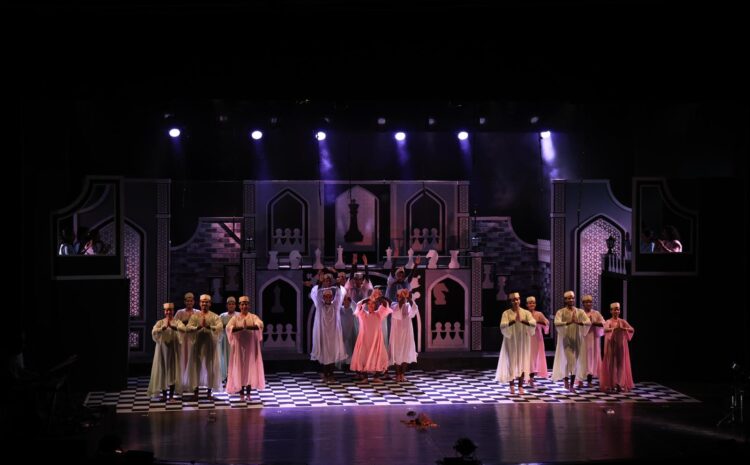
Essence of the directorial by Abhijit Panse & Bhalchandra Kubal presents Ghasiram Kotwal as a grand musical that explores power, politics, and moral decay during the Peshwa era in 18th-century Pune. The director rhetorically asks, “Was Ghasiram the first authoritarian to rule Pune? Was he the last? Why did America re-elect Trump?” suggesting that the play reflects recurring cycles of oppression and complicity across eras. Artistic Approach by both directors emphasizes that the production preserves the play’s strong musical and folk roots, featuring Maharashtra’s traditional dances like Lavani, kirtan, and Qawwali, as well as music composed by Mandar Deshpande. The visual design draws inspiration from Shaniwarwada and the grandeur of Chess board with pawns, aiming to immerse audiences in the historical setting while underscoring themes of corruption and abuse of power.
Group
Ravan Future Productions Pvt Ltd stages productions replete in innovative staging, use of music, folk dance (like Lavani), and ensemble choral narration revolutionized Indian experimental theatre.