
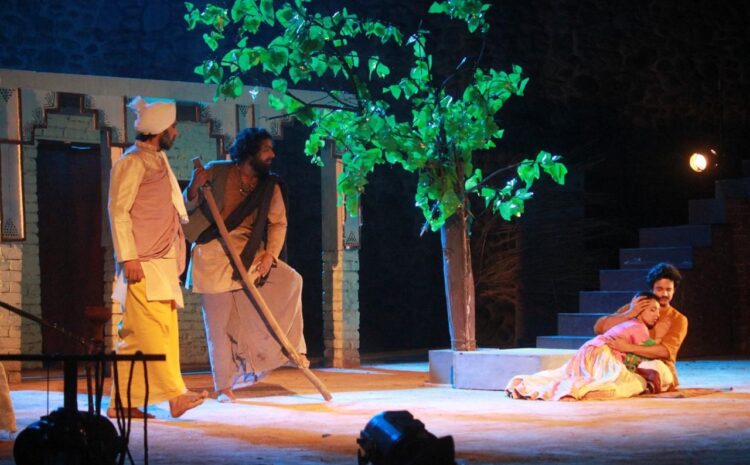
Heer Ranjha pays homage to the heritage of Punjab as well as those who love truly. Only lovers who break the barriers of society’s customs, castes and other challenges know what a furnace is like. This play presents a vivid picture of the feudal society of the 14th century and the social, economic, religious, and cultural conditions of Punjab at that time. Heer is a young woman and Ranjha is eager to be the love of her life. Both are ignorant and indifferent to the other side of society. This becomes a mountain of troubles for them. Kaidon (Heer’s uncle) becomes the biggest enemy of Heer and Ranjha’s love and manipulates the entire society. Heer’s parents and Ranjha’s brothers also fail to maintain their relationships honestly by being subject to this social system. Heer is forcibly married to Sayyed Kheda. The Qazi forcibly performs Heer’s marriage with Sayyed which she refuses to accept this marriage. Ranjha becomes a yogi in Heer’s absence and goes to meet her at her in-laws’ house. Saidaan (Heer’s sister-in-law) realizes Heer’s spiritual love for Ranjha and she tries her best to reunite the two. With the decision of the family, Heer’s marriage with Ranjha is fixed and but she is sent away after making her eat poisoned laddoos. While going to Takht Hazare in a doli, Heer dies. Seeing her dead, Ranjha also collapses there. The love of both is not worldly but spiritual. Even today, thousands of people come and worship at their shrines.
Writer
Ekam Maanuke, born in village Manuke, district Moga, Punjab is a poet, lyricist, script writer, music composer, and vocalist. He has worked with Zee Punjabi as creative writer and has written songs and have sung in various Punjabi and Hindi albums, and movies. He has written two dramas Heer Ranjha and Sohni Mahiwal performed by the students of Indian Theatre department, Panjab University, Chandigarh.
Director
Dr. Navdeep Kaur, has been working as the Chairperson of the Department of Indian Theatre at Panjab University, Chandigarh since a decade. Her productions have been staged in various National & International festivals. She is a recipient of various National awards and fellowships. She is the Founder Director of Natya Griham – A cultural forum for Research and Creativity.
Director’s Note
Heer Ranjha is a theatrical reflection where the timeless spirit of our roots finds its resonance in the pulse of today. The play draws inspiration from the poetic world of Waris Shah’s Heer. As a female director, I see Heer not just as a character, but as a voice – a woman who questioned, loved, and existed beyond her time. I see her silence and her strength as a mirror to the women of every era, including our own. The production blends folk and live music, using traditional instruments and folk melodies that echo the essence of our land. For me, the essence of Heer Ranjha lies in how culture is not just remembered but relived through the modern generation. When we allow our roots to speak through our contemporary selves, we do not just preserve tradition – we expand it.
Group
Department Of Indian Theatre, Punjab University, Chandigarh was set up in 1972. The Department of Indian Theatre is committed to the development of its students as well-rounded creative human beings and to nurture a close-knit community of intellectually curious and artistically daring theatre practitioners by educating its students within a broad liberal arts framework in the discipline of theatre.