
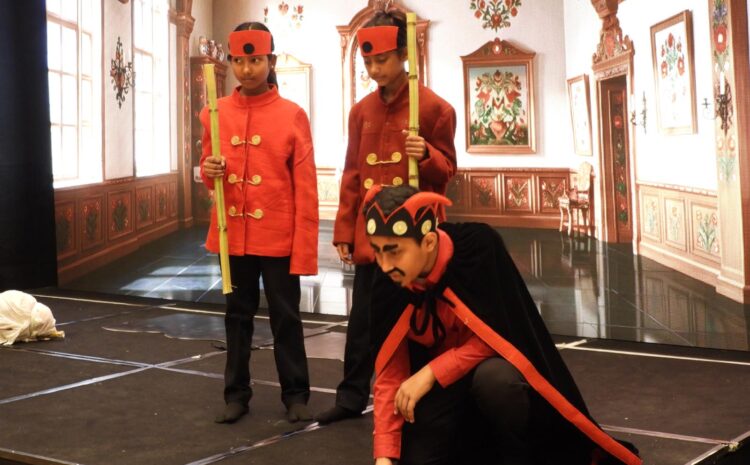
Hungarian Folk Tales is a vibrant theatrical tapestry weaving three timeless tales of courage and transformation. Directed by Vikrant Singh and envisioned by Mariann Erdő, the performance explores the universal struggle between shadow and light through the eyes of resilient heroes.
The journey begins with The Green Bearded King, where Prince János is gambled away to the King of Devils. To win his freedom, János must survive three impossible trials in the underworld, ultimately escaping the realm of shadows with the help of a magic ring and the Devil’s own daughter.
The narrative shifts to the ethereal world of Ribike, a girl cursed into the form of a lizard and banished to the deep forest. To break the spell, the young Prince Miklós must navigate royal trials with the aid of a magical spider and a dwarf. In a final act of faith in the forest, he shatters the nun’s vengeful curse, restoring Ribike to her human form.
The finale features the Sky-High Beanstalk, following a poor boy who trades a cow for a shimmering bean. He climbs into the heavens to outwit a Seven-Headed Dragon and reclaim a magical hen that lays golden eggs. By felling the giant plant, he secures his family’s future, proving that bravery and wit can conquer even the most monstrous of foes.
Director :
Vikrant Singh is a distinguished Indian actor, drama teacher, and Theatre-in-Education specialist with over 23 years of experience. He has worked extensively with schools, colleges, and NGOs, focusing on children with diverse needs, including those with physical disabilities, HIV, underprivileged backgrounds, and special needs. His pedagogy emphasizes theatre games, improvisation, and dramatics, prioritizing confidence-building and emotional growth over performance. As the creative architect of the Manch Project, Singh transforms complex Hungarian legends into engaging, high-energy stage productions for under-resourced children. The project is supported by the vision of Mariann Erdő, Director of the Liszt Institute – Hungarian Cultural Centre Delhi, who has played a key role in strengthening Indo-Hungarian cultural ties. Beyond education, Singh is an accomplished performer with over 150 stage productions and appearances in more than 10 Bollywood and a Tamil film.
Director’s Note
In my drama classes, what I enjoy the most is witnessing how the magic happens. My approach has always been rooted in the belief that theatre games and improvisations are powerful tools for self-discovery, especially for those with diverse backgrounds and special needs.
In the MANCH Project, we set out to bridge the vibrant spirit of Indian youth with the timeless wisdom of Hungarian folklore. These children did not memorize lines; they improvised and navigated the underworld with Prince János, felt the resilience of Ribike, and climbed to the heavens with the beanstalk. Through these stories, they have discovered their own creative agency, built immense confidence, and learned that storytelling is a universal language.
This production is a celebration of their growth and the raw, unfiltered energy they bring to the stage. It has been an honor to guide them from students into storytellers. I invite you to see the world through their eyes— a world where every challenge is an opportunity for a hero to rise.
Group :
The MANCH Project is a collaborative theatre initiative envisioned by Mariann Erdő, Director of the Liszt Institute – Hungarian Cultural Centre Delhi, in partnership with Director Vikrant Singh along with MIMA NGO. This project serves as a bridge between Hungarian heritage and local social development, using the performing arts as a transformative tool for youth.
The production is brought to life by a dedicated ensemble of 22 under-resourced children, aged 10 to 14, from the MIMA NGO, R.K. Puram. These young performers participated in an intensive six-week workshop designed to foster child development, confidence, and emotional wellness.
The performance is a celebration of the children’s growth and resilience. By retelling classic Hungarian folk tales, like Ribike and Giant Bean Stalk, the kids demonstrate their ability to cross cultural and linguistic barriers. The production showcases that the stage is a powerful platform for personal and community empowerment.