
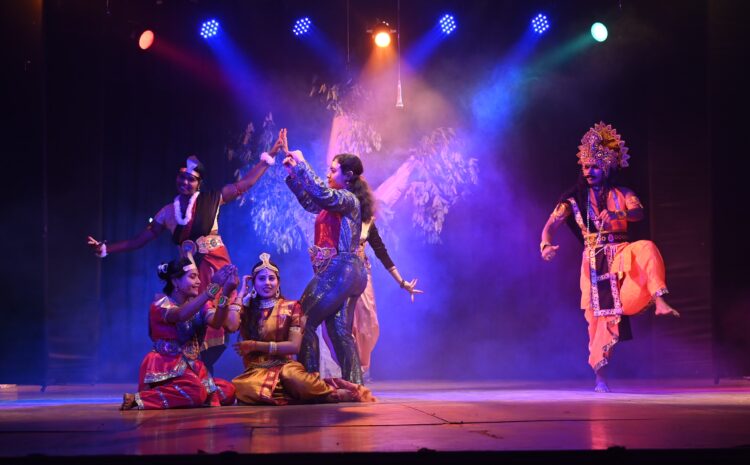
Jāti Jīvanam, is a Sanskrit play by Pandit Gobinda Mishra inspired by an episode from the Mahābhārata that highlights sacrifice, destiny, and the preservation of dharma.
The play revolves around Vāsuki, the king of the serpents, whose race faces annihilation during King Janamejaya’s great serpent sacrifice (Sarpa Satra). In a desperate attempt to save his clan, Vāsuki recalls an ancient prophecy foretelling that a son born to his sister Jaratkārū and the sage Jaratkārū would one day be the saviour of the Nāgas. Despite her ascetic life, Vāsuki’s sister consents to marry the sage for the higher cause of protecting her people and the clan is saved altimately. The play explores themes of self-sacrifice, destiny, and the triumph of wisdom over vengeance.
Director :
Chittaranjan Satpathy is a distinguished theatre director, playwright, actor, and mime artist whose practice is rooted in the classical principles of Indian dramaturgy-Natyashastra while engaging contemporary performance aesthetics. Born in Rourkela, Odisha, his association with theatre began early and has evolved into a lifelong artistic pursuit. He holds a postgraduate degree in Management and a Diploma in Natya Shastra from the Central Sanskrit University, Bhopal.
A Senior Fellowship Awardee of the Ministry of Culture, Government of India, Chittaranjan Satpathy has conceptualized, directed, and performed in critically recognized productions including Jayadev – Sri Gitagovinda, Chandrabhaga, and Bhishm: Ek Atmamanthan. He has the grace of paitispating in Bharat Rang Mahotsav, National School of Drama, New Delhi.
Chittaranjan Satpathy’s artistic repertoire extends across theatre, film, television, and national cultural exchange initiatives. As the founder of the Sanskrit Theatre Festival “Dasharupakam,” he has played a pivotal role in revitalizing Sanskrit performance traditions. He continues to make a significant contribution to the preservation, advancement, and global resonance of classical principles Indian theatre and its presentation.
Director’s Note
“Jāti Jīvanam” – is more than a retelling of a Mahābhārata episode; it is a timeless reflection on sacrifice, duty, and the collective spirit of survival. In Pandit Gobinda Mishra’s evocative rendering, the story of Vāsuki’s sister Jaratkārū, who willingly abandons her ascetic life to marry a sage and ensure the preservation of her clan, transcends myth to become a profound statement on selfless service and the continuity of dharma.
As a director, I have sought to present this play as a mirror to our times – when the survival of humanity often depends on the courage of a few who act for the welfare of all. The characters, drawn from divine and mortal realms alike, embody eternal values: sacrifice without expectation, wisdom that conquers vengeance, and compassion that redeems destruction. In staging Jāti Jīvanam, we have attempted to blend the grace of Sanskrit theatre with a contemporary sensibility – where the lyrical speech, expressive movement, and symbolic visual design invite the audience into a dialogue between the past and the present. This play reminds us that every generation must safeguard its moral lineage just as Jaratkārū safeguarded her race…
Group :
The CATCH, Odisha is dedicated to promoting moral values and fostering a healthier social environment through the medium of performing arts. We believe that theatre, music, and folk culture serve as powerful instruments for communicating meaningful messages, often leaving a stronger impact than conventional academic learning.
We celebrate cultural luminaries who have enriched our language, literature, and heritage, while also creating platforms such as competitions and local festivals to engage the younger generation.
At present, we have also undertaken the propagation of Sanskrit through theatre, enabling the general public to appreciate the language and realize the richness of the scientific knowledge preserved in the Vedas and Upanishads. Therefore, we organize a three-day Sanskrit Theatre Festival every year, where distinguished Sanskrit scholars and laureates deliberate on various aspects of this ancient language.