
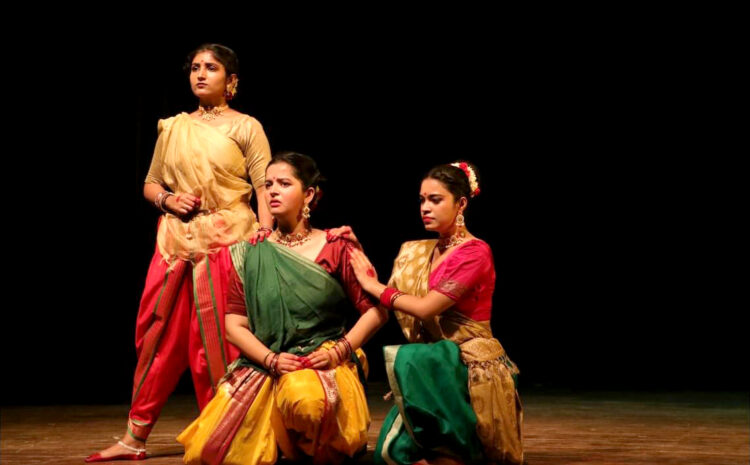
The omnipresent Sita, who has been honoured by various names such as Vaidehi, Maithili, Bhoomija, Raghav Vallabha, Janaknandini, and many others, her life narratives from the epic Ramayana, are widely known amongst the people. From her birth until her marriage, Sita lived in the city of Mithila. After her marriage, she never returned to Mithila, nor does Mithila ever call her daughter back.
In the present narrative of this play, Sita has returned among her friends. Seeing their friend Sita, the companions sometimes become emotional and at other times tease her. They wish to verify the rumours and hearsay by directly asking Sita. Today, Janaknandini speaks fearlessly, expressing everything she was never able to say before. She unfolds all the bitter and sweet layers of her life, yet she never truly distances herself from her husband, Raghav. Although she is upset, yet remains bound to him by the thread of love.
Janaknandini is not a silent though a restrained contemporary narrative of our daughters. Even today, they are married off to men through whom they seek their ‘completeness.’ Separating from their parental home, women seek only affection, companionship, and trust from their beloved husbands. With the strength of her husband’s affectionate support, she overcomes hardships, sorrow, fear, stress, and insecurity. But a husband’s suspicion and mistrust break her—just as it once broke Janaknandini. Then no one stand by them even today—not the Janak-like father, Maithil-like relatives, Kaushalya-like mother-in-law, Lakshman-like brother-in-law, and nor the Ayodhya-like society. What then should she do? Janaknandini is the portrayal of the silent resonance of the anguish of daughters as represented by Sita.
Director
Dr. Prakash Jha is a known theatre practitioner and researcher who has played a pioneering role in expanding and establishing the Maithili language and culture in the national capital Delhi. He has been honoured with several awards, including the ‘Bihar Samman’ in 2015 by the Department of Art, Culture, and Language, Government of Delhi. He is the Founder Director of Mailorang Repertory and Prakashan. He is a Ph.D. in Dramatic Arts and has received the Junior and Senior Research Fellowships from the Ministry of Culture, Government of India. Currently he is pursuing a D.Litt. Several of his books in Maithili have been published. His play Vibhajan Ki Vibhishika was translated and staged in all official languages of India by the Ministry of Culture, Government of India. He is credited with the first staging of historic Maithili plays such as Goraksh Vijay, Manimanjari, and Sundar Sanyog.
Director’s Note
Sita has always fascinated the global society as a mysterious female character. For the people of Mithila, she is their sister and daughter. As Maithil, In the minds of her younger brothers including me, reside thousands of unanswered questions we wish to ask our sister, Sita. These questions are expressions of a brother’s love and anger—emotions that also reside within me and which I have attempted to express through Janaknandini. Through the play, I have found an opportunity to confront our society. The inner anguish of Janaknandini is most powerfully expressed when she speaks for herself. Hence, it was decided that Janaknandini on stage would be played by five actresses, to identify with all women. Presenting one’s story through another brings a sense of fulfilment. In performance, efforts were made to balance expression between classical and modern styles. Costumes, music, and design was evolved to reflect the essence of Mithila. Light design has been kept subtle to evolve a visually enchanting experience. Stage design remains minimal—like a simple garden platform. Watching the play many questions will arise within you, many misconceptions will dissolve hoping our perspective towards Janaknandini (s) will surely change—this itself may be the true achievement of theatre.
Group
Maithili Lok Rang known as Mailorang Repertory, Delhi, was established in 2006. Its primary objective is the research, preservation, promotion, training, dissemination, and documentation of intangible cultural heritage and diverse cultural traditions, including Mithila paintings, theatre arts, and associated arts and artisans. Mailorang’s stage productions have made their presence felt in various theatre festivals of Indian cities and have participated in many festivals in Nepal as well. Some of its major plays include Kathak Lok, Ek Chhal Raja, Kamalmukhi Kaniya, Kosi San Bedardi Jag Me Koi Nai, Jal Damru Baje, Panch Patra, Vilaap, Mukti Parv, Bada Natakiya Kaun, Bhrashtachar Ya Sadachar, Romeo–Juliet / Chan Chakor, Maithil Nari: Char Rang, Amli, Aab Mani Jau, Ekadashi, Domkach, Jat-Jatin, Dhurttasamgam, Chainpur Ki Dastan to name a few.