
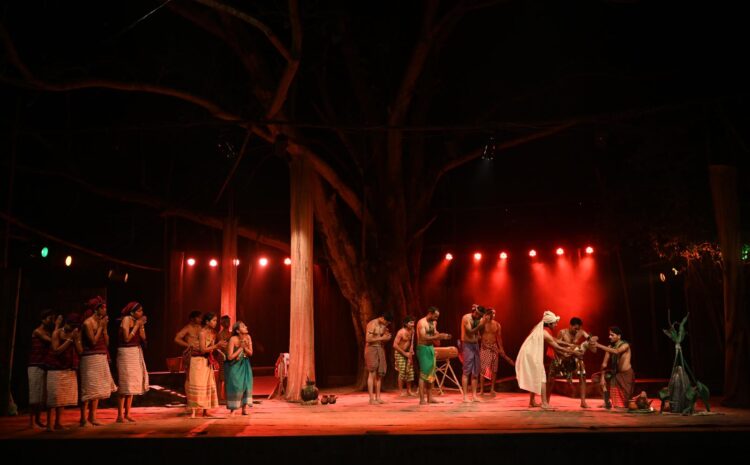
The play Jeth Rangreni (Sansa) is a folk-based play rooted deeply in the indigenous life and language, the spiritual worldview, ritualistic beliefs, and traditional cultural systems of the Rabha community seen through the lens of Baikho Puja. Set during the month of Jeth, the time of fertility, the play portrays how the Rabha people connect nature, community, and the divine through ritual performance. Folk songs, traditional dance, rhythmic movements, chants, and symbolic actions are used as primary theatrical tools, allowing the stage to transform into a living ritual space rather than a conventional narrative structure. The performance highlights the worship of Aaya Baikho and other spiritual forces believed to protect crops, ensure abundance & maintain harmony between humans and nature. The play is not merely a retelling of a ritual but an attempt to revive ancestral memory and celebrate indigenous knowledge systems.
Director
Pabitra Rabha, born in Tangla, Assam, is an alumnus of National school of Drama. His organization DAPON-The Mirror actively work to enhance the socio-cultural aspects of theatre in the region. He has directed and choreographed several plays in languages and dialects like Assamese, Nagamese, Aao, Garo, Kok-borok, Hindi, Kannada, Bengali, Rabha and Bodo. He has worked in various capacities like actor, and designer for Stage Lighting, Sets, Property, Mask making, Make-up & costumes in many plays. As a musician his music album, “The Rhythm of Bordoichila” encompasses the traditional folk performances of the native region. He has established a village, Amar Gaon, a project based on ‘Theatre & Vocational Training for Dwarf,’ open for all creative dwarves and young Artistes.
Directors Note
This production seeks to return to the primal roots of Rabha civilization and to a time when the belief was inseparable from nature; and ritual was a lived experience rather than performance. At the heart of the play lies Baikho Puja, performed by the Rabha community. The Rabhas venerate Aaya Baikho, a sacred stone—formless, silent, and powerful. The performers do not ‘act’ rituals but inhabit them, allowing the stage to transform into a sacred space of invocation and remembrance. By presenting Rabha heritage on a national platform, especially with the students of the NSD Sikkim Centre I aim to initiate dialogue about indigenous knowledge systems, alternate spiritual practices, and a theatre rooted in community memory.
Group
The Sikkim Centre is the first centre established by NSD outside Delhi in the year 2011 offers a one-year residential certificate course in Dramatic Arts. The Centre established a Repertory Company in 2012 which has staged noteworthy productions in many national theatre festivals.