
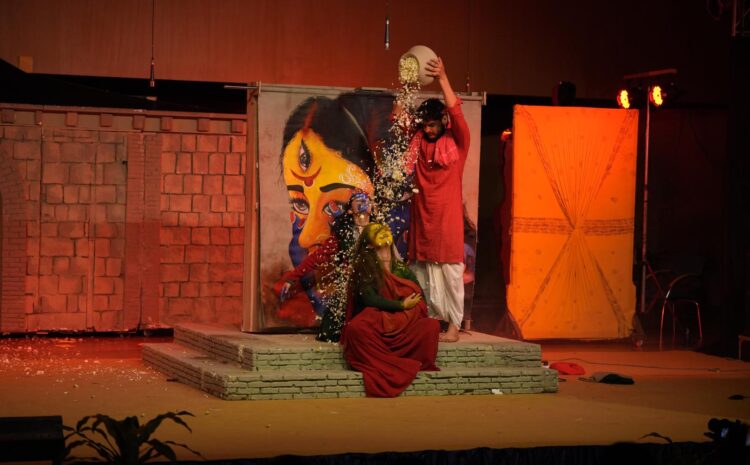
Kaal-Roopam is a profound and mysterious story, based on real events that took place in Etawah district of Uttar Pradesh in 1985. The play accurately portrays the concept of transmigration of souls and presents a narrative of a mother’s extraordinary love and the unique experience of motherhood.
The protagonist, Sumitra Singh, is an ordinary woman, declared dead by doctors. But after some time, a stranger’s soul enters Sumitra’s body. This soul belongs to Shiva Tripathi, who previously lived in the same district and lost her life in a tragic accident.
The central theme of this play is that motherhood is not merely a physical or biological relationship; rather, it is a profound, spiritual, and eternal bond. The play depicts a mother’s love that transcends the boundaries of the physical world and defies logic and reason. Even after death, a mother’s love persists; she strives to fulfill her responsibilities, even if she faces impossible challenges.
Kaal-Roopam makes it clear that motherhood and a mother’s love are immortal, transcending death and time. What situations do arise while Shiva’s soul inhabits Sumitra’s body? Does she succeed in reaching her children? Can love and motherhood truly transcend boundaries? This play grapples with these very questions and exposes the audience to deep psychological and emotional aspects.
Writer
Kuldeep Kunal is a significant figure in contemporary Hindi theatre, whose writings have a powerful presence in both stage and screen mediums. He began his theatrical journey approximately twenty-five years ago with the Haryana Gyan Vigyan Samiti, Rohtak, and since then, he has pursued writing as both his passion and profession. Plays, written by Kuldeep Kunal have been performed in India as well as on international stages. His plays have had the privilege of being staged at prestigious theatre events such as the Bogotá International Festival in Colombia, Colors of India in Mauritius, and the National School of Drama’s Bharat Rang Mahotsav (2010 and 2014).
His major original works include Eklavya Uvach, Key of Darkness, King of Tragedy, Majnu Lausment, Kaal Roopam, Che-As Reference, The Land Weaver, Killer Versus Comedian, Knock It Down, Kissa Peru Simon, Prem Satat Hai, Kyunki Main Ghulam Thi, Katha Ashok, Karma-Chakra, Kalank, Kissa Roop-Kanwar, Jhalkari, Reh Jayega Dhai Aakhar, Akka Amoli, Kasima, Gauhatya, Poorna, Plastic Money, Kalikh, Uncivilized Daughters, and Bharat Milap. He has also done notable theatrical adaptations of classic literary works such as George Orwell’s satirical novel Animal Farm, William Shakespeare’s A Midsummer Night’s Dream and The Merchant of Venice, and August Strindberg’s ‘A Dream Play.’
His works in the field of translation include Rabindranath Tagore’s Rather Rashi and Bratya Basu’s Seventeen July. His acclaimed play Eklavya Uvach has been translated and staged in Kannada, Assamese, English, and Bengali languages. A poet at heart, Kunal’s works consistently addresses questions of social justice, human dignity, and the meaning of life. Currently, he is busy with film writing and direction.
Director
With over 23 years of experience in theatre and performing arts, Kashish Devgan (K.D.) is a versatile and accomplished director, actor, choreographer, lyricist, and rapper. He has directed 22 full-length plays and over 16 short plays, choreographed more than 30 musical theatre productions, and contributed as an assistant director to 9 plays.
His major original works include King of Tragedy, Knock It Down, Kissa Peru Simon, Kalikh, Kalank, Key of Darkness, Kyunki Main Ghulam Thi, Kissa Vyah Da, Naldai, Kings of Tragedy, Karna Bharam, King of Pop, Karuna Mayi – Sindhu Tai Kamli, Katha Ashok, Samadhi Sarp, Karma Chakra, Katha Jhalkari, Kasima, Kanwar, Kaal Roopam, and Kaju Katli.
His work has received widespread recognition, and he has been awarded over 28 national awards in theatre by the Association of Indian Universities (AIU), along with a national award in dance. He has been the ‘State Champion’ in theatre three times in Haryana and twice in Punjab. His productions have been staged across almost all of India and have also received special recognition at international theatre festivals, reflecting his powerful artistic vision and indelible contribution to contemporary theatre.
Director’s Note
Kaal-Roopam is not just a theatrical performance, but a profound experience, unfolding between time, consciousness, and motherhood. Inspired by real events that took place in Etawah district of Uttar Pradesh in 1985, this play, through the concept of transmigration of souls, unveils a love that transcends the boundaries of body and demise.
The central theme of this play is motherhood – an emotion not limited to biological relationships mere, instead is spiritual, sensitive, and eternal. The soul of Shiva Tripathi, residing in the body of Sumitra Singh, symbolizes that a mother’s love does not cease its responsibilities even after the death. She makes every possible effort to reach her children, no matter how impossible the path may be.
Kaal-Roopam is a play of emotion and feeling rather than of logic and reason. It engages the audience with questions rather than answers – Is love dependent on the body? Can motherhood transcend time and death? And can consciousness fulfill its relationships in another form? Through this performance, my aim is to take the audience to a realm where a mother’s love is immortal – bound neither by time nor death, but only by dedication and consciousness.
Group
Chandigarh University (CU) is one of India’s leading educational institutions, known for its academic quality and professional excellence. The university has received an A+ grade from the National Assessment and Accreditation Council (NAAC), becoming the first private educational institution to achieve this feat in such a short time. The university has been ranked among the top 20 universities in India by the National Institutional Ranking Framework (NIRF) and has also gained global recognition in the Quacquarelli Symonds Asia and Quacquarelli Global rankings. CU continuously inspires its students to become responsible citizens academically, culturally and socially. The Department of Art and Cultural Affairs (DACA) aims to foster the creative potential of students through art and culture. This department preserves various forms of human expression and provides students with opportunities to showcase their talent. The Department of Art and Cultural Affairs creates an environment where diversity is respected and students are encouraged to participate in creative activities.
At Chandigarh University, students are encouraged to participate in literature, dance, drama, music, modeling, and other performing arts. The department operates 9 student clubs, 36 state chapters, and 7 international chapters, which organize events at various levels.
The cultural activities organized by this department boost students’ confidence, teach time management, and contribute to their personality development. In the 2024–25 academic session, the department brought laurels to the university by winning more than 163 awards at the national level.