
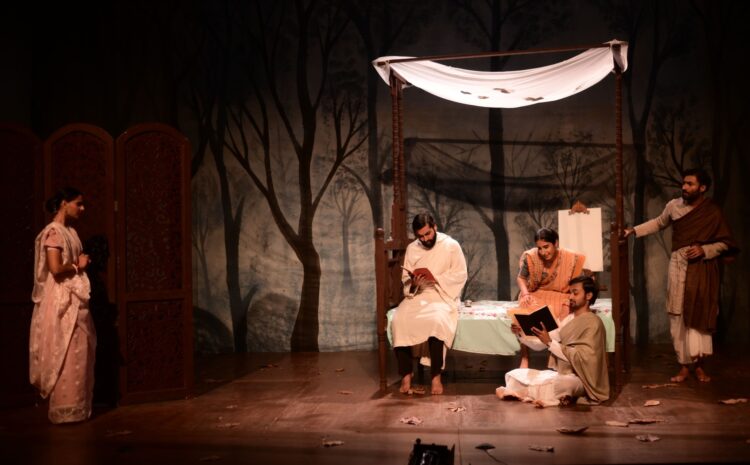
Kadambari, Tracing the Voice of a Shattered Muse, is a lyrical theatrical journey into the silenced life of Kadambari Devi, Rabindranath Tagore’s critic, muse, companion, and sister-in-law. Married into the Tagore family at nine, she ended her life at 25 years while the poet was 23 years then. The play moves beyond her being a footnote in the poet’s life, seeking instead to restore her voice through memory, fiction, and imagination. This is a journey of uncovering the traces of a muse within the work of one of the greatest artists, Rabindranath Tagore. Set in the final hours of her life, it imagines a meeting where Death comes to claim her. In this space between life and afterlife, Kadambari confronts Rabi with questions of love, freedom, and erasure. Their exchange flows between the real and the poetic, echoing Tagore’s heroines who bear her shadow. Through these encounters, the play becomes a story of loss and resistance, reclaiming her agency from history’s silence. The muse refuses to remain inspiration alone; she demands to be remembered as herself.
Director
Meghna Roy Choudhury is a theatre maker with 23 years of Bharatanatyam training, a master’s degree in Physics, and a graduate of Drama School Mumbai. She is also trained in Kalaripayattu and performed in Indianostrum Theatre’s The Tragedy of Abhimanyu, directed by Kalaimamani P. K. Sambandan. Meghna works as a director, actor, and playwright, contributing to commercial theatre while engaging with schools and NGOs through Theatre in Education. Her directorial debut, The Apology, blends Indian classical art forms with theatre, creating a dialogue between tradition and experimentation. For her work she has been bestowed with the Niloufer Sagar Alumni Production Grant, the Parivartan Annual Grant, the INLAKS Theatre Award, and she is the 2025 Tendulkar Dubey Fellow.
Director’s Note
Kadambari Devi, married into the Tagore family at nine, lived in the vibrant Jorasanko household yet remains silent in history. A woman of wit and depth, she lingers only in fragments between Rabindranath Tagore’s lines. When I visited Jorasanko, every room was remembered except hers. The silence of the Andarmahal stayed with me. This play began after I read a fictional suicide note written in her name, where she was reduced to a lovelorn woman yearning for her brother-in-law. That unease grew into a question: how is Kadambari remembered, and who decides that memory? As a Bengali raised outside Bengal, I was scared to touch this subject, but eventually the urge to tell this story became stronger than my fear. It was about a woman’s voice being erased and edited. With my dramaturg Abhishek Majumdar, I began to see that it is not only Tagore but generations of readers who shaped her legacy. This play is not a biography but a conversation with her silence, with history, and with myself and one of the greatest poets of our land, Rabindranath Tagore.
Group
By fostering a dynamic ecosystem of artistic exploration, Paradigm Shift Arts aims to redefine the very essence of art, pushing boundaries and sparking a paradigm shift in how we perceive and engage with creative works to build a future where art is synonymous with innovation and transformative audience engagement.