
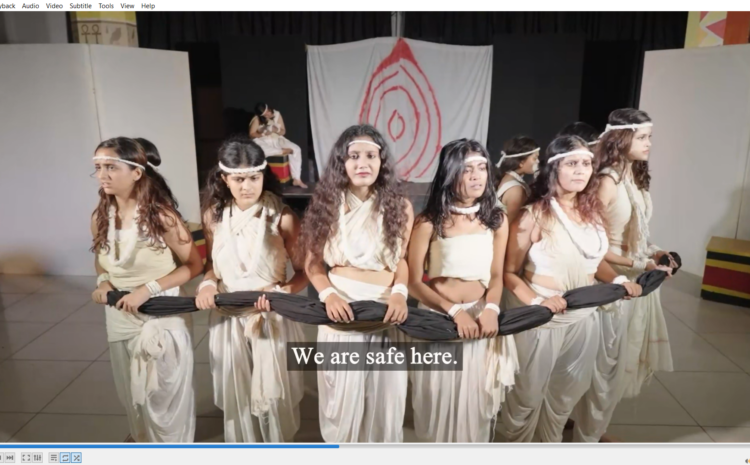
Kamroo is a dramatic tale set in an isolated matriarchal nation ruled by Queen Kamini Devi, where women appear free yet live under rigid control. Kamini offers shelter to homeless women, revealed with the arrival of Jamna and a young girl, Bhairavi. The community celebrates Bhairavi’s first menstruation, after which the women recount Kamini’s violent rise to power, including the killing of all men in Kamroo, including her own father and brother.
The order shatters when two men accidentally enter Kamroo. One is executed instantly, while the other survives by disguising himself as a woman named Lavangika. He forms a secret relationship with Yamini, resulting in her pregnancy. When the truth emerges, Kamini exposes Lavangika’s identity, becomes pregnant herself, and kills him. These rapid tragedies provoke a rebellion, as the women of Kamroo rise against the Queen’s tyranny, realizing that imposed power is not freedom, demanding liberation, and choice.
Writer
Dr. Satish Vyas is a Gujarati playwright, literary critic, and poet. He completed his postgraduate studies in Gujarati from Gujarat University and later earned a Ph.D. from South Gujarat University, where his research focused on The Language of Modern Poetry: Experiment, Application, and Achievement.He began his academic career as a lecturer in Gujarati and later served as a professor at the Bhasha–Sahitya Bhavan, Gujarat University. His major creative work includes the one-act play collection No Parking. His important critical writings include Atmakatha, and Adhunik Ekanki. As the writer of Kamroo, Dr. Vyas brings literary depth, strong dramaturgical structure, and intellectual richness to the play.
Director(s)
Dr. Vikram Panchal is a theatre director, actor, writer, and academician. He is currently serving as the Head of the Department of Theatre and Production Management at St. Xavier’s College (Autonomous), Ahmedabad. With decades of contribution to Indian theatre and cinema, he has been deeply involved as a director, cultural administrator, and event coordinator, notably with the Gujarat University Youth Festival. His acting works include the Hindi films Satyaprem Ki Katha and Shortcut Safari, and the Gujarati film Saheb. He is also the writer, director, and actor of the award-winning Gujarati film Teacher of the Year. Dr. Panchal received the Best Director and Best Writer Awards at the Indian National Theatre Competition 2024, followed by the Best Writer Award at the Indian National Theatre Competition 2025. He has also earned multiple Transmedia Awards, LLDC–Bhavan’s Cultural Awards, and recognition from the Gujarat Sangeet Natak Academy.
Shaunak Vyas, a multi-faceted artiste, has over two decades of experience across theatre, film, and media. He currently serves as an Assistant Professor in the Department of Theatre and Production Management at St. Xavier’s College, Ahmedabad. Shaunak has received the Best Writer and Director Award at the Indian National Theatre Competition 2024, followed by Best Writer at the same competition in 2025. He has also won Best Actor at the Gujarat Iconic Film Awards, along with multiple Transmedia Awards for writing, direction, and best play across theatre and film projects. He was honoured with the Janmabhoomi Pravasi Award for Best Actor for his performance in the play Balcony. He co-directed and co-wrote, and acted in the award-winning Gujarati film Teacher of the Year. He holds a Master’s degree in Theatre and is currently pursuing a PhD in Non-Visual Theatre and Radio Drama, seamlessly bridging practice, and research.
Director’s Note
Kamroo is an acclaimed Gujarati play. As theatre practitioners, we were drawn to this play for its thematic universality, as its narrative can be situated in any historical period and social context. The play conveys a powerful message that excess in any form ultimately leads to destruction.At its core, Kamroo explores the necessity of balance between man and woman, symbolically reflecting the relationship between humanity and nature. Just as the dominance of a purely patriarchal system hinders the healthy functioning of society, an exclusively woman-centred social structure would be equally problematic. Portraying this sense of incompleteness and imbalance on stage has been our primary directorial responsibility.Dance and music have been used creatively to express the woman’s restlessness and her longing for love in aesthetically sensitive ways, avoiding the grotesque. Presented in a folk-oriented theatrical idiom, the play concludes at a reflective juncture, inviting the audience to seek their own answers and become active participants in the theatrical experience.
Group
St. Xavier’s College, Ahmedabad, is a premier institution known for its commitment to academic excellence, holistic education, and cultural enrichment. The College, established the Theatre and Production Department in 2023, has since demonstrated remarkable growth.The department’s students receive training in all aspects of theatrecomplemented by skill-enhancement courses such as cinematography, sound engineering, theatre writing, makeup, and prosthetics, Canva, and Photoshop.The productions of the Department have garnered numerous awards and recognition at national and regional youth festivals and competitions, likeThe Others’ Day, Mammo, Yeh Kahani Phir Sahi, and Holi.