
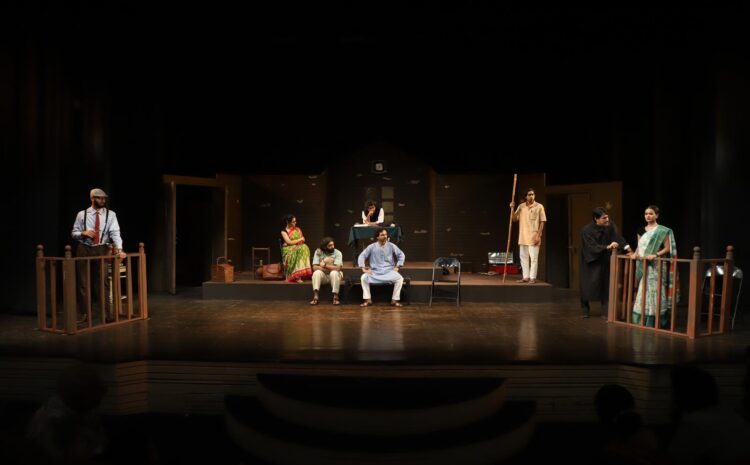
‘Khamosh! Adaalat Jaari Hai’ is a path-breaking play by Vijay Tendulkar that redefined Indian theatre with its fearless social commentary. The story unfolds with an amateur theatre troupe visiting a village to perform a play. To pass the time, they stage a mock courtroom trial – an exercise that begins playfully but soon turns disturbingly real. What starts as harmless entertainment becomes a ruthless inquisition when Leela Benare, a spirited schoolteacher, is accused of immorality and extramarital relationships. The fictional trial unravels her private anguish, exposing society’s cruel judgment of a woman’s autonomy, desire, and motherhood.
Through sharp satire and searing realism, Tendulkar dissects patriarchal hypocrisy – where men’s freedom is normalized, but women’s independence is vilified. Leela Benare emerges as the symbol of every woman silenced by social convention yet yearning to live freely. The ‘court’ in the play mirrors society itself, perpetually in session, constantly trying women for their choices.
Deeply human and emotionally charged, the play compels audiences to confront uncomfortable truths about morality, gender, and justice. Decades after its first staging, ‘Khamosh! Adaalat Jaari Hai’ remains as powerful, relevant, and unsettling as ever – a timeless reminder that silence, too, can be a verdict.
Writer
Vijay Tendulkar (1928–2008) stands out as one of the most prominent playwrights, screenwriters, and intellectuals in modern India. He was a bold voice in Indian theatre; he depicted the intricacies of human connections and the harsh realities of society with unparalleled fervor.
His landmark plays, including Khamosh! Adaalat Jaari Hai, Ghashiram Kotwal, Sakharam Binder, Kanyadaan, and Mitro Marjani, revolutionized Indian drama, establishing him as a transformative figure in contemporary theatre.
Tendulkar also left a significant impact on Indian cinema. He penned notable screenplays for renowned films such as Manthan (directed by Shyam Benegal), Ardh Satya (directed by Govind Nihalani), Akrosh (directed by Govind Nihalani), and Umbartha (directed by Jabbar Patel). Many of these works are regarded as benchmarks in parallel cinema and still resonate with filmmakers today.
Having received numerous national and international accolades, including the Padma Bhushan, Vijay Tendulkar continues to serve as a source of inspiration for artists, intellectuals, and audiences who view theatre and cinema as vehicles of truth.
Translator
Sarojini Verma is a noted Hindi translator best known for bringing the works of acclaimed Marathi playwright Vijay Tendulkar to Hindi audiences. Through her sensitive and faithful translations, she has made some of Indian theatre’s most powerful social dramas accessible to a wider linguistic and cultural audience.
Her Hindi translation of Vijay Tendulkar’s landmark play ‘Shantata! Court Chalu Aahe’, titled ‘Khamosh! Adalat Jaari Hai’, is among her most celebrated works. The play has been performed by leading theatre companies across India and continues to resonate with audiences for its bold exploration of gender, morality, and social hypocrisy.
Beyond this, Verma has translated several of Tendulkar’s seminal plays, including ‘Sakharam Binder’, ‘Panchhi Aise Aate Hain’, and ‘Dambhadweep’, all of which have been published by major Hindi literary houses such as ‘Rajkamal Prakashan’, ‘Lokbharti Prakashan’, and ‘Vani Prakashan’. Her translations preserve the rhythm, realism, and regional essence of the original Marathi texts while ensuring the dialogues flow naturally on the Hindi stage.
Sarojini Verma’s contribution stands as a bridge between regional and national theatre traditions, allowing Tendulkar’s humanist vision and social critique to find renewed life in the Hindi heartland. Her work continues to inspire theatre practitioners, scholars, and audiences who seek to experience the depth of Indian dramatic literature across languages.
Director
Avtar Sahni, born in Shimla in 1958, is an acclaimed theatre director and a graduate of the National School of Drama (NSD), specializing in Direction (1984). Over the past four decades, he has directed more than 45 plays with leading theatre institutions such as the Actor’s Repertory Theatre, Shri Ram Centre Repertory Company, Bhartendu Natya Academy, Sahitya Kala Parishad Repertory (New Delhi), and Chorus Repertory Theatre (Imphal). His noted works include Uljhan, Nagin Tera Vansh Badhe, Mrichkattikam, Archangels Don’t Play Pinball, Khamosh! Adaalat Jaari Hai, Thieves’ Carnival, and Chekov Ki Duniya, among others. His production Uljhan was selected for the National Theatre Festival (Sangeet Natak Akademi, 1992) and earned high critical praise.
As a visiting faculty and workshop director, Sahni has trained generations of artists across India, conducting workshops under the aegis of NSD, Sahitya Kala Parishad, Madhya Pradesh Natya Vidyalaya, Shiv Nadar University, and various Delhi University colleges. His international collaborations span theatre festivals in Moscow, the UK, Ireland, Mexico, Peru, Cuba, Holland, Norway, South Korea, China, Colombia, and Ecuador.
He has also contributed extensively as Technical Director for major festivals such as the Ibsen International Theatre Festival, Bharat Rang Mahotsav, and Days of Delhi in Moscow, and as Light Designer for the Commonwealth Games 2010 (New Delhi). Sahni’s lighting expertise has supported celebrated directors including Prasanna, Barry John, Ratan Thiyam, and Robin Das. His work extends to cinema, with credits in films such as Dil Se, Sarfarosh, Omkara, The Blue Umbrella, Highway, and Chef.
Director’s Note
‘Khamosh! Adaalat Jaari Hai’ is not just a play – it is a mirror. Vijay Tendulkar’s path-breaking work redefined Indian theatre by daring to confront the moral hypocrisies buried within everyday life.
As I revisited this timeless piece, what struck me most was its deceptive simplicity. An amateur theatre troupe gathers in a village to rehearse – a playful mock trial begins, and suddenly, the line between performance and reality vanishes. The stage transforms into a courtroom of judgment, and Leela Benare becomes both the accused and the voice of countless women silenced by social convention.
Through Tendulkar’s piercing satire and emotional depth, the play exposes how society often masquerades cruelty as morality. It compels us to ask uncomfortable questions: Who truly sits in judgment? Who decides what is ‘moral’? And why must a woman’s autonomy still stand trial?
Directing this play has been both a challenge and a privilege. Each rehearsal revealed a new layer of humanity – of laughter, cruelty, vulnerability, and truth. Even decades after its first performance, ‘Khamosh! Adaalat Jaari Hai’ remains hauntingly relevant, reminding us that silence is not absence – it is often a verdict.
My hope is that as you watch, you not only see Leela Benare’s story but recognize the echo of every voice that was ever judged, silenced, or misunderstood.
Group
The Shri Ram Centre for Performing Arts Repertory Company established in 1980, stands as one of India’s most respected and enduring theatre ensembles. Functioning under the aegis of the Shri Ram Centre for Performing Arts (SRCPA), the repertory has been at the forefront of nurturing Indian theatre through professional training, artistic innovation, and public engagement.
The SRCPA Repertory was created with the aim of providing a sustainable platform for trained theatre artists to continue performing and experimenting with form, language, and storytelling. It serves as a bridge between formal theatre education and the professional stage, promoting original Indian works alongside adaptations of global classics, thereby cultivating a vibrant, inclusive cultural dialogue.
Over the decades, the Repertory has produced an impressive repertoire of contemporary and classic plays, often highlighting social, political, and human themes. Its productions have ranged from works by Vijay Tendulkar, Mohan Rakesh, Girish Karnad, Badal Sircar, and Shakespeare to modern experimental theatre that challenges conventional form. The troupe has participated in numerous national and international theatre festivals, gaining recognition for its disciplined performances, aesthetic direction, and commitment to artistic integrity.
A cornerstone of the Repertory’s mission is to develop emerging talent through rigorous training in acting, movement, voice, and stagecraft. Many of India’s prominent theatre personalities and film actors have been associated with SRCPA Repertory, either as members, trainers, or collaborators. The environment fosters creative exploration and teamwork, allowing artists to evolve their craft under the mentorship of experienced directors and dramatists.
The SRCPA Repertory also plays a vital cultural role in Delhi’s theatre ecosystem by engaging audiences through regular performances, workshops, and educational outreach programs. Its presence at the Shri Ram Centre auditorium in Mandi House, Delhi’s cultural hub, makes it a living institution that continuously contributes to the growth and accessibility of Indian theatre.
With over four decades of sustained work, the SRCPA Repertory continues to uphold the ethos of artistic excellence and social consciousness envisioned by the founders of the Shri Ram Centre. Its productions remain a testament to the power of theatre as a medium for dialogue, introspection, and transformation, ensuring that the legacy of Indian performing arts thrives in the modern era.