
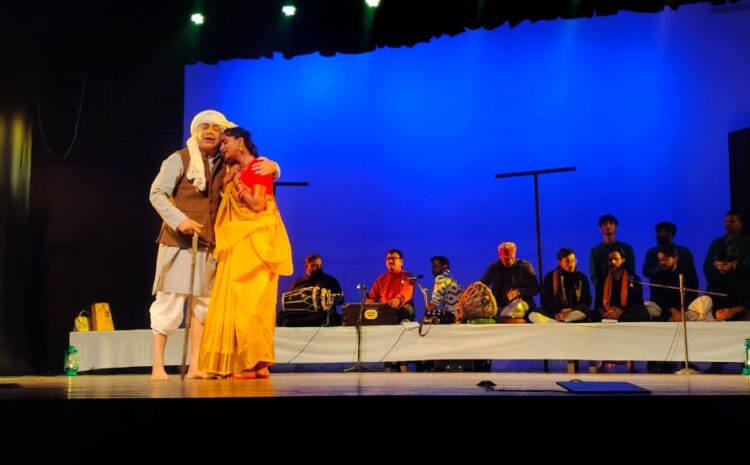
Janeshwar’s is a lower-class, indebted family, living in the village. After taking a loan and educating his son, Nageshwar, he seeks him to join the army, thinking that life will be happy now. Nageshwar gets married to Anandi meanwhile within a few days, war breaks out on the border, and Nageshwar returns to duty only two days after his arrival in kedge at leave. He never returns. His old mother, driven mad by the wait, goes away. The moneylender, Kamleshwar, and the village head, who harbor evil eyes on Anandi, repeatedly attempt to force molest her. Janeshwar is accused of having an illicit relationship with his daughter-in-law, Anandi. Meanwhile, Anandi, who became pregnant during her husband’s leave, gives birth to a child. The villagers, believing it to be an illegitimate child, come to expel both of them from the village. Anandi stands firm with the truth, faces oppression, fights for her own survival, exposes and drives everyone away, and resolves to send her child also to the army. The play depicts women’s dignity, patriotism, the relevance of war, and human insensitivity. ‘Khulaal Rah Gail Khidki Ke Ago pala’ also tells the story of the justification of war against the backdrop of war.
Writer
Dr. Harisuman Bisht is a renowned author of modern Hindi literature. He was born on January 1, 1958, in Kunhil village, Almora district, Uttarakhand. His experiences in the mountains have given depth to his literature, particularly his female characters, who emerge as both struggling and victorious. To date, he has written numerous excellent works, including ten novels, nine short story collections, eight plays, and three travelogues. His works have been translated into various languages. His notable works are ‘Achhari Machhari,’ ‘Basera,’ ‘Bheetar Kayee Ekant,’ ‘Battees Raag Gaao Mola,’ ‘Apne Aranya Ki Or,’ and his recent acclaimed novel, ‘Hawaon Mein Ghirra Aadmi.’ He developed a new fictional style in Hindi fiction and also made significant contributions through academic writings and editing. He edited the magazine ‘Indraprastha Bharti’ for 27 years and served as Secretary to the Hindi Academy and Maithili Bhojpuri Academy, Government of Delhi. His works are included in university curriculums, his plays have been staged, and research has been conducted on them. He currently resides in Noida.
Director
Young theatre artist Kumar Veer Bhushan was born in district Vaishali, Bihar. He holds a Master’s degree in Political Science, and Diploma in Journalism, and Dramatics. He was awarded a research fellowship in the field of theatre by the Ministry of Culture. He has acted in approximately 25 major plays and has performed in Bihar and Delhi. He has directed several major plays, including Charandas Chor, Amali, Yahudi Ki Ladki, Ramlila, Saiyan Bhaye Kotwal, Bakri, Bidesiya, Rashmirathi, Othello, Sanyasi Yoddha Swami Vivekananda, Vaishali Ki Nagarvadhu Ambapali, Dhruvaswamini, Mudrarakshas, Barahmasa, and Save Ser Gehun. He worked for eight years as an anchor and producer for the Lok Sabha TV. He also worked extensively as a theater instructor and director for the Ministry of Culture of the Government of India, the Sangeet Natak Akademi, and important departments of the Delhi Government, including the Sahitya Kala Parishad, Hindi Akademi, Maithili and Bhojpuri Akademi. Veer Bhushan is currently active in the fields of theater and journalism simultaneously in Delhi and Bihar, and is also pursuing a Ph.D. on the Sanskrit play ‘Mudrarakshas.’
Director’s Note
This play was originally written as a short story by the country’s renowned story writer, Hari Suman Bisht. Afterwards a graduate of the National School of Drama and a Bhojpuri speaking, theatre artist Rakesh Kumar adapted this play into a Bhojpuri drama. The play presents patriotism and the relevance of war as well as good ideas. It addresses the irony of rural life and the many questions of the female mind. All the actors in the play are enthusiastic and dedicated theatre artists who will present the play- set against a mountainous backdrop and connected to the land of Bihar, with folk music. The Bhojpuri language has been kept flexible in its dialogues. The play takes a path between modern and folk drama, presenting Bhojpuri culture and broadening its subject matter. The organization is grateful to the National School of Drama, Maithili and Bhojpuri Academy, the writers, actors, assistant directors, background artists, and its collaborators for presenting this play to you.
Group
Babu Shivji Rai was formed in 2012 by young theatre artists in Delhi to work in the fields of art, literature, and culture. The foundation has organized numerous workshops, literary conferences, birth anniversary celebrations, and other events. The organization has directed and produced numerous plays by Delhi theatre artists Utpal Jha, Saurabh Tripathi, Kumar Veer Bhushan, Bablu Jha, and others. These plays include Ramlila, Bakri, Mahabhoj, Ambapali, Dhruvswamini, Rangbhoomi, Bidesiya, Barahmasa, and Jeevan Hamar – Zimmevart Hamari, along with numerous other street plays staged in schools, colleges, and at intersections to raise awareness. The foundation is also affiliated to the Song and Drama Division of the Government of India.