
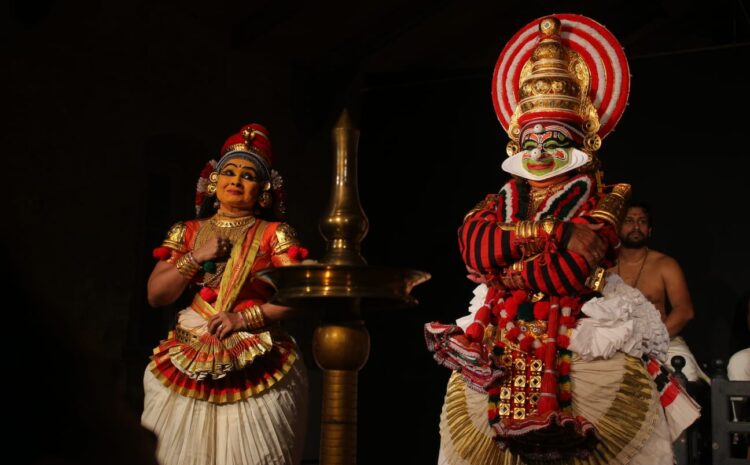
Ascharyachudamani is one of the most important plays in the repertoire of Kutiyattam today.
In the play, Ravana appears in disguise as Maya Rama is carrying away Sita in a chariot. The charioteer (Suta) is in disguise as Maya Lakshmana. When in the chariot, Sita’s hand, while tying her hair chances to touch Ravana. By the power of the ‘Choodamani’ (magic gem given to by Rama for protection against harm) which Sita is wearing on her finger, Ravana’s evil spell is removed and his ‘maya’ cease to work. The ‘maya’ Rama form is lost and Ravana appears in his true form. But Ravana does not realise his change of form. While returning to Lanka after abducting Sita, Ravana is challenged by Jatayu. In the “marma” war that ensued Ravana lies while Jatayu tells the truth. Ravana deceptively kills the giant bird and heads for Lanka.
Director
Margi Madhu Chakyar, born into the illustrious Moozhikkulam Chakyar family, is the son of Padmasree Moozhikkulam Kochukuttanchakiar and disciple and nephew of Padma Bhushan Ammannoor Madhava Chakyar. He is M.A. in Kutiyattam and has undergone extensive gurukul training at Moozhikkulam and Margi. He has performed widely across Kerala, India, and in more than fifteen countries including Japan, France, USA, Canada, Italy, Germany, and the UK. He is a recipient of numerous honours such as the Sanskriti National Award, Kerala Kalamandalam Award, Kerala Sangeetha Nataka Akademi Award, and the Sangeet Natak Akademi Award (2022) to name a few. His works include several Attaprakaram compositions, books, and academic papers, along with collaborations in international theatre festivals and cross-cultural productions.
Director’s Note
Kutiyattam, recognized by UNESCO as a Masterpiece of the Oral and Intangible Heritage of Humanity, is the oldest living Sanskrit theatre tradition in the world. Evolved in Kerala over more than a thousand years, it represents a confluence of theatre, ritual, and classical aesthetics rooted in the Natyashastra. Jatayuvadhaṃ, the fourth act of Ashcharyachudamani written by the eminent Sanskrit dramatist Śaktibhadra, dramatizes one of the most poignant moments in the Ramayana—the valiant bird Jataayu’s attempt to rescue Sita from Ravana, and his heroic fall. Through this episode, the play explores profound themes of sacrifice, dharma, and divine destiny. This production seeks to bring forth the layered emotional landscape of the act through the refined performative grammar of Kutiyattam—its highly codified gestures (mudras), rhythmic precision, expressive elaboration (abhinaya), and live percussion accompaniment on mizhavu and edakka. The performance aims to introduce audiences to the grandeur of Sanskrit theatre while preserving its ritual depth and meditative intensity.
Group
Nepathya, founded in 1998 in the heritage-rich village of Muzhikkulam in central Kerala, is a major centre for excellence in Kutiyattam. Muzhikkulam has long been an important centre of the Ammannoor tradition, nurtured by several generations of Chakyars who migrated from Koppam in Malabar. Continuing this legacy, Nepathya preserves, performs, and teaches Kutiyattam in its classical form, while also engaging in research, revival of old repertoires, and the conceptualization of new performance texts. Nepathya has revived and staged works such as Doothaghatotkacham, Abhijnanasakunthalam Act I, Vichchinnankam, Pratimankam, Atavyankam, and Matavilasam, and has also adapted Macbeth into Kutiyattam. The troupe has performed widely across Kerala, India, and internationally, including Jerusalem, Singapore, Yale University, Salzburg Festival, Zürich Museum, Stuttgart Museum, and festivals in Switzerland, Italy, France and Dubai. Each year, Nepathya presents an award in honour of D. Appukkuttan Nair to support young talents in Koodiyattam and Kathakali.