
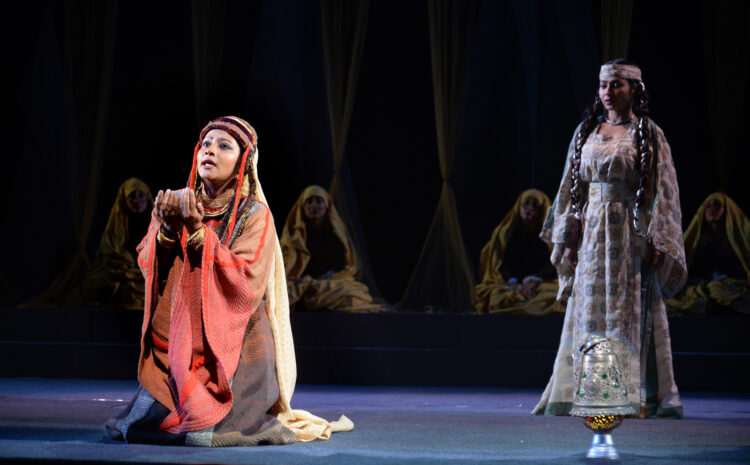
A love poetry, stretching way back, the story of Laila Majnun is retold yet again as a narrative poem and a play, tracing the lives of two young people, both hemmed in by what was around them; the people, the places and the nature of the nomadic Bedu society in the early years of the 7 Century A.D in the Middle East.
Laila’s parents have a realization that the love between Qais and Laila has brought the family nothing else but shame and that Laila must now be kept at home.
Qais runs away into the wilderness, becoming unkempt, not knowing good from evil. People start calling him Majnun.
Laila is married to Ibn Salem. Time passes and one hears of Ibn Salem’s death. After having mourned his death for two years Laila sets out on a journey to find Qais. She finds him, but, realizes that the one she loved is lost.
Playwright
playwright, poet, essayist and a painter, Ismail Choonara was born in South Africa but has lived most of his life in U.K., where he has worked as a research chemist, mathematics teacher and lecturer in science. He has also written on apartheid in South Africa, the plight of industrial workers and the segregation of the African and Asian communities in England.
His major works include ‘Laila Majnu’, ‘A River Across Unseen Divide’ (Urdu version Yaadon ke Bujhe Huye Savere), ‘A Broken Chair’, ‘Compartment No. C-35’ etc. Mr. Choonara died in London in 2021.
Director
A theatre artist who earned an important place and respect in the Indian theatre world with his five-decade-long journey and exemplary work, Prof. Ram Gopal Bajaj was born (in 1940) in Darbhanga, Bihar and completed his graduation from Bihar University. Later, he graduated in dramatic art from the National School of Drama in 1965 and became the Director of the institute between 1995-2001.
He served as a drama teacher at Modern School, Delhi (1969-73), worked as Reader at the Department of Indian Theatre, Panjab University, Chandigarh and as a Professor and Head of the Department of Dramatic Arts, Punjabi University, Patiala (1979-80). In the year 2002, he has also been Professor and Head of Dr. Radhakrishnan Chair at S. N. School of Central University of Hyderabad.
As an actor, his plays ‘Suno Janmejay’, ‘Hayavadan’, ‘Begum Ka Takia’, ‘Ghasiram Kotwal’, Andha Yug’, ‘Tughlaq’, ‘King Lear’ and got broad appreciation. ‘Ajatghar’, ‘Ashad Ka Ek Din’, ‘Surya ki Antim Kiran Se Surya ki Pahli Kiran Tak etc. the plays disceted by him enriched further his reputation.
He has been equally active in All India Radio, Doordarshan and Cinema. Some of his important works, for media have been ‘Tamas’, ‘Basanti’, ‘Main Azad Hoon’, ‘Masoom’, ‘Mirch Masala’, ‘Chandni’, ‘Parzania’, ‘Mango Dreams’,’The Myth’, ‘Xuan Zang’, ‘Jolly L.L.B-2’.
He has received Padmashree, Sangeet Natak Akademi Award, Nandikar Samman, National Kalidas Samman and the Ratna Sadasyta of Sangeet Natak Akademi in 2016.
Directorial
As soon as we say Laila Majnun, we start feeling a special kind of romanticism and folk tradition, but when we read the play ‘Laila Majnun’ written by Ismail Choonara, we found it completely different.
I had done this play earlier for the Shabdakar group of Delhi, now I am doing it again.
There is immense contribution of dance compositions in the play that in a way which cannot be called dance, but, how the body movement should be, how the blocking of the actors should be, that became an integral part of the compositions. Initially Bhaskar Chandavarkar was supposed to compose its music, when he could not come due to some reason, Rajesh started making proxy music. Rajesh tried to keep the feel of it, it consists original compositions of some famous Indian and foreign artists, while many sounds have been added. Particularly, he used two pieces of music by Abida Parveen and Sabri Brothers, which are very suitable for the place.
It is very difficult for me to say that I am the director of the play! I think the whole team, and the boys and girls who had joined at that time, were trying to take the process forward understanding my small gesture in that small rehearsal space. All deserve to be credited for the making of the play. The play is now before the audience.
Translator
Born in Barabanki, U.P., Sabir Irshad Usmani Matriculated there, moved to Karachi in early 50’s and then to London, working and studying part time at L.E., and Regent Street Polytechinic, In the 90s, with others founded the Urdu Trust and the European Urdu Writers’ Society. His mojor literary works include – various articles for Kitab Numa; five parts in Sadah on Khusro, Book on the Life of Moulana Mohd. Ali Johar; and Translation work of Ismail Choonara’s plays ‘Yaadon ke bujhe huye savere’ and Laila Majnun.
Group
Established in 1964 with only 4 members, Rangamandal Company is the regular performing wing of the school. It was established with the dual objective of establishing commercial theater on the one hand and continuing regular experimental work on the other.