
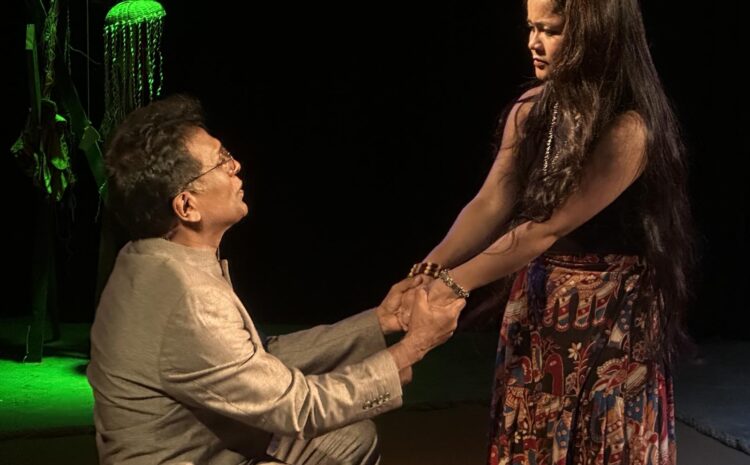
Mukta Nisanga explores the life of a professor, Dr Hazarika, who feels disconnected from the world around him. The story delves into his mundane life, highlighting his struggles with aging, illness, and the meaninglessness of his existence. Through Dr Hazarikai’s narrative, Anton Chekhov’s critiques the societal expectations and pressures that lead to a sense of purposelessness and isolation. The play is a thought-provoking commentary on the human condition, inviting readers to reflect on the significance of life’s experiences.
Writer
Anton Chekhov (1860 – 1904) was a Russian playwright and short-story writer, widely considered to be one of the greatest writers of all time. Along with Henrik Ibsen and August Strindberg, Chekhov is often referred to as one of the three seminal figures in the birth of early modernism in the theatre. Chekhov renounced the theatre after the reception of The Seagull in 1896, but the play was revived to acclaim in 1898 by Konstantin Stanislavski’s Moscow Art Theatre, which subsequently also produced Chekhov’s Uncle Vanya and premiered his last two plays, Three Sisters and The Cherry Orchard. Chekhov while writing stories made formal innovations that influenced the evolution of the modern short story. His writings made a strong point that the role of an artist was to ask questions, not to answer them.
Director
Baharul Islam, an alumnus of NSD, is a distinguished actor, director, writer, and filmmaker. Soon after completing his training, he founded his own theatre group, Seagull, in Guwahati, which has since contributed extensively to the nation through its repertory, academy, children’s programmes, publication wing, and studio theatre. He has acted in several plays in Assamese, Hindi, and English, and has designed and directed around 30 productions for Seagull as well as for renowned institutions such as the NSD Repertory, Ninasam Repertory, Rangayana Mysore, Banjara Mumbai, and several commercial theatres in Assam. He also performed in Assamese commercial theatre, worked with TARA Arts, London, touring the UK and Japan with the play Heer Ranjha. Besides acting in films and media, he has directed three feature films, notably The Seventh String (2021), which received several international awards, and has produced documentaries and fiction films for Doordarshan. As a writer, he has authored and published multiple books and plays, and his contributions have been recognised with many prestigious national and international awards.
Director’s Note
Chekhov always attracts me. His novel Skuchnaya Istoriya sets itself the paradoxical task of holding a reader’s attention using an admittedly “boring” narrative. Accumulations of small details, painstaking descriptions of minor characters, and beside-the-point intellectual discussions are all hallmarks of Dr Hazarika style in the play. All these features seem designed to exasperate readers. Yet Dr Hazarika’s longwindedness also helps us to understand the tragicomic side of this character. His need to tell his story to himself, in bizarre detail, is an indication of what a self-absorbed, isolated, unfulfilled person he truly is.
Group
‘Seagull’ was established on 10th December 1990 at Guwahati. The troupe has several activity wings are Seagull Theatre Academy, Theatre in Education, Publication, Organizing Theatre Festivals for 15 years, Working for Spastic Children in association with Sishu Sarothi, Conducting Theatre Workshops for Children and Youth, Seagull Repertory company.
Seagulls some important play productions are Urukha, Guwahati Guwahati, Jatra, Simar Sipare-beyond the obvious, Abhimoinnu, Gandhari Ka Abhishap, Ashad Ka ekdin, Puntila and his man matti, Saraighat, Buddhuram, Antigone, Holi, Gadha Nritya, Mricchakatikam, Tughlaque, Parashuram, Court Marshal, Ram Shyam Jadu, The green serpent, Madhyabartini etc.