
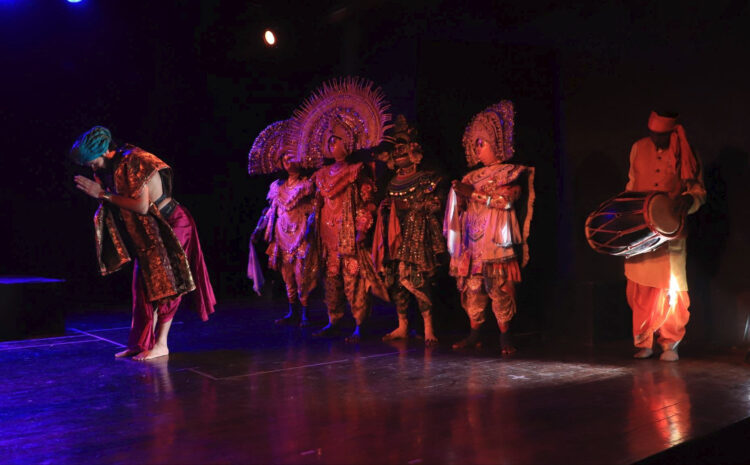
Once in India is an historical play based on an historical event that took place about 22 centuries ago. The beautiful representation of Greek culture and Mauryan empire constitutes the core of the play. But the play is not mere narration of history. It is a creative exploration of those times, in dramatic idiom, to give contemporary audiences a meaningful theatrical experience. The only incident of army coup in the entire Indian history was that of Army Chief Pushyamitra Shung overthrowing and killing the last Mauryan king, Brihadrath, when he hesitated to defend the country against foreign invasion. This incident is presented in dramatic idiom in the play, while debating the moral dilemma of violence vs. non-violence in regards to national security.
Writer:
The Indian theatre fraternity pays tribute to the visionary playwright and administrator, D.P. Sinha, who left for his heavenly abode on 7th November 2025. As an actor and director, Shri Sinha possessed an innate grasp of “stage-worthiness,” crafting plays that resonated with audiences while maintaining the highest literary standards. His canon of fifteen plays, including the Sahitya Akademi Award-winning Samrat Ashok, has been translated into multiple languages and serves as essential curriculum in universities across India. His monumental contribution to Indian culture was recognized with the Sangeet Natak Akademi Award and the Padma Shri.
Director:
Aayushi Tripathi is a young Indian Theatre Director and Classical Odissi Dancer with over a decade of experience in the performing arts. Her artistic excellence has been acknowledged through multiple accolades, including a Scholarship and a prestigious Junior Fellowship in the field of Theatre from the Ministry of Culture. Her directorial signature is defined by her unique ability to synthesize movement and drama.
Director’s Note
“Peace is a noble ambition, but what is the price of a sword left sheathed when the borders are burning?” Once in India is an attempt to touch the pulse of a civilization at a fragile intersection. Twenty-two centuries ago, the Indian subcontinent became a melting pot where the rigid grandeur of the Mauryan Empire collided with the aesthetic philosophies of the Greeks. As a director, my intent was not to resurrect a museum piece, but to construct a “dramatic idiom”—a living, breathing exploration of how culture and chaos coexist. This performance dissects the single most tumultuous transfer of power in our history: the coup by Army Chief Pushyamitra Shunga against the last Mauryan Emperor, Brihadrath. On one side stands a King, paralyzed by a high moral philosophy, hesitating to defend his land in the name of non-violence. On the other stands a General, realizing that sometimes the preservation of a nation demands the destruction of its ideals. Through scenic composition and movement, we navigate this grey space. We do not offer judgment; we offer a mirror and invites the contemporary audience to wrestle with the eternal paradox of governance: Where does the morality of non-violence end, and the duty of national security begin?
Group:
Upstage Art Group has been working on various cultural aspects like theatre productions, music programs both classical and western, folk dances, folk music, folk arts, and involvement of youth with cultural values. It conducts workshops, seminars; have done more than 250+ stage performances; staged about 60 one-act plays in Delhi and different cities of India; and have performed over 9,000 street plays to raise awareness about various social issues.