
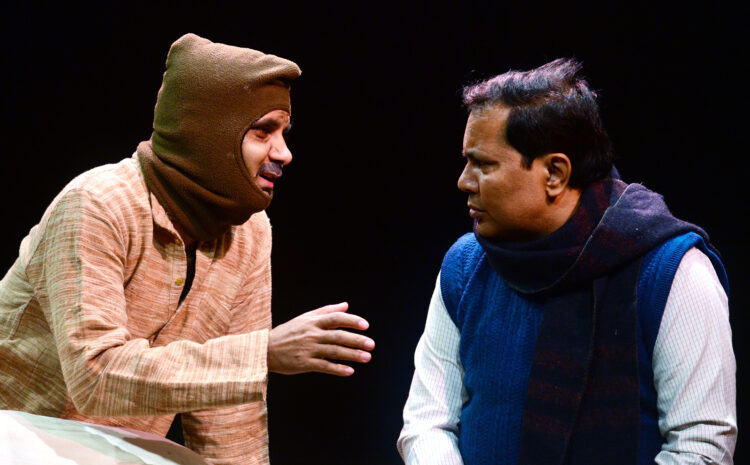
The first letter in Harimohan Jha’s work, is a love letter from a young man who has just graduated. And it is addressed to his future wife. In this letter, the protagonist talks about catching a glimpse of his future wife, corresponding with her, and giving her a necklace as a gift. Exactly ten years later, in the second letter, the protagonist has two daughters and a son with the same wife. In this letter, he speaks like a responsible householder. He talks about taking measures for his wife’s health, taking care of his elderly mother, and his inability to bring her to the place where he works. Ten years later, when his responsibilities have increased significantly, the third letter shows how the protagonist is constantly failing to fulfil them. It mentions how he is suggesting that his wife come to the village instead of him going there. Ten years after that, the protagonist Dev Krishna learns from his wife’s letter that their “worthy son” Bangatbabu, and his son’s wife, has gone to Calcutta. So, he writes the fourth letter. In first two letters he addressed his wife as “My Beloved,” and “Dear,” but in the third and fourth letters, he writes “Blessings” without any specific address. He offers consolation, saying, “Let it be, what if the son and daughter-in-law have left?” The fifth and final letter is written to his son Bangat instead of his wife. They also write that when the old woman “passes away,” her last rites will be performed by their hands.
“When that fortunate day arrives, please place a piece of wood from me on her funeral pyre” – Harimohan Jha has not explicitly written this, but it becomes clear from reading the letters that the man who tried to win over his beloved with a “necklace” is still unable to give up his desire for salvation by dying in Kashi.
Writer:
Harimohan Jha (1908-1984) was born in Kumar Bajitpur village in the Vaishali district of Bihar. He has made a valuable contribution to Maithili literature, and is considered one of the most respected figures after the great poet Vidyapati. He was awarded the Sahitya Akademi Award. His works such as Khattar Kaka Tarang, Dwiragaman, Pranamya Devta, and Kanyadaan have been particularly popular. A film has even been made based on Kanyadaan.
Adaptor:
Shri Mahendra Malagia was born in Malangia village of Madhubani district. He is fluent in Maithili, Hindi, English and Nepali and is a freelance teacher of theatre teaching, screenwriting, and related research.
Director:
Born in Saharsa, Bihar, Utpal Jha is alumnus of Bharatendu Natya Akademi (BNA), Lucknow, and National School of Drama, Delhi. He has directed many plays in different languages and has special experience in designing lights, stage, costumes, and music. He has experience of working with many renowned national and international directors for light and set design. He has worked as guest faculty of acting and design in BNA, NSD and its various centres, Indira Kala Sangeet Vishwavidyalaya Khairagarh, SRC etc. He has worked as technical director and technical coordinator in various national and international theatre/contemporary dance festivals and has travelled to many countries including USA, Germany, Australia, Indonesia, Malaysia, Netherlands, Saudi Arabia, Sri Lanka, and Nepal for international theatrical performances.
Director’s Note
There is less writing, but more communication. “Five Letters” (Paanch Patra) is written in epistolary style and depicts the changing facets of love and relationships in a man’s (Dev Krishna) 40-year married life, presenting the complexities, expectations, and constraints of relationships with a blend of humor, satire, and poignancy. This play offers a profound critique of the realities of relationships in middle-class society, the evolving emotions between husband and wife, and societal expectations. The narrative shows how the warmth of love diminishes over time, and bitterness creeps into the relationship. While the husband criticizes his wife, in the final letter, he instructs his son to place “a single log” on his wife’s funeral pyre on his behalf. This story portrays the fragility of relationships, the changing nature of human emotions, and social ills, where deep pain is hidden beneath the humor and satire. It teaches us to understand and cherish our relationships.
Group:
Panchkosi was founded in 2005. The group has organized several theatre workshops, seminars, theatrical festivals such as Rajkamal Natya Mahotsav, Mithila Natya Utsav and have produced plays such as Kanya Putra, Madhusravani, Paul Gomara ka Scooter, Gaam Nai Sutaye, Vaywastha, Paanch Patra, Legend of Baal Bhagwan, Jaanch Partal, The Zoo Story, Court Martial, Amli, Bakri, Macbeth, Andher Nagri, Gajakhor, Fushion Chowk etc. An acting school, Mantra Actor’s and Designer’s Studio, is also working under the aegis of Panchkosi in Delhi.