
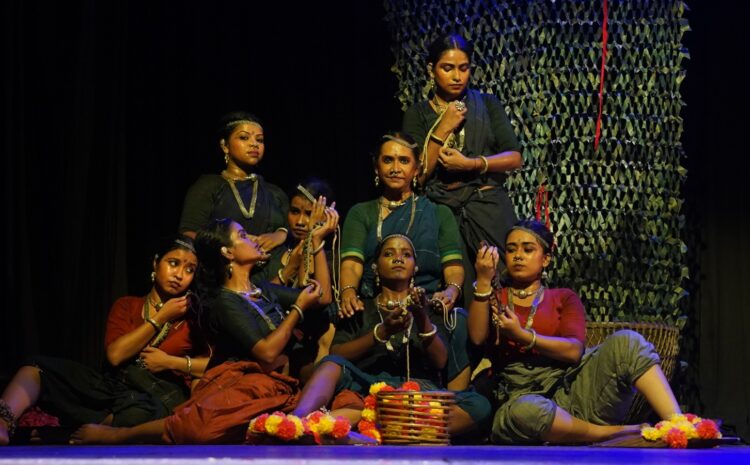
Rudraganika explores the untold journey of the Devadasis – women once dedicated to temple service, whose lives revolved around ritual dance and divine servitude. Born into social oppression, they were bound to the gods but denied personal freedom.
The narrative follows a group of Devadasis who, while witnessing warriors practise Kalaripayattu, awaken to the strength hidden within their own bodies. Defying custom and constraint, they secretly train in this martial art, transforming their vulnerability into empowerment.
When invaders threaten their temple, these women rise as protectors, blending the grace of dance with the power of combat. They emerge as Rudraganikas – embodiments of divine rage and liberation, symbolizing the triumph of feminine strength over oppression.
Director and Writer
Born on 17th September 1975 at Berhampore, Murshidabad, Soma Giri entered the world of dance with Kathak. She later joined the renowned Dancer’s Guild, training under the magical mentorship of Dr. Manjusri Chaki Sirkar and Ranjabati Sirkar – pioneers of modern Indian dance.
Soma Giri holds a First-Class Master’s degree in Bharatanatyam from Rabindra Bharati University, where she studied under Guru Khagendranath Burman, and was also fortunate to learn from Guru Ambali Praharaj.
Since 1990, she has been deeply involved in theatre and contemporary dance, creating performances that emphasize pure movement and vibrant theatrical expression. Her works combine classical discipline with a contemporary vision, bringing emotion and rhythm to life through motion.
Soma has also dedicated herself to studying the Kerala martial art form Kalaripayattu, forming an all-women Kalaripayattu dance troupe in collaboration with Guru Ajith Kumar (MMC Kalari, Kerala). Her workshops have earned wide appreciation from tribal dance communities in Jhargram, Ashokenagar, and Jangalmahal, fostering inclusivity and cultural exchange.
In 2023, Soma Giri participated in the prestigious Bharat Rang Mahotsav with the acclaimed theatre production Silence, showcasing her creative integration of dance and dramatic form, marking another milestone in her evolving artistic journey.
Director’s Note
Rudraganika is a journey into the lives of the ancient Devadasis, women whose devotion to the temple masked lives of social confinement and oppression. Through this performance, I wanted to explore themes of resilience, courage, and self-liberation, showing how even the most marginalized can discover immense strength within themselves.
In observing the warriors practise Kalaripayattu, the Devadasis in our story awaken to a latent power a fusion of grace, discipline, and determination. The performance combines classical dance, martial movement, and theatrical expression to create a non-verbal narrative, emphasizing physical storytelling over dialogue, and transcending language barriers.
My intent is to evoke a sense of awe and empathy, allowing the audience to witness
the transformation of vulnerability into power, and to experience the enduring spirit of women who reclaim their agency. Rudraganika is not only a story of defense and rebellion but also a celebration of inner strength, courage, and the universality of human resilience.
Group
Founded in 2006, Baguiati NrityaMandir has evolved over the past twelve years into a vibrant theatre and dance collective, navigating the many challenges and transformations of the contemporary performing arts world. The group was officially registered on 24th November 2006, and was founded by a passionate young ensemble led by Soma Giri and Arabinda Giri, at Kolkata.
The group began its journey performing at DE-53, Adarsha Co-operative Housing Society, Baguiati, and now continues its creative activities from 92A, Bansdroni Government Colony, near Bansdroni Bridge, Kolkata – 700070.
From its very inception, Baguiati NrityaMandir has been committed to producing dance- theatre and movement-based performances rooted in Indian dance traditions. The group dedicatedly trains in traditional Indian dance techniques and the martial art
form Kalaripayattu, enriching their performances with physical precision, rhythm, and strength.
Over time, the collective has moved beyond conventional styles, experimenting with symbolic body language, gesture, sound, choreography, and objects to communicate emotion and meaning directly to audiences.
Their current artistic pursuit is to discover a new theatrical language – one that transcends words and regional boundaries, using movement, rhythm, and visual expression as the universal medium of connection and communication.