
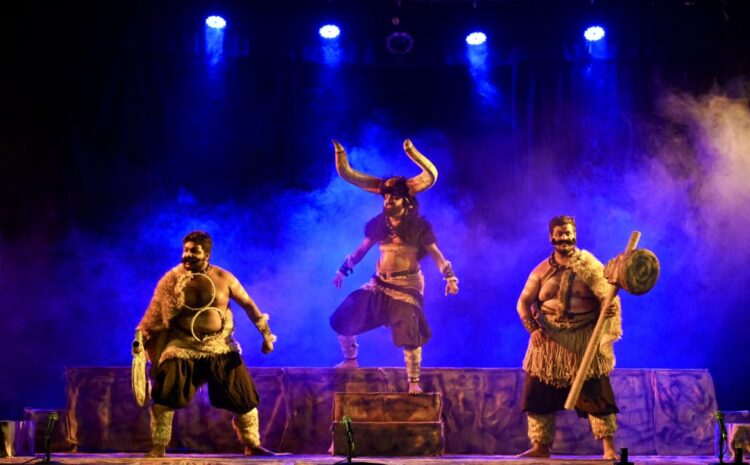
From the boundless power of Adi Maya, the primordial divine energy, emerged the cosmic trinity – Brahma the Creator, Vishnu the Preserver, and Maheshwara (Shiva) the Destroyer – entrusted with maintaining universal balance. From Vishnu arose the demons Madhu and Kaitabha, whose arrogance led to their destruction, and from whose remains Medhini, the Earth, was formed.In a forest, the demoness Malini undertook severe penance to please Brahma, but due to a curse by Suparshakha Rishi, she was destined to give birth to a buffalo-child. When Brahma appeared, he revealed that her son would possess immense strength and wisdom. Malini later married the asura Vidyunmali, and their son Mahishasura was born – a half-buffalo, half-demon destined to challenge the gods.After defeating the gods and seizing control of the celestial realm, Mahishasura’s tyranny plunged the universe into chaos. In desperation, the gods invoked Adi Maya, who manifested as Goddess Durga, the embodiment of divine power. In a fierce battle, Durga vanquished Mahishasura, restoring cosmic order.Soon after, the demon brothers Shumbha and Nishumbha rose to power, spreading darkness once again. The Goddess assumed fierce forms such as Kali and Chandika, destroying their armies and ultimately slaying the brothers. The play portrays the eternal triumph of divine feminine energy over evil and chaos.
Director
Bhuvan Manipalhas been actively involved in theatre since the age of twelve. He has been an integral member of the Sangama Kalavidaru Manipal troupe, contributing as both actor and technician.He trained under renowned Yakshagana Guru Bannanje Sanjeeva Suvarna in the traditional Badagutittu style and later received training in the Tenkutittu style under Rakesh Rai Adka.After completing his studies at Ninasam Theatre Institute in 2018, Bhuvan worked as a theatre instructor at Kundapura Ranga Adhyayana Kendra and Alva’s Ranga Adhyayana Kendra.Bhuvan has directed notable productions including Sahebaru Bharutthare, Mooka Nartaka, Duryodhana, and Soradaanti Nalike. His work in children’s theatre includes Govina Haadu, Makkala Ramayana, Ekalavya, Mowgli (The Jungle Book), and Alladin Maya Deepa.
He has received the Best Actor Award at the National-level Tulu Drama Competition for Vali Vadhe, and the Best Director Award for Soradaanti Nalike, which was staged at the 24thBharat Rang Mahotsav, New Delhi. He continues to actively contribute to contemporary and folk theatre as a member of Kalabhi (R.) and Sangama Kalavidaru Manipal.
Writer
Shrinidhi Shetty is a multifaceted theatre artist, writer, and cultural leader with an academic background in Commerce and Journalism. Alongside her professional experience as an Educational Counsellor, and in other diverse capacities, she has actively pursued theatre, storytelling, and creative writing.Trained in Yakshagana under Rakesh Rai Adka, she has performed in mythological and folk productions across Dakshina Kannada, Udupi, and Mumbai with groups such as Sai Shakti Kala Balaga and Kalabhi (R). As a writer, she has authored over 100 articles, scripted three documentary films, and created the story Yaake, focusing on women’s empowerment. Her contributions have been recognized with several awards, including Best Newcomer at the International RecTech Conference and felicitation from Women of Dakshina Kannada. Currently, she serves as District Leo President (2025–26), leading initiatives that integrate art, leadership, and community service.
Director’s Note
When I first encountered the folk drama Shree Devi Mahatme from the Yakshagana tradition, I was deeply drawn to its elemental power-the epic struggle between goddess and demon, and the rich synthesis of dance, music, and mythic imagery. As a long-time Yakshagana practitioner, I have always been inspired by the form’s dynamic blend of storytelling, rhythm, and ritual.What fascinated me most was its narrative of transformation and transcendence, where divinity emerges from chaos. In honouring this legacy, I have reimagined the traditional all-night performance into a concise presentation, while preserving its essential arc: the rise of the asura, the invocation of the Devi, the climactic confrontation, and the ultimate triumph of the divine. This adaptation is not a break from tradition, but a respectful reinterpretation that maintains the myth’s emotional intensity and spiritual resonance for contemporary audiences.Visually, the production bridges past and present. The asura imagery draws from rugged, primal aesthetics, while the Devi and her ensemble are inspired by Bengal temple art, reflecting grace, power, and feminine divinity. Musically, traditional Yakshagana rhythms blend with modern textures, creating a dialogue between folk heritage and contemporary theatre.
Group
Ambabhavani Kala Arts Drama Troupe is a subsidiary organization of Shri Ambabhavani Marati Sams Krithika Kala Vedike Parkala Valaya (R). Established in 2007 in the coastal town of Parkala, Udupi District, Karnataka, the troupe has been consistently active in the fields of theatre and traditional arts.The troupe is dedicated to preserving and promoting the rich cultural heritage of Tulu Nadu through various art forms such as Yakshagana, Chende, Nasik Band, and other folk performances. The group conducts regular training programs to pass on these traditional art forms to the younger generation, ensuring continuity of cultural values.
Notable Yakshagana productions of the troupe are Shweta Kumara Charitre, Kamsa Digvijaya – Kamsa Vadhe, and Mahisha Vadhe. With an aim to bring innovation to Tulu theatre, the group collaboratively produced the play Shree Devi Mahatme, staged multiple times across the coastal region with great acclaim.The troupe has had the honour of performing at the prestigious Mysuru Dasara festival and other major national and international festivals.