
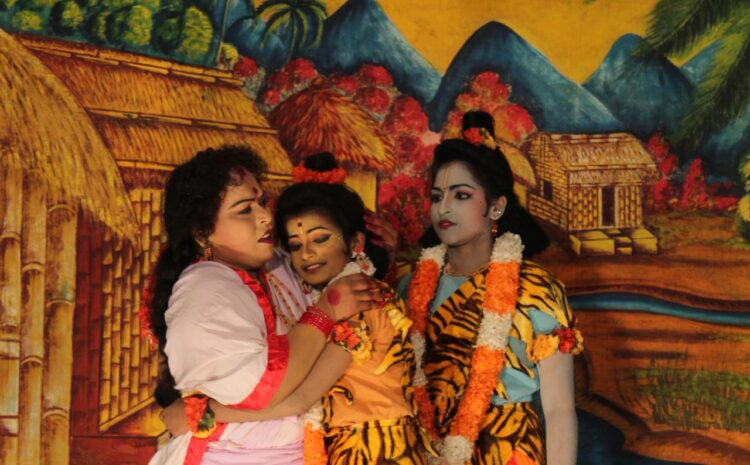
Sri Rama along with Sita, returned to Ayodya, after killing Ravana and his followers. The drama starts with Sri Rama Pattabhisekam. He ruled the kingdom with peace and joy. He used to get the daily information about his people by “Bhadra”. In the meanwhile, Bhadra, one day he was shy and unhappy to say a unfortunate information to Rama i.e., a washerman was quarrelling with her wife, he quarreled said that was not like “Rama”, who brought his wife, after spending one year with Ravana.
On hearing this news, shocked himself, and decided to leave her in the forests. He ordered his brother Laxmana, to leave her in deep forests. Sita, was went Valmiki Ashrama, for some time, where she got two children Lava and Kusha. These children were growned under guidance of Valmiki. They learnt Ramayana and were singing Rama Katha sweetly as and where requested. One day a horse was reached Valmiki Ashram, there Lava Kusha, brothers hold the horse. There was fight with Laxmana and twins. After Rama reached the spot and asked them to leave the horse. But they were ready to any fight. At last, Rama look the children with him to Ayodhya. Sita entered into Earth Godess Bhoodevi. These the Ramavatharam ends.
Director
Born on 24 February 1962 at Numberpoolakunta village in Rayalseema region of Andhra Pradesh, Shri Rekandar Venugopal Rao is a senior actor, director and organizer of many dramas in the Surabhi group a 137-year old family tradition of theatre performing mythological plays. He is the fifth generation artist of the Surabhi family (current generation is the eighth one).
He started his acting career in the Telugu theatre at the age of five as Bhakta Prahlada. Since then he has acted in major roles such as Sri Krishna, Manmadha and Lohithasa, Viswamithra, Veera Bahu, Ravan Brahma, Kamsa, Mayala Marathi, Hiranya Kasyapa, Yama and Duryodhana, Sri Rama, Satya Harishchandra, Narada, Balarama, Vikramarka, Veerabrahmam Garu, etc., in about 30 mythological plays with hundreds of shows each. With the passage of time Shri Venugopoal Rao also learnt theatre music, and began his foray into theatre direction and made his mark with successful productions of the established Surabhi dramas Mayabazar, Bhaktha Prahaladha, Sri Srinivasa Kalayanam, Balanagamma, Veera Bharamam Gari Charithra, Sri Krishna Tulabharam, Sridi Saibaba, Sathi Savithri, Chinhamani, and Sathi Anasuya.
He has been awarded by the Government of Andhra Pradesh with Kala Ratna (Hamsa) in 2018, Burra Venkata Subba Rao Award instituted by Telugu University in 2007, and many other awards given by institutions of repute including the State governments of Andhra Pradesh, Telangana, and Karnataka.
Shri Rekandar Venugopal Rao receives the Sangeet Natak Akademi Award for the year 2021 for his contribution to Indian theatre as a director.
Director’s Note
As the curtain rises on Sri Rama Rajyam, I invite you to join us in a journey beyond the familiar narrative of the Ramayana – into the heart of human values, relationships, duty and redemption. Though the epic of Lord Rama has been told in many forms, this drama invites us to dwell not merely on victory and exile, but on the inner trials of each character, their moral choices, and the quiet sacrifices that define true greatness.
In this staging, I have sought to emphasise the delicate balance between rājyadharma (leadership), sēvā (service) and ātmārpaṇa (self-surrender), as exemplified by Rama, Sita, Lakshmana, and the twin sons Lava and Kusha. Each moment – the return to Ayodhya, the exile of Sita, the shepherding of the twins under sage Valmiki’s guidance – is treated not just as mythic spectacle, but as a human experience: of expectation, of belonging, of letting go.
Our set-design and lighting reflect this duality: grand palace halls and forest hermitages, shimmering triumph and silent absence; the music embraces both celebration and introspection. My hope is that the audience does not just watch Sri Rama Rajyam, but feels it: the burden of the crown, the stain of doubt, the sanctuary of love, and the epiphany of return.
To our actors, musicians, designers and technicians: thank you for bringing your skill, your patience and your devotion to this enterprise. It is collective service. To you, the audience, I say: let us together surrender to the story – not only because it is old and sacred, but because it still speaks of what it means to live rightly, with compassion, courage and self-less commitment.
May this drama stir in us the resolve to be better sons and daughters, better siblings and friends, better citizens and human beings. Let the legacy of Rama’s reign not feel distant, but alive in our own times. I welcome you, with folded hands, to Sri Rama Rajyam.
Group
With its history of over 140 years, the theatre took birth in the village “SURABHI” in the Chakaripeta Mandal of the Kaddapah District in the year 1885, so that SRI VINAYAKA NATYA MANDALI (SURABHI) was earlier Kamalananda Natya Mandali, it was established in the year 1985 by Sri R. Koteshwar Rao, in the village “UNDI”, West Godavari District. First it was founded as “Kamalananda Natya Mandali”, on this banner. “Soudamini” drama written by Puttapati Nagabhushan Sharma was exhibited. Particularly this drama theatre was staged in Andhra and Rayalaseema areas in many times. R. Koteshwara Rao was not only actor, but also writer and they were very popular. Whenever they stage these type of drama and were fully enjoyed and approached by the audience.
Surabhi is famous for the Drama, as it is a teaching institution traditional values to next generation. There is a great importance of keeping drama alive. Though there are many drama group, Sri Vinayaka Natya Mandali (Surabhi) as unique. This is not an organization. This is a system which has travelled through 95 years with discipline and dedication. Any other group can be live a play for some time. But this troupe makes the play eternal since the troupe is one family. The descendants inherit the drama as their asset as well as essence of life dwell. In the meaning of life. A Surabhi artist is an artist by birth. Surabhi artist brought on to the stage on their 11th day from birth to person the role of infant. Krishna, Prahlada and Lava. They feel proud to have the child artist of Surabhi. This is the seventh generation since from 1885 from the birth of Surabhi.