
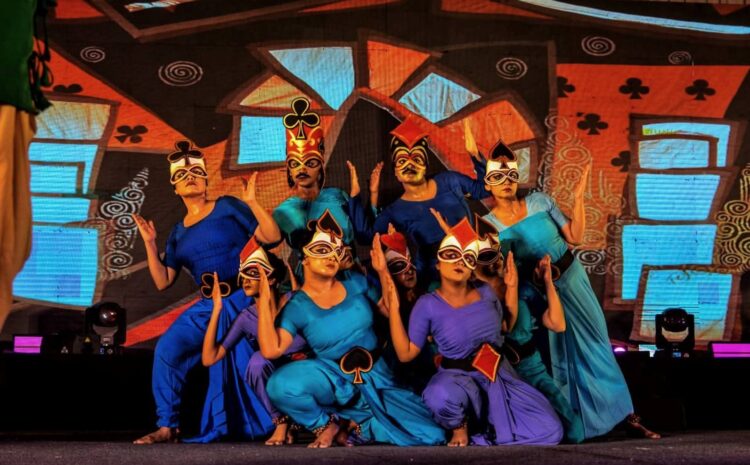
‘Kon Nutaneri Dak’ (Tasher Desh) is based on Rabindranath Tagore’s play Tasher Deshor the Kingdom of Cards. A social satire written in the early 20thcentury, it was dedicated by Tagore to the fearless freedom fighter Netaji Subhash Chandra Bose. The play appears like a caricature of the caste‐ridden stratified Hindu society based on the Brahmanical valuesystem. The story begins with the prince and his friend going on a voyage, and arriving on a exotic land to be bewildered by its inflexible disciplines and unyielding dictums. The advent of the new prince nonetheless, ushered in a whirl of change, breaking the barriers of class and caste hierarchies and social segregation. As the princess and the queen of the archaic order joined hands, the prince led the way to pull down the Tasher Desh ‐ the mantle of obsolete order and rigidity.
Director
Since 1998, Jonaki Sarkar has been the trusted assistant to Dr. Manjusri ChakiSircar in choreography at the Dancer’s Guild. With intensive training in Navanritya, Bharatnatyam, and Kathak, Jonaki’s foundation in dance is rooted in diverse traditions.As a dancer with the Guild, Jonaki has performed in prestigious festivals likethe Konark Festival (Odisha), Sangeet Natak Akademi Festival (New Delhi), Nrityagram Festival (Bengaluru), Uday Shankar Festivals (Jaipur and Kolkata) to name a few. Her international performances have been held at Tagore Centre (London), and in countries like Scotland, China, Indonesia, Philippines, Nepal, Egypt, Vietnam, Bangladesh, and Bhutan. After the demise of Dr. Manjusri Chaki Sircar and Ranjabati Sircar, Jonaki took the reins as Director of the Dancers’ Guild in 2000. Under her leadership, the group has performed at several national & international festivals.
Director’s Note
Choreographed &conceptualized by Manjusri Chaki Sircar, she reinterpreted the fantasy tale of Tagore’s Tasher Desh as a text of feminist resistance against the moral scrutiny of the patriarchal state. While Tagore situated the agency of revolution within the docile yet desirous bodies of ‘card-women,’ Manjusri took a few more steps forward in dramatizing their collective protest as a revolt against caste-based hierarchy. Manjusri had used masks to define the hidden identities of the people living in this exotic ‘Card‐Land’ and their gradual unmasking portrays the gradual transition of the society. It is the women who take the lead in rebelling against age‐old, meaningless customs.
Writer
Rabindranath Tagore was a polymath (a poet, writer, composer, painter, philosopher, social reformer, and educationist) who was a central figure in the Bengal Renaissance. He was the first non-European to win the Nobel Prize in Literature in 1913 for his collection of poems, Gitanjali. He is remembered for composing the national anthems of both India (Jana Gana Mana) and Bangladesh (Amar Shonar Bangla).
Translator/Adaptor
William Radice studied English literature at Oxford and Bengali under late Dr Tarapada Mukherjee at SOAS University of London.Among his research interests in Bengali language and literature, the writings of Michael Madhusudan Dutt (epic poem Meghnadbadh kabya) and Tagore hold a special place.His publications on Bengali literature include two volumes of translations for Penguin ClassicsRabindranath Tagore: Selected Poems (1985),Rabindranath Tagore: Selected Short Stories (1991), Particles, Jottings, Sparks: The Collected Brief Poems of Rabindranath Tagore (HarperCollins, Delhi 2000 and Angel Books, London 2001), Myths and Legends of India (The Folio Society, 2001 and Penguin India, 2002) and Poetry and Community: Lectures and Essays 1991-2001 (D. C. Publishers, Delhi).He is also the author of Teach Yourself Bengali (1994).
Group
Founded in 1983 by legendary danseuse and scholar Dr. Manjusri Chaki Sircar, Dancers’ Guild is a premier institution dedicated to promoting Indian dance globally. Thegroup has evolved a contemporary dance language, ‘Navanritya’or the new dance, pioneered by Dr. Manjusri Chaki Sircar and Ranjabati Sircar as a contemporary way of looking at dance and may be defined as a ‘chemical synthesis’ of several traditional Indian dance forms, semi classical forms, folk, rituals, martial art, yoga, and daily life gestures. Since 1983, Guild has received national and international recognition for productions exploring social oppression, ecological destruction, images of women and other themes, both narrative and abstract. Group’s impressive repertoire of accolades includes the Shiromani Puraskar, West Bengal State Academy award, Uday Shankar award, London Dance & Performance award bestowed upon Ranjabati Sircar and the 1994Sangeet Natak Akademi Award to Dr. Manjusri Chaki Sircar. As an empanelled Group of the Indian Council for Cultural Relations since 1984, Dancers’ Guild has represented India at numerous international festivals. The legacy of Dancers’ Guild continues to thrive under the visionary directorship of Jonaki Sarkar and expert guidance of Parbati Gupta.