
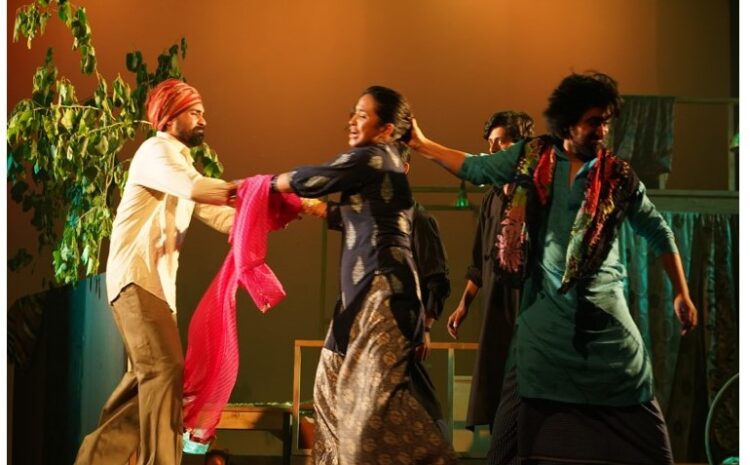
This play is based on stories by the renowned writer Dr. Sachchidanand Joshi.During Durga Puja, a sudden stampede breaks out in a pandal. It is discovered that a child has broken the idol. The crowd becomes furious and begins searching for the child as he belongs to another religion.A Hindu doctor hides the child in his house. The doctor tries to reason with the crowd, saying:
“You want to punish a small child because the idol of the Mother Goddess was broken – something he did not do intentionally. How will the Mother Goddess ever forgive you?”
But the crowd, no longer human has turned into rioters, and refuses to listen. Chaos erupts. The child’s father, along with the doctor and nearby residents, is brutally beaten. The news spreads like wildfire, and Muslims also reach the spot in anger.At that moment, the child’s father asks the rioters to kill him but spare the Doctor as he belongs to their religion.
Hearing this, the doctor shouts, “These people are not Hindus – just like those who came years ago were not Muslims.”
Everyone is stunned. Who came years ago? What happened back then?
The doctor takes them back to 1947, when the country gained independence but was divided into two parts. Back then too, a similar mob had arrived – the only difference being that they were Muslims instead of Hindus.He narrates the story of people from the same neighbourhood who suffered during the riots. This story is not about rioters but about friendships that survived, lovers who were never united, and neighbours who helped one another.These stories must be remembered because the history of Partition is not merely a record of violent incidents. Listening to the story, everyone, regardless of religion, lower their heads in shame.The doctor then asks them to introspect. A hope like the doctor’s appears, and the people all say together, “Humanity is still alive.”What was it that gave everyone hope?What really happened years ago?The play answers these questions.
Writer
Dr. Sachchidanand Joshi,along with academic writing, has written stories, poems, plays, essays, and satire. He has translated significant works from Marathi and English.He has directed twenty-five plays, written five plays, and written television serials. He has the privilege of editing the speeches of Honourable Prime Minister of India, Shri Narendra Modi. He has authored ten books on various subjects and published collections of speeches in two volumes.He has served in the distinguished capacity of Vice-Chancellor of Kushabhau Thakre University of Journalism and Mass Communication, Raipur, and earlier served as Registrar at Makhanlal Chaturvedi National University of Journalism. He has been the National President of BhartiyaShiksha Mandal. Since 2016, he has been serving as Member Secretary of the Indira Gandhi National Centre for the Arts, Ministry of Culture, Govt. of India.He has been felicitated with the Maithili Sharan Gupt Award, Deendayal Upadhyay Award, Janardan Rai Nagar Culture Ratna Award, and Kala Tapasvi Award.
Director
Laxmi Rawat is afilm and theatre director, actor, writer, and editor.Her directed plays have been staged at several festivals, including BRM 2024, Bharatendu Natya Utsav (Delhi Government), BharataMuni Natya Utsav, Urdu Academy Theatre Festival, and others.She has directed several plays based on themes and issues of Uttarakhand and is the editor of “Cultural Heritage of Uttarakhand” publication and authored a book “Uttarakhand’s Nightingale: Kabutari Devi.”Her work includes travel, addressing migration issues in Uttarakhand, promoting reverse migration, and conducting personality development workshops for children in villages.She is currently serving as Assistant Financial Advisor and Accounts Officer at the Indira Gandhi National Centre for the Arts under the Ministry of Culture, Government of India.
Director’s Note
The Partition of India is one of the most tragic chapters in our history. Beginning on 15 August 1947, the country paid a heavy price for freedom – millions lost their lives and countless were displaced.Honourable Prime Minister Shri Narendra Modi announced on 15 August 2021 that 14thAugust will be observed annually as “Partition Horrors Remembrance Day”to honour the memories and sacrifices associated with Partition and to keep the nation vigilant.This inspired as a responsibility to convey this thought to the nation – especially to the youth. While reading Dr. Sachchidanand Joshi’s stories about riots across different times, the idea emerged to weave four such stories together.The biggest challenge was connecting the present with 1947. Characters from the past were blended into the present narrative like simultaneous flashbacks. Thus, this play came into existence – born from an announcement, a decision, a line drawn, and a nation divided.This play salutes humanity, friendship, love, and compassion that survived amid madness.
Group
Pragya Arts is a registered theatre group dedicated to promoting art and culture. Its several initiatives are:Pragya Arts Theatre Group;Pragya Arts Production House focusing on Uttarakhand films as well; Nature with Theatre Workshops – personality development through theatre for children in Uttarakhand; Pragya Arts Theatre Awards; publishing of Gathaein aur Kathaein – an Uttarakhand Calendar; and Cultural Exchange Programs encompassing regions and languages.