
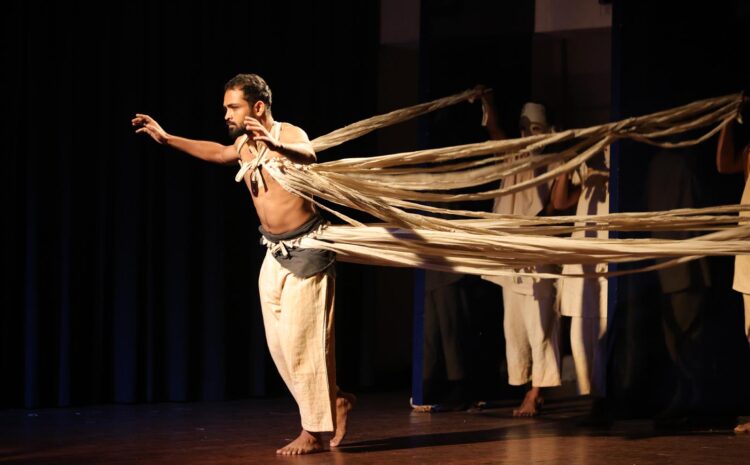
Set in a war-scarred landscape where wells are sealed and memories lie buried, the play follows a wandering theatre actress on a spiritual journey through loss, remembrance, and hope. Searching for a mythical woman who sings stories with seven dolls, she finds shelter beside a bomb-surviving tree, transforming it into her stage. Her songs awaken silenced grief—the suffering of women and children, the restless spirits of the dead—and release a bird that carries the unspoken sorrow of war. Through ritual, movement, music, and imagery, the play confronts the erasure of human identity caused by war and ideological divisions. From ashes emerges a “Theatre Land,” where art heals wounds, restores dignity, and reclaims silenced voices. Interwoven African and Tamil percussion dissolve borders, affirming coexistence, resilience, and the possibility of rebirth.
Director
- Murugaboopathy is an alumnus of the Department of Performing Arts, Pondicherry University. Rooted in indigenous performance traditions, ritual practices and resistance aesthetics, his work transforms theatre into a space of social awakening, reflection, and healing. His writings explore subaltern histories, marginalised voices, collective memory, and social injustice. His acclaimed plays are Vanathadhi, Koondhal Nagaram, Semmoodaay and Soorpanangu and he has also directed several modern plays and children’s productions. He is a recipient of the Sangeet Natak Akademi Yuva Puraskar, and Founder–Artistic Director of group Manal Magudi Theatre Land.
Director’s Note
Despite millennia of human evolution, violence resurfaces repeatedly, fuelled by the relentless pursuit of power, corroding both the human spirit and the fragile balance of nature. In an era of ecological collapse and growing estrangement from the world around us, art must reclaim its role as a living conscience – a voice for the earth’s harmony. This production reflects the imaginative vitality and ethical sensibility of a younger generation. Through music, movement and six interwoven narratives, it interrogates power, restores silenced voices, and offers moments of remembrance and renewal. As a poetic resistance, the play creates a language of empathy, imagination, and transformation, reaffirming the enduring capacity of theatre to awaken conscience, foster reflection and envision a world of hope.
Group
Established in 1988–1989, the Department of Performing Arts, Pondicherry University, is one of India’s pioneering centres for theatre education and performance-based research. Rooted in the legacy of the Sri Sankaradass Swamigal School of Performing Arts, the Department under the leadership of Dr. M. Subbiah, Head and Dr. T. Marx, Dean offers B.P.A., M.P.A., Ph.D., and a PG Diploma in Drama and Theatre Arts.